Jackie Chan's Early Fighting Days
This is one of the best fight scenes I have seen. Chan's opponent in the scene was a 6 time world kickboxing champion and is quite good.
H/T Impact Lab
Labels: no category
An assorted mix of posts, some original, some favourites previously published in other Al Fin blogs.
Labels: no category
Labels: science fiction
Just as Nobel Prize winner Al Gore and the IPCC predicted, warm tropical air is rushing south from melting icecaps, threatening to envelop the entire northern hemisphere. Saskatoon has been particularly affected by the heat, but Winnipeg is also suffering from the unseasonable heat wave.Labels: CAGW

Gore has demanded--as a condition of giving the keynote speech--that press be barred from the room. As Kim Zetter wrote for Wired.com: "Video recordings, broadcasts and photography are also prohibited."This does not reduce my opinion of Al Gore in the slightest. Nothing could do that, given that Gore negative-pegged my opinion-o-meter years ago, and it has not recovered since.
Gore might have gotten away with it a decade ago. And, to be sure, he has the right to negotiate that requirement with RSA. But nowadays, when tech-savvy audience members, who each coughed up some $3,670 for registration, are outfitted with digital cameras and recording devices (including on mobile phones), any speaker who insists on this requirement is foolish or naive.
You decide which category Gore falls into.
This isn't the first time that Gore has insisted on a $100,000-or-so speaking contract that prohibited press from attending. He did it at a speech at Augustana College (billed as "free and open to the public"). He did it at a speech last year to the American Institute of Architects convention, which the San Antonio Express-News crashed and wrote up anyway.
...Does anyone really think Gore's Don't-Record-Me Ban will work at a conference of 17,000+ gadget-outfitted security geeks? Thought so. So here's my offer: A free News.com (or CNET, depending on what we have in stock) baseball cap or fleece--your choice--to the first person who e-mails me a link to the video of the astonishingly publicity-shy ex-veep at RSA next month.___Cnet
Intelligent people understand that they can trust neither politicians, nor the media. What some of them have not yet learned, is that they cannot blindly trust anyone, regardless of credentials....global warming requires a more-or-less monotonic increase in the accumulation of heat (in Joules) within the climate system. The use of a global average surface temperature, regardless if it is increasing or decreasing is an inadequate and inaccurate metric of global warming as the heat is not only a function of temperature but also mass over which the heat change occurs! This is why the ocean is the dominate reservoir of heat content change.
With respect to the change in upper ocean heat content, as reported on a Climate Science weblog on February 15 2008, the paper
Willis, J. K., D. P. Chambers and R. Steven Nerem, 2008: Assessing the Globally Averaged Sea Level Budget on Seasonal and Interannual Time Scales. Journal of Geophysical Research-Oceans (in press),
reports on no upper (700m) ocean warming since 2004.
Thus while we cannot state that the recent widely distributed cold waves or overall cooling of the troposphere are evidence of the end of global warming over decadal and longer time scales, we can state that global warming has not occurred in the last 4 years. This is a major issue for both climate science and for policymakers, as only those who blindly (or deliberately) ignore the scientific evidence can still accept the 2007 IPCC conclusions as settled science.___ClimateScience
Labels: CAGW
Examples of memes are tunes, ideas, catch-phrases, clothes fashions, ways of making pots or of building arches. Just as genes propagate themselves in the gene pool by leaping from body to body via sperms or eggs, so memes propagate themselves in the meme pool by leaping from brain to brain via a process which, in the broad sense, can be called imitation. If a scientist hears, or reads about, a good idea, he passed it on to his colleagues and students. He mentions it in his articles and his lectures. If the idea catches on, it can be said to propagate itself, spreading from brain to brain.___RichardDawkins
A lethal meme, analogous to a lethal gene, is a meme that leads to a certain level of lethality for the society or culture that is parasitised by the lethal meme. Meme-complexes are even more sophisticated than simple memes, and lethal meme-complexes produce more wide-ranging lethal effects to entire cultures and civilisations. Multiculturalism is one such meme-complex.The idea that all cultures are equal in merit and deserving respect, an idea devoid of any historical perspective, could be seriously proposed and adopted only in western liberal democracies. And logically such an idea meant only one thing, the diminution of the West and its achievements in comparison to other cultures.
Multiculturalism institutionalized as a policy, run by self-perpetuating bureaucracies and sustained by entrepreneurs of a growing multicultural industry, became an easy ride for its proponents and clients.
Immigrants were not required to embrace the West's culture and complex history; and the West did not have to strain itself in instructing immigrants on the need or importance of embracing it, warts and all.
Multiculturalism worked so long as the illusion of cultural harmony could be maintained.
But once the sham of equality got exposed by the heat of Islamist violence -- once it became undeniable that a culture in which a woman, for instance, can assert her individual freedom without fear is not at par with a culture where a woman's worth is less than that of a man -- multiculturalism as an idea was dead.
Historians will note a period of confusion followed the death of multiculturalism before the West asserted its ideals of freedom and democracy, and moved on. ___TorontoSun
Labels: academic lobotomy, multiculturalism
Labels: Online Music Videos
Welcome to the future, where city streets are war zones between drug gangs and sectarian militias. A world whose cities are like Beirut of the 1980s, where the sounds of firefights, car bombs, and bloody martyrdom greet one's ears more commonly than sounds of birds singing or children playing.
Financially and morally depleted by the Obama administration of the early 2000s, the United States had lost all ability to keep trade routes safe, or to ride herd on trans-national criminal organisations and religious terrorist groups. At street level, it has become a free-for-all, worldwide.
The rise of China as world hegemon in the early 2020s paved the way for entrenchment of large-scale corruption across Europe, North America, and Oceania -- regions formerly supportive of property rights and rule of law. Then as China itself fragmented into warring factions in the late 2020s, the entire world became a place without law. The teeming masses of the third world discovered that the developed world lacked the will to defend its borders. Soon there was no distinction between third world and first world.Labels: science fiction
Labels: Online Music Videos

The bees' rules for decision-making--Source—so impressed Seeley that he now uses them at Cornell as chairman of his department.
- seek a diversity of options,
- encourage a free competition among ideas,
- and use an effective mechanism to narrow choices
"In biology, if you look at groups with large numbers, there are very few examples where you have a central agent," says Vijay Kumar, a professor of mechanical engineering at the University of Pennsylvania. "Everything is very distributed: They don't all talk to each other. They act on local information. And they're all anonymous. I don't care who moves the chair, as long as somebody moves the chair. To go from one robot to multiple robots, you need all three of those ideas."
....Within five years Kumar hopes to put a networked team of robotic vehicles in the field. One purpose might be as first responders. "Let's say there's a 911 call," he says. "The fire alarm goes off. You don't want humans to respond. You want machines to respond, to tell you what's happening. Before you send firemen into a burning building, why not send in a group of robots?"
Taking this idea one step further, Marco Dorigo's group in Brussels is leading a European effort to create a "swarmanoid," a group of cooperating robots with complementary abilities: "foot-bots" to transport things on the ground, "hand-bots" to climb walls and manipulate objects, and "eye-bots" to fly around, providing information to the other units.
The military is eager to acquire similar capabilities. On January 20, 2004, researchers released a swarm of 66 pint-size robots into an empty office building at Fort A. P. Hill, a training center near Fredericksburg, Virginia. The mission: Find targets hidden in the building.
Zipping down the main hallway, the foot-long (0.3 meter) red robots pivoted this way and that on their three wheels, resembling nothing so much as large insects. Eight sonars on each unit helped them avoid collisions with walls and other robots. As they spread out, entering one room after another, each robot searched for objects of interest with a small, Web-style camera. When one robot encountered another, it used wireless network gear to exchange information. ("Hey, I've already explored that part of the building. Look somewhere else.")
In the back of one room, a robot spotted something suspicious: a pink ball in an open closet (the swarm had been trained to look for anything pink). The robot froze, sending an image to its human supervisor. Soon several more robots arrived to form a perimeter around the pink intruder. Within half an hour, all six of the hidden objects had been found.
...."It's much harder for a predator to avoid being spotted by a thousand fish than it is to avoid being spotted by one," says Daniel Grünbaum, a biologist at the University of Washington. "News that a predator is approaching spreads quickly through a school because fish sense from their neighbors that something's going on."
When a predator strikes a school of fish, the group is capable of scattering in patterns that make it almost impossible to track any individual. It might explode in a flash, create a kind of moving bubble around the predator, or fracture into multiple blobs, before coming back together and swimming away.
Animals on land do much the same, as Karsten Heuer, a wildlife biologist, observed in 2003, when he and his wife, Leanne Allison, followed the vast Porcupine caribou herd (Rangifer tarandus granti) for five months. Traveling more than a thousand miles (1,600 kilometers) with the animals, they documented the migration from winter range in Canada's northern Yukon Territory to calving grounds in Alaska's Arctic National Wildlife Refuge.
"It's difficult to describe in words, but when the herd was on the move it looked very much like a cloud shadow passing over the landscape, or a mass of dominoes toppling over at the same time and changing direction," Karsten says. "It was as though every animal knew what its neighbor was going to do, and the neighbor beside that and beside that. There was no anticipation or reaction. No cause and effect. It just was."
One day, as the herd funneled through a gully at the tree line, Karsten and Leanne spotted a wolf creeping up. The herd responded with a classic swarm defense.
...For each caribou, the stakes couldn't have been higher, yet the herd's evasive maneuvers displayed not panic but precision. (Imagine the chaos if a hungry wolf were released into a crowd of people.) Every caribou knew when it was time to run and in which direction to go, even if it didn't know exactly why. No leader was responsible for coordinating the rest of the herd. Instead each animal was following simple rules evolved over thousands of years of wolf attacks.
That's the wonderful appeal of swarm intelligence. Whether we're talking about ants, bees, pigeons, or caribou, the ingredients of smart group behavior—decentralized control, response to local cues, simple rules of thumb—add up to a shrewd strategy to cope with complexity.
"We don't even know yet what else we can do with this," says Eric Bonabeau, a complexity theorist and the chief scientist at Icosystem Corporation in Cambridge, Massachusetts. "We're not used to solving decentralized problems in a decentralized way. We can't control an emergent phenomenon like traffic by putting stop signs and lights everywhere. But the idea of shaping traffic as a self-organizing system, that's very exciting."
Social and political groups have already adopted crude swarm tactics. During mass protests eight years ago in Seattle, anti-globalization activists used mobile communications devices to spread news quickly about police movements, turning an otherwise unruly crowd into a "smart mob" that was able to disperse and re-form like a school of fish.
The biggest changes may be on the Internet. Consider the way Google uses group smarts to find what you're looking for. When you type in a search query, Google surveys billions of Web pages on its index servers to identify the most relevant ones. It then ranks them by the number of pages that link to them, counting links as votes (the most popular sites get weighted votes, since they're more likely to be reliable). The pages that receive the most votes are listed first in the search results. In this way, Google says, it "uses the collective intelligence of the Web to determine a page's importance."
Wikipedia, a free collaborative encyclopedia, has also proved to be a big success, with millions of articles in more than 200 languages about everything under the sun, each of which can be contributed by anyone or edited by anyone. "It's now possible for huge numbers of people to think together in ways we never imagined a few decades ago," says Thomas Malone of MIT's new Center for Collective Intelligence. "No single person knows everything that's needed to deal with problems we face as a society, such as health care or climate change, but collectively we know far more than we've been able to tap so far."
Labels: academic lobotomy, childhood competence, psychological neoteny
Labels: Online Music Videos
Last thing I remember, I was
Running for the door
I had to find the passage back
To the place I was before ....
Eagles: Hotel California
And the end of all our exploring will be to arrive where we started and know the place for the first time.
T. S. Eliot, Little Gidding
Labels: Online Music Videos, power of innocence
Labels: Beatles, Online Music Videos
Labels: Beatles, Online Music Videos, popular culture
Labels: Beatles, Online Music Videos, Orderly Brits
Labels: Islam
Labels: Idiocracy
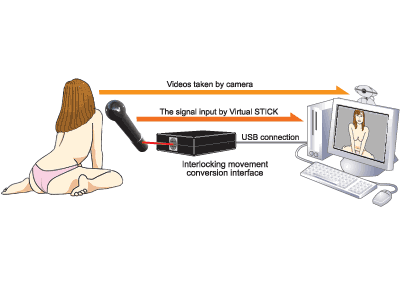
This really is a fascinating concept--using data-linked artificial sex organs, a man and a woman can pleasure each other over great distances. They can even record a "pleasure session" using the artificial sex organ interface and a data storage device, then transfer the "pleasure file" to their partner, who then replays the session using his or her own artificial sex organ as the interface.
Most of you already know that manure can produce methane via microbial digestion. In fact many dairy farmers are taking advantage of this process to create much of their own electricity with methane powered generators.
"Life Hacks" are simply personal shortcuts for getting the job done. Some may be elegant, others may be quick and dirty, but the end result is what is important.