Tuesday, February 01, 2011

Wikimedia's Role in Dumbing Down the Idiocracy?

NYT

Several areas of commerce, enterprise, and science remain the province of mainly-male participation. Physics, mathematics, advanced computer science, technical engineering, math-intensive sciences, aircraft test pilots and combat pilots, commercial sea captains, and so on. Most informed people understand that research is dominated by males, but few people realise that technical information intensive areas -- such as highly demanding reference information providers -- are also dominated by males. A lot of politically involved feminists would like to change that situation, but is there a danger in moving too forcefully from the top down when changes may adversely affect critically important services?
...surveys suggest that less than 15 percent of [Wikipedia's] hundreds of thousands of contributors are women.

About a year ago, the Wikimedia Foundation, the organization that runs Wikipedia, collaborated on a study of Wikipedia’s contributor base and discovered that it was barely 13 percent women; the average age of a contributor was in the mid-20s, according to the study by a joint center of the United Nations University and Maastricht University.

...The notion that a collaborative, written project open to all is so skewed to men may be surprising. After all, there is no male-dominated executive team favoring men over women, as there can be in the corporate world; Wikipedia is not a software project, but more a writing experiment — an “exquisite corpse,” or game where each player adds to a larger work.

...The public is increasingly going to Wikipedia as a research source: According to a recent Pew survey, the percentage of all American adults who use the site to look for information increased to 42 percent in May 2010, from 25 percent in February 2007. This translates to 53 percent of adults who regularly use the Internet.

Jane Margolis, co-author of a book on sexism in computer science, “Unlocking the Clubhouse,” argues that Wikipedia is experiencing the same problems of the offline world, where women are less willing to assert their opinions in public. “In almost every space, who are the authorities, the politicians, writers for op-ed pages?” said Ms. Margolis, a senior researcher at the Institute for Democracy, Education and Access at the University of California, Los Angeles.

...Ms. Gardner said that for now she was trying to use subtle persuasion and outreach through her foundation to welcome all newcomers to Wikipedia, rather than advocate for women-specific remedies like recruitment or quotas.

“Gender is a huge hot-button issue for lots of people who feel strongly about it,” she said. “I am not interested in triggering those strong feelings.”

Kat Walsh, a policy analyst and longtime Wikipedia contributor who was elected to the Wikimedia board, agreed that indirect initiatives would cause less unease in the Wikipedia community than more overt efforts.

But she acknowledged the hurdles: “The big problem is that the current Wikipedia community is what came about by letting things develop naturally — trying to influence it in another direction is no longer the easiest path, and requires conscious effort to change.” _NYT
The Wikipedia world is indeed a rough and tumble world of competitive edits and re-writes. If a person cannot withstand criticism and competition, they will not likely last long in that world.

The male hormone testosterone shapes the human brain in multiple ways not yet fully comprehended by science or society at large. Much of what science has learned about the influence of hormones such as testosterone on the gender differences so prevalent in society, is considered not politically correct -- and thus essentially unmentionable in left-leaning tabloids such as the New York Times, quoted above. Testosterone makes males more interested in objects than people, more competitive, have generally superior spatial and higher math skills, physically larger and stronger with greater stamina, tending to greater independence, and generally more logically determined and less emotional in the face of distractions.

Charles Murray's fascinating book, Human Accomplishment, provides a historical reflection of the phenomenon that Wikimedia's executives and critics are struggling with. Males have tended to achieve the lion's share of discoveries, inventions, and masterpieces of art, music, and literature as far back as history can tell.

A population shrinkage is occurring among the more intelligent people of the world -- Europeans and Northeast Asians -- while an explosive growth of population is occurring among the less intelligent people of the world. The average intelligence of the human population is inexorably dropping from near 90 points of IQ, downward -- close to the mid-80s and below. That qualifies as an Idiocracy.

In order to dumb down the Idiocracy, one must institute foolish rules of arbitrary and counter-productive governance, while educating the populace to accept dumbed-down groupthink rather than to think for themselves. It is easier than you might think. What Wikimedia is contemplating -- and what many western governments have done, and called affirmative action -- is an excellent example.

Also published at Al Fin and Al Fin, the Next Level

Labels: , ,

Monday, May 03, 2010

War of the Sexes: Not Politically Correct


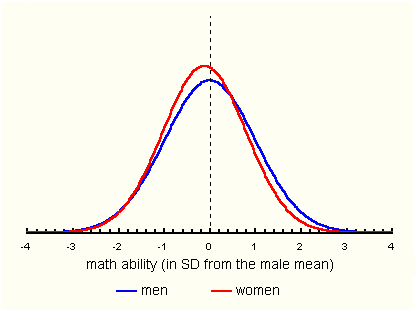
In the paper, Nyborg looks at many other studies to try to determine whether sex differences in IQ exist and, if so, which sex does better on which subtests and by how much. He comes to the conclusion that women do slightly better in verbal tests, men better on spatial, and in sum, men have an IQ advantage over women of between 3 and 8 points, his best number being around 7 points. Men also have a wider dispersion of IQs than women....The result, as the graph shows, is that at an IQ of 145, which could reasonably be deemed an elite level, men outnumber women by a factor of 8. _Mangans

Mangans

Dennis Mangan looks at a 5 year old study comparing gender differences in intelligence. The study was by Helmuth Nyborg at a Danish university, U. of Aarhus. Nyborg received no end of grief from pseudo-intellectuals, and was even reprimanded by his own university for daring to cross the line of political correctness. But lines of political correctness must be crossed if humans are to get at the truth -- and learn to live with the truth while doing whatever they feel is necessary to change the underlying reality.
Experts have long disagreed about the existence of a sex difference in overall intelligence. Some (e.g. Lynn, 1994, 1997, 1999; Lynn, Irwing, & Cammock, 2002) find that males outscore females by about 3.8 IQ points, but most find no sex difference (e.g. Brody, 1992; Halpern & LaMay, 2000; Jensen, 1998).

This disagreement is confusing for theoretical reasons. First, males dominate all higher ranks of education, research, occupation, and political power structures that call for capacity to deal with complexity, which is just another way of defining general  intelligence g. Second, males have, on average, larger brains than females, and brain size correlates positively with intelligence. Yet, the empirical evidence for a male g advantage is equivocal.

The present study addresses these paradoxes by testing four hypotheses: (1) Ambiguous definitions and methods explain the current disagreement among the experts, (2) The proper analytic approach will identify a male lead in general intelligence g, (3) The larger male brain
partly explains the average male g lead, and, (4) Classical Distribution Theory illustrates how a small male mean SD g score advantage and a wider male SD dispersion score translate into an exponentially increased male–female ratio at the high end of the g distribution. This unequal ratio of high g males to females explains in part why males (always, according to Goldberg, 1977) dominate the intellectually most demanding top occupational and political strata.

...The study made it understandable how an exponentially growing male/female ratio at the high end of the g distribution—with the exact numerical ratio being a function of the size of the average sex difference in mean g and of the dispersion of g—provides part of an explanation of the male dominance in high society.

The present results derive from a more careful sampling of the two independent sub-samples than any before, but the small Ns call for caution in interpretation, even if it is harder to obtain a statistically significant difference in a small than in a large sample.

The general conclusion: Proper methodology identifies a male advantage in g that increases exponentially at higher levels, relates to brain size, and explains, at least in part, the universal male dominance in society. _PDF_Nyborg_PDF

Later research using fMRI and other brain scanning methods have looked at specific differences in connections between brain centers (white matter) and differences in specific brain centers themselves (grey matter), finding much greater significance in those subtle differences than in gross brain size and weight differentials.

That is to be expected, since it is the actual performance of the brains, rather than the size of the hat, that is at issue.

Males dominate the top levels of most professions for many reasons. A significant part of the reason is hormonal -- testosterone providing a certain assertiveness that often lends toward hard work and achievement. At the upper levels of cognitive performance, males are undeniably dominant. Part of that difference is also likely due to testosterone's effects on the developing brain -- primarily in adolescence, but also in early life.

Modern political correctness is counter-productive and self defeating for society as a whole, since it leads to wholesale waste of many of the finest male brains on the planet -- and for too many other reasons to mention here.

In the final reckoning, there will be no final reckoning. But there will certainly be repercussions that Susan Faludi never dreamed of. ;-)

Labels:

Saturday, June 03, 2006

Under-Population Bomb: Too Busy for Making Babies

Paul Ehrlich's bestseller The Population Bomb (1968) made some dire predictions. . . . hundreds of millions of people are going to starve to death." The earth, he claimed simply could not support the 6 billion people projected to exist by the year 2000. In a 1969 article titled "Eco-Catastrophe!", Ehrlich later stated that "by 1985 enough millions will have died to reduce the earth's population to some acceptable level, like 1.5 billion people." Source. Interestingly, many journalists and university academics are still repeating the same lines, decades after they became obsolete.

Two years ago, Phillip Longman published an article in Foreign Affairs entitled The Global Baby Bust. He convincingly argues that western nations will soon be underpopulated, due to falling birthrates. Longman's article probably helped to jump start the discussion of this topic within the mainstream, although underpopulation had long been a growing concern among western conservatives and independents. After reading Longman's piece, you might consider readingthis article, which is also quite informative.

Japan, Russia, France, Germany, Sweden, Italy, South Korea, and a number of other Western/or European countries will either shrink in population, or experience severe cultural shock as populations are replaced by outsiders. Even China and India will face inevitable problems unique to their populations and economies, due to the slowing of birthrates.

If their populations shrink significantly, current social democratic governments are doomed. There will be no one to pay the pensions. If on the other hand, the indigenous populations are replaced by outsiders, it is by no means certain that the new workers will be willing to pay the pensions of the retired indigenous populations who refuse to emigrate. It is likewise by no means certain that the new populations will have the technical and professional skills to maintain European/Western civilisation at its current level of sophistication.

The problem, put bluntly, is that the productive part of the world is shrinking, and the non-productive parts of the world are expanding, population wise. There is no gentle or PC way to put it, which is why the topic is largely ignored in most social democracies--yet social democracies are certainly doomed by the phenomena unless it is addressed firmly. And if the social democracies are doomed, the third world is also doomed--since the undeveloped world is dependent on the developed world for aid and sustenance.

Today, Glenn Reynolds of "Instapundit" published an article called The Parent Trap in TCS Daily. Reynolds talks about the high costs and low prestige of parenthood in modern western societies. He wonders what it will take to induce young professional adults to have more children. Leaders of industrial nations are worrying about the same thing.

Here's a list of countries that are either decreasing in population or will decrease in population, if current birthrate is continued.
List of countries:

1. Bulgaria 1.13 children born/woman (2003 est.)
2. Czech Republic 1.18 children born/woman (2003 est.)
3. Latvia 1.2 children born/woman (2003 est.)
4. Singapore 1.24 children born/woman (2003 est.)
5. Hungary 1.25 children born/woman (2003 est.)
6. Slovakia 1.25 children born/woman (2003 est.)
7. Spain 1.26 children born/woman (2003 est.)
8. Italy 1.26 children born/woman (2003 est.)
9. Slovenia 1.27 children born/woman (2003 est.)
10. Andorra 1.27 children born/woman (2003 est.)
11. Estonia 1.27 children born/woman (2003 est.)
12. San Marino 1.31 children born/woman (2003 est.)
13. Macau 1.32 children born/woman (2003 est.)
14. Hong Kong 1.32 children born/woman (2003 est.)
15. Russia 1.33 children born/woman (2003 est.)
16. Belarus 1.34 children born/woman (2003 est.)
17. Ukraine 1.34 children born/woman (2003 est.)
18. Greece 1.35 children born/woman (2003 est.)
19. Romania 1.36 children born/woman (2003 est.)
20. Guernsey 1.37 children born/woman (2003 est.)
21. Germany 1.37 children born/woman (2003 est.)
22. Poland 1.37 children born/woman (2003 est.)
23. Japan 1.38 children born/woman (2003 est.)
24. Austria 1.41 children born/woman (2003 est.)
25. Lithuania 1.43 children born/woman (2003 est.)
26. Switzerland 1.48 children born/woman (2003 est.)
27. Portugal 1.49 children born/woman (2003 est.)
28. Liechtenstein 1.5 children born/woman (2003 est.)
29. Georgia 1.51 children born/woman (2003 est.)
30. Sweden 1.54 children born/woman (2003 est.)
31. Saint Helena 1.54 children born/woman (2003 est.)
32. Korea, South 1.56 children born/woman (2003 est.)
33. Armenia 1.56 children born/woman (2003 est.)
34. Jersey 1.57 children born/woman (2003 est.)
35. Taiwan 1.57 children born/woman (2003 est.)
36. Cuba 1.61 children born/woman (2003 est.)
37. Canada 1.61 children born/woman (2003 est.)
38. Belgium 1.62 children born/woman (2003 est.)
39. Gibraltar 1.65 children born/woman (2003 est.)
40. Barbados 1.65 children born/woman (2003 est.)
41. Man, Isle of 1.65 children born/woman (2003 est.)
42. Netherlands 1.65 children born/woman (2003 est.)
43. United Kingdom 1.66 children born/woman (2003 est.)
44. Luxembourg 1.7 children born/woman (2003 est.)
45. Finland 1.7 children born/woman (2003 est.)
46. China 1.7 children born/woman (2003 est.)
47. Bosnia and Herzegovina 1.71 children born/woman (2003 est.)
48. British Virgin Islands 1.72 children born/woman (2003 est.)
49. Denmark 1.73 children born/woman (2003 est.)
50. Moldova 1.74 children born/woman (2003 est.)
51. Macedonia, The Former Yugoslav Republic of 1.75 children born/woman (2003 est.)
52. Northern Mariana Islands 1.75 children born/woman (2003 est.)
53. Anguilla 1.76 children born/woman (2003 est.)
54. Monaco 1.76 children born/woman (2003 est.)
55. Australia 1.76 children born/woman (2003 est.)
56. Serbia and Montenegro 1.77 children born/woman (2003 est.)
57. Trinidad and Tobago 1.78 children born/woman (2003 est.)
58. Seychelles 1.79 children born/woman (2003 est.)
59. New Zealand 1.79 children born/woman (2003 est.)
60. Aruba 1.79 children born/woman (2003 est.)
61. Martinique 1.79 children born/woman (2003 est.)
62. Montserrat 1.8 children born/woman (2003 est.)
63. Norway 1.8 children born/woman (2003 est.)
64. France 1.85 children born/woman (2003 est.)
65. Cyprus 1.88 children born/woman (2003 est.)
66. Ireland 1.89 children born/woman (2003 est.)
67. Bermuda 1.9 children born/woman (2003 est.)
68. Tunisia 1.9 children born/woman (2003 est.)
69. Sri Lanka 1.9 children born/woman (2003 est.)
70. Malta 1.91 children born/woman (2003 est.)
71. Cayman Islands 1.91 children born/woman (2003 est.)
72. Thailand 1.91 children born/woman (2003 est.)
73. Guadeloupe 1.92 children born/woman (2003 est.)
74. Croatia 1.93 children born/woman (2003 est.)
75. Saint Vincent and the Grenadines 1.95 children born/woman (2003 est.)
76. Lebanon 1.98 children born/woman (2003 est.)
77. Iceland 1.98 children born/woman (2003 est.)
78. Mauritius 1.98 children born/woman (2003 est.)
79. Iran 1.99 children born/woman (2003 est.)
80. Dominica 1.99 children born/woman (2003 est.)
Source: CIA World Factbook 2003

It is easy to find academics, journalists, and various other uninformed groups who continue to believe Paul Ehrlich and the Club of Rome. For them, overpopulation is the problem, and they make no distinction between the productive and non-productive worlds. In fact, to those activists favoring the "die-off", disposing of the productive populations of the world appears to be a gift from above.

Many people may discern how "global warming" and "peak oil" have been inserted into the "catastrophe slot" of many of these groups. Catastrophes, for many activist groups, are interchangeable. As long as you have a current catastrophe in the works, your noble cause is free to appeal for donations from the gullible.

When a person's predictions fail so badly as did Ehrlich's and the Club of Rome's, there is bound to be a great deal of fancy backstepping and sidestepping. We have the advantage of hindsight, and should not gloat. We should probably keep that in mind in twenty years, when looking back at the failed predictions of the "warmers" and the "peakers." There is far too much to be done to waste time in that way.

Labels: ,

Friday, May 19, 2006

Brave Feminists Rage, Rage, Against the Testicle!

Recent news stories about finding stem cells in the testicles of mice and humans has prompted a backlash from courageous feminist professors of Women's Studies at Balwynne College. Dr. Letisha Snotsberry and Dr. Nadine Bulsnort have graciously agreed to be interviewed by Al Fin, on this important issue.

AF: Thank you for speaking with me today. I wonder if you can each summarize your objections to the latest stem cell news, starting with Dr. Snotsberry.

LS: The issue is very simple, Al. Feminism in the western world is based upon the fact that all bad things in the world come from the human testicle. Testosterone is the maker of war, the source of domestic abuse, and the reason for the subjugation of women everywhere . . .

NB: . . . Not only that, but the testicle produces sperm, and sperm causes pregnancy which stops many women from achieving their potential. You have no idea how many women drop out of school, or even careers, just to have a sniveling little baby. It's uncivilized.

AF: But surely you can see the necessity of propagating the species, after all if there were no babies, the entire human race would . . . .

NB: . . . Don't give me that nonsense, Al. If women stopped allowing men to use them as babymakers, men would have to invent another way to have babies. Women are just too convenient . . .

LS: . . . Getting back to the topic of the human testicle, I think it's pretty clear that it already had two strikes against it. Now with the news of stem cells being derived from the human testicle--well it's simply too much! The testicle simply contains too many things--it could lead us all back to the patriarchy again.

AF: Excuse me, you are saying that because the human testicle is turning out to be the Swiss Army Knife of human organs, it should be downgraded somehow?

LS: Well, obviously, Al. For one thing, why do all men have two testicles?

NB: Exactly, Tish! It's total overkill. One testicle is plenty--maybe even too much. We've had discussions in national committee about a "Testicles-Optional Policy", or TOP for short. All newborn males would come under the policy, all overseen by a Bioethics Committee staffed by professors of Women's Studies from the local college or university.

AF: Wait a minute, Doctor. Are you suggesting neutering baby boys when they are born?

LS: Let me answer that. No, Al, you are making it sound worse than it is. The informed consent would clearly give the option of retaining one testicle or none. The parents are given a vote in the matter, along with each member of the Bioethics Committee. It is all quite democratic.

AF: But what would be done with the testicles that are removed?

The two professors exchange a quick glance, then check their watches for the time.

LS: Oh dear, Al, it seems to be getting quite late. We have another appointment--if you'll please excuse us . . .

NB: . . . Yes, we're in a big hurry Al, sorry.

AF: But surely you have some plans for the little boys' testicles?

NB: You're making too much of a big deal out of this, Al. We already told you that testicles are the source of everything bad in the world. What would we want with testicles? You seem to be insinuating . . .

AF: . . . No, not at all. I am simply curious . . .

LS: Thank you so much, Al. We have both really enjoyed this.

The professors walk away whispering furiously to each other.

AF: Well, ladies and gentlemen, I certainly appreciate the professors' sharing their thoughts. Apparently the human testicle is more controversial than I had thought previously. Please stay tuned for further developments.

Labels:

Sunday, April 16, 2006

Dump the Guy--You're Better Off Without Him

Many of you have read this article in today's issue of The Economist. The article is slick and provocative, an excellent example of modern journalism. (it may be necessary to view a short advertisement before viewing the premium content)

....Girls get better grades at school than boys, and in most developed countries more women than men go to university. Women will thus be better equipped for the new jobs of the 21st century, in which brains count a lot more than brawn. In Britain far more women than men are now training to become doctors. And women are more likely to provide sound advice on investing their parents' nest egg: surveys show that women consistently achieve higher financial returns than men do.

Furthermore, the increase in female employment in the rich world has been the main driving force of growth in the past couple of decades. Those women have contributed more to global GDP growth than have either new technology or the new giants, China and India.... It used to be said that women must do twice as well as men to be thought half as good. Luckily that is not so difficult.
Source.

It is fascinating to contemplate the continuing need for strong "affirmative action" programs for women in academia and the workplace, in the face of such obvious female superiority of achievement. But I digress.

I doubt if many readers here are privy to the triple ultra premium content of The Economist. Probably few would even know where to find it. Fortunately, we at Al Fin read all, so that you do not have to. Here are excerpts from the 3UPC edition of The Economist:

...In fact, the only reason men are tolerated at all, is that women scientists have not quite perfected cloning. There is still a need for human sperm, and for now, only human male testicles are capable of reliably supplying that need. Currently there are projects supported by UNESCO and the EU, which will allow scientists to create sperm-producing human testicles in the laboratory from male embryos....

....Some male scientists have suggested that male humans are overrepresented on the high end of cognitive ability, particularly in math and spatial abilities. Fortunately, Liz Spelke has totally refuted that bit of obsolete patriarchal folk psychology. Once the effects of millenia of prejudice are allowed to wear off, women will outperform men in math and spatial abilities, just as they have in all the other fields of human endeavor....

....In summary, men are a total waste of resources, if not for sperm. It should be a top priority to, in the short term, create alternate sources of sperm. In the intermediate term, the perfection of cloning will allow the total elimination of any need for men at all--in the long term.


There you have it, the master plan. I would like to be able to provide links, but the triple ultra premium content is quadruple-encoded, preventing the use of ordinary links. I cannot help but think back to Al Fin's fascinating interview with two of the leading members of the movement referred to in the 3UPC article above.

For more detailed information on why men have become the disposable sex, consult Warren Farrel, Lionel Tiger, and Cristina Hoff Sommers.

Labels:

Monday, April 03, 2006

Sex and Gender Differences in the Human Brain

While the scientific findings that male and female brains are anatomically and functionally different, statistically, is still quite controversial on a political level, on a purely scientific level it is becoming well established. Doreen Kimura is one of several prolific women cognitive scientists who are brave enough to buck the political storm in order to pursue scientific truth. Camilla Benbow is another.

In this article published in Sexualities, Evolution and Gender, Kimura plainly lays out the basic argument and evidence.

Many reliable anatomical brain differences have been found to differentiate men and women, from basic structures such as the hypothalamus, to differences in systems connecting the two hemispheres, such as the anterior commissure. Some of these have been reviewed in my book......We don’t yet know the significance of such differences for cognitive function, but to describe them as fiction is to deny the careful investigations of many respected scientists (e.g., Allen and Gorski 1990, 1991; Allen, Hines, Shryne and Gorski 1989; Allen, Richey, Chai and Gorski 1991). Although we now have a fair understanding of how brain systems work in mediating certain cognitive functions such as memory, language, and the like, we are still far from understanding how individual differences, the variation in such functions from one type of person to another, are mediated by the brain. However, it must follow that if two groups (such as males and females, left-handers and right-handers, or masculine and feminine gender types) differ reliably in some behaviour not simply dependent on physical differences, then their nervous systems must also differ in some way. Where else could the behavioural differences reside? This is just as true of learned as of unlearned behaviours. Brain differences underlying cognitive differences need not, however, be visible in simple structural features. They may take the form of differing organizational mechanisms not apparent by simply viewing the external brain.

This Scientific American article by Kimura presents the argument more methodically, and at greater length.

Men and women differ not only in their physical attributes and reproductive function but also in many other characteristics, including the way they solve intellectual problems. For the past few decades, it has been ideologically fashionable to insist that these behavioral differences are minimal and are the consequence of variations in experience during development before and after adolescence. Evidence accumulated more recently, however, suggests that the effects of sex hormones on brain organization occur so early in life that from the start the environment is acting on differently wired brains in boys and girls. Such effects make evaluating the role of experience, independent of physiological predisposition, a difficult if not dubious task. The biological bases of sex differences in brain and behavior have become much better known through increasing numbers of behavioral, neurological and endocrinological studies.

Read the entire article here, it is quite fascinating.

This is a brief list of scholarly research supporting the concept of "innate differences" in neuroanatomy and cognition in males and females. It is a very abbreviated list, but it serves to introduce the evidence. For a much longer list, consult this reference list from one of Kimura's articles. Scroll down to the list, and continue scrolling. There are 111 citations, and that list is far from complete.

I have posted on this topic before--here, here, and here.

The research continues, and the weight of research--new and old--points to significant cognitive sex differences, or if you prefer, gender differences or gender disparities.

Politically, this is not a popular topic, and politically inclined "scientists" will more easily cling to the political line. It is difficult to get funding for this type of research, and publishing in some mainstream journals is difficult. Even university presidents can fall from grace if they forget the politically correct stance, and deviate from it. This has not discouraged the very persistent women and men of cognitive science.

Neither men nor women are superior to the other as groups. Both groups have statistical strengths and weaknesses. A wise society will seek to understand its members, rather than try to sweep under the rug any scientific findings that are inconvenient to a dominant political viewpoint.

Addendum: This Guardian article by Simon Baron-Cohen contains a link to a test you can take to determine if you have a male brain or a female brain. Just looking at your genitalia or your chromosome map will not tell you that. Regardless of your chromosomes, your brain has a mind of its own, perhaps of a different gender than your body. Are you willing to find out?

Labels: ,

Monday, March 27, 2006

Gender Gap and the Procrustean Bed

At the elite levels of sports and athletics, the gender gap is prominent and resists closure. There is an approximate 15 minutes difference in the best times of elite male marathoners, and elite female marathoners. Other sports show similar differences at the elite level.

Remember when it was predicted that intensive training for women in athletics would close the gender gap in performance? Some years ago, when the marathon was first becoming a competitive event for women, the rapid improvement in female times led some to predict that female performances would soon equal those of men in the marathon. This has not happened, and it won't. The current world record for women is 2:21, compared to 2:06:50 for the men, a difference in speed of about 10%. This same 10% gap is present across the distance running performance spectrum The reason for the performance gap is not that women don't train as hard as men. There are some important physiological differences between the sexes that can't be overlooked or overcome.

....The "typical" young untrained male will have an absolute VO2 max of 3.5 liters/min, while the typical same-age female will be about 2 liters/min. This is a 43% difference! Where does it come from? Well first, much of the difference is due to the fact that males are bigger, on average, than females. Us humans are all (sort of) geometrically similar, so heart size scales in proportion to lean body size . If we divide VO2 by bodyweight, the difference is diminished (45 ml/min/kg vs 38 ml/min/kg) to 15 to 20%, but not eliminated.

....It is important to make note of the fact that these differences are "on average". In reality, there are many women with significantly higher VO2max values than average men. However, if we look at the "best of the best", the differences persist. Using XC skiing as an example from here in Norway, the highest reliable values for VO2 max recorded in national team XC skiers are about 90 ml/min/kg. The very best Norwegian woman has been measured at 77 ml/min/kg, a 17% difference. So, while this woman will outperform 99.9% of all men, she will not out-perform the national team level males.


Read more here.

A number of studies have demonstrated that boys inherit a performance advantage in athletics, for both pre-puberty, and even more so in post-puberty.
The stopwatch does not lie, and whether in swimming, running, weightlifting, shot put, bicycling etc. the superior VO2 max and muscle mass of males prevents the gender gap in athletics from closing. The only way to narrow the gap is to train the elite athlete girls and confine the elite athlete boys in restraints to encourage muscle atrophy and loss of VO2 max.

In the cognitive realm, you see a similar phenomenon in the measures of spatial ability and mathematical ability at the elite levels. Although hope springs eternal that training will narrow the gap, as in athletics, sometimes it seems that the only way to narrow the gap is to train the elite girls and prevent the elite boys from training somehow.

One can be excused for wondering why all the excitement about male superiority in a small area of elite cognitive performance? The number of jobs involved is minimal. Certainly an intelligent businesswoman, female physician, or female lawyer, can make much more money than an elite mathematician, physicist, or engineer. What is all the near-hysteria about?

Average intelligence levels of men and women test virtually identical. A 1995 study examined the performance of more than 100,000 American adolescents on various mental tests. The study found that on average, females performed slightly better than males on tests of reading comprehension, writing, perceptual speed, and certain memory tasks. Males tended to perform slightly better than girls on tests of mathematics, science, and social studies. In almost all cases, the average sex differences were small.

And here is how developmental psychologist David C. Geary puts it:

There was no sex difference on the IQ test, but males showed significantly higher mean scores on the arithmetical computations, arithmetical reasoning, and spatial cognition measures. A series of structural equation models indicated that individual differences in arithmetical reasoning were related to individual differences in IQ, spatial abilities, and computational fluency. Moreover, the results suggested that the male advantage in arithmetical reasoning is mediated by the male advantages in both computational fluency and spatial cognition.

Women are graduating from schools of higher education at a rate of 6 to 4 vs. men. Women have achieved virtual parity in schools of medicine and law, and make up about 70% of graduate psychologists. Women are achieving phenomenally in the modern world, and if any gender should be worried about current trends, it is the males. A few men are holding on under siege, to a small sliver of cognitive excellence, and all that many psychologists can think of doing is to try to eliminate the small gap within that tiny sliver of cognitive performance.

It is a fascinating study in academic frustration--the data will simply not behave in a politically correct fashion. Many more research studies and outreach programs will be mandated, however, to erase that gap. But I can tell the gender psy-sers exactly how to erase the gap, and I will not charge for the valuable information. Simply prescribe pro-androgenic drugs that cross the placental barrier, to pregnant women in their second trimester, who are carrying female fetuses. Some additional androgenic supplementation may be necessary at different time periods after birth--and there will be potentially unpleasant side effects. Hirsutism, deep voice, skin blemishes, a certain manly aggressiveness, etc. But all of that would be a small price to pay to erase the gender gap in this one small remaining area of academics, no?

Just as there are elite women athletes who can defeat 99% of males in their sport, there are women mathematicians and physicists who are better at their trade than 99% of males. But they are not competing against those 99%. They are competing against the elite males, a very small number, but a significantly greater number than the number of elite females in those vocations. That is the hump that the gender Procrusteans are incapable of leveling. The relatively tiny number of male elites in a relatively tiny number of fields who will simply not go away.

Lawrence Summers paidwith his job, for making a very timid suggestion about possible biological gender or sex differences in that very small, elite sliver of academic professorship in a few top rank schools. The politics of this subject are absolutely deadly to anyone in a public position who lets down his guard for even a moment.

But why? I will deal with the real reasons for the excitement in a later posting.

Labels: