Monday, February 06, 2012

Emerging Idiocracy on Planet Earth: Engage Anti-Zombie Precautions


Decades of genetics research have shown...that people are born with different hereditary potentials for intelligence and that these genetic endowments are responsible for much of the variation in mental ability among individuals
. Last spring an international team of scientists headed by Robert Plomin of the Institute of Psychiatry in London announced the discovery of the first gene linked to intelligence. Of course, genes have their effects only in interaction with environments, partly by enhancing an individual's exposure or sensitivity to formative experiences. Differences in general intelligence, whether measured as IQ or, more accurately, as g are both genetic and environmental in origin--just as are all other psychological traits and attitudes studied so far, including personality, vocational interests and societal attitudes. This is old news among the experts. The experts have, however, been startled by more recent discoveries.

One is that the heritability of IQ rises with age--that is to say, the extent to which genetics accounts for differences in IQ among individuals increases as people get older. Studies comparing identical and fraternal twins, published in the past decade by a group led by Thomas J. Bouchard, Jr., of the University of Minnesota and other scholars, show that about 40 percent of IQ differences among preschoolers stems from genetic differences but that heritability rises to 60 percent by adolescence and to 80 percent by late adulthood. With age, differences among individuals in their developed intelligence come to mirror more closely their genetic differences. It appears that the effects of environment on intelligence fade rather than grow with time. In hindsight, perhaps this should have come as no surprise. Young children have the circumstances of their lives imposed on them by parents, schools and other agents of society, but as people get older they become more independent and tend to seek out the life niches that are most congenial to their genetic proclivities.

A second big surprise for intelligence experts was the discovery that environments shared by siblings have little to do with IQ. Many people still mistakenly believe that social, psychological and economic differences among families create lasting and marked differences in IQ. Behavioral geneticists refer to such environmental effects as "shared" because they are common to siblings who grow up together. Research has shown that although shared environments do have a modest influence on IQ in childhood, their effects dissipate by adolescence. The IQs of adopted children, for example, lose all resemblance to those of their adoptive family members and become more like the IQs of the biological parents they have never known. Such findings suggest that siblings either do not share influential aspects of the rearing environment or do not experience them in the same way. Much behavioral genetics research currently focuses on the still mysterious processes by which environments make members of a household less alike. _Linda Gottfredson
The general finding after over 100 years of studying intelligence and genetics, is that IQ is heritable over the lifetime to between 50% and 80%. Heritability of IQ tends to be lower in low socioeconomic groups and in very young children. As a person ages, the genes tend to influence intelligence more.

The table below is a guessing game, where you are to fill in the "country" which matches the continent and the IQ score. The table of national IQs below, should assist you in this task. Notice that African nations are not included in the game, since the national IQ scores in the game do not go below 92.
Continent/RegionCountryAverage IQ
Asia108
Asia 106
Asia 105
Europe102
Europe101
Asia101
Europe101
Europe100
Asia100
Europe100
Europe100
Europe100
Europe100
Europe99
North America99
Europe99
Europe99
Europe99
Oceania99
Europe99
Europe99
Europe98
Oceania98
Europe98
Europe98
Continent/RegionCountryAverage IQ
Europe98
Europe98
Europe98
Europe98
North America98
Europe97
Europe97
Europe97
Europe97
Europe96
Europe96
Europe96
South America96
Middle East95
Europe95
Middle East94
Middle East94
Asia94
Europe94
Asia94
South America93
Europe93
Europe92
Europe92
Asia92
Name the Country

A more complete table of national IQ scores from Lynn and Vanhanen summarized by Steve Sailer
This graphic displays a simplified bell curve distribution overlap for 4 generalised human population groupings.
This graphic provides a general idea as to realistic occupational expectations for individuals whose valid IQ scores fall within a particular range of values.
Fourmilab
This simplified time projection from the Fourmilab website: Global IQ 1950-2050, looks at the change in average "global IQ" over time, due to differential birthrates among distinct breeding groups, possessing different IQ.
Total fertility rates by country (via the EvoandProud anthropology site). By comparing the TFRs and national IQs, one can estimate the general trend for global IQ, as a falsifiable hypothesis.

What about the "Flynn Effect?" Unfortunately, the multiple and poorly defined underlying mechanisms behind the "Flynn Effect" are not strong enough to overcome the compounding magic of differential birthrates combined with heritability of IQ.
This graphic allows you to visually compare homicide rates with both total fertility rates and national IQ. Keeping in mind the heritability of IQ, this triple juxtaposition allows for some simple falsifiable predictions as to the future of both particular nations, and of the nations which are emigration targets for the excess from low IQ, high crime, high fertility populations.

Hope for the best. Plan for the worst.

More: Here is an extremely optimistic look at the future of commodities, energy resources, and food. The human ingenuity of "the smart fraction" has been pushing back against the forces of depletion -- just as Julian Simon said they would do.

It is crucial to look at as many sides to the story as one can. Nothing in real life is as simple as it seems.

Previously published on Al Fin blog

Persons of low IQ have a tendency to commit crimes of both violent and non-violent nature, and to become dependent upon the public purse. As the numbers of low IQ persons grow, the quality of elected officials will tend to decline sharply (the Idiocracy). As more and more cities of the first world come to resemble Detroit, Port-au-Prince, and Ciudad Juarez, the violence and poverty will drive more intelligent persons into gated enclaves and other more protected areas.

Eventually, shadow governments will emerge, with alternative law enforcement and defense forces, and alternative economies. Civil wars are inevitable, if only as a means of last resort self-preservation.

Choose your location and your neighbors wisely, and always have an escape plan prepared. Escaping a zombie horde is similar in many ways to escaping an Idiocracy. Hope for the best. Prepare for the worst.

Labels: , , , ,

Saturday, October 08, 2011

Everybody Talks about Low IQ in Africans, But Nobody Does Anything About It

IQ of Nations (Wikipedia)

By almost any measure imaginable, Subsaharan Africa is the most backward collection of nations on Earth. When taking measures of literacy, productivity, education, rule of law, corruption, crime, poverty, innovation in terms of patents, Nobel Prizes or Fields Medals, health care, quality of life, etc., SS Africa falls at or near the bottom.

IQ testing has consistently placed average population IQs of most Subsaharan African nations well below 80, with only the Australian aboriginal population (and closely related populations) scoring consistently lower. In other words, the actual performance of the SS African nations by almost any measure is perfectly consistent with the average population IQs which are generally obtained via testing.

If SS Africans consistently outperformed their putative population IQ scores, there would be excellent reason to doubt the validity of those scores. In that case, there would be ample justification to perform much more rigorous IQ testing across the nations of SS Africa. But even with the general agreement between national and regional performance and tested IQ scores, any honest scientist would insist that a program of careful and thorough cognitive testing be carried out in the region.

The reason for this is that there are many possible reasons for the low IQ scores in the region, some of which may well be amenable to intervention -- either now or in the foreseeable future. Valid baseline testing is crucial before any broad scale intervention, in order to assess its effectiveness.

Examples of interventions which might conceivably result in increased IQ scores across parts of SS Africa include eradicating or reducing many of the parasitic and infectious diseases in the region, improving general levels of maternal and childhood nutrition, improving early childhood intellectual stimuli and education, providing greater access to books and the internet, reducing local levels of violence and warfare, and so on . . .

Other viable interventions should suggest themselves as we learn more about the nature of intelligence. Two intriguing candidates for improving IQ which are available now include neurofeedback and working memory training.

Why is IQ important?
The results from a series of follow-up studies indicate that the IQ score at age 13 could be viewed as a relatively good indicator for future life outcomes, defined in terms of attained education, occupational status, and material well being. Dramatic differences in this attainment between the groups of respondents with high and low IQ scores attest to this conclusion. Smaller, yet still significant, differences between talented teenagers and their counterparts from the two control groups who apparently did not have the high IQ advantage also support the thesis that IQ matters much for life success. _Source

Intelligence is a life-long trait that exerts powerful influences on educational success, occupational status, use of health services, life style and recreational choices. _ScienceDirect

Specifically, adults with higher intelligence show attenuated cortical thinning and more pronounced cortical thickening over time than do subjects with average or below average IQ. Genes influencing variability in both intelligence and brain plasticity partly drive these associations. Thus, not only does the brain continue to change well into adulthood, these changes are functionally relevant because they are related to intelligence. _J.Neurosci
Relationships between brain volumes and IQ is being solidly established using MRI and DTI studies, and the relationship between cognitive aptitude - brain volume - and genetic complement is likewise being clearly elaborated bit by bit.

A lot of research will be needed to tease apart the portion of cognitive aptitude attributable to particular constellations of genes, from what is due to various factors in the environment. Throughout this very important process, valid and thorough cognitive testing across SS Africa -- and any other regions where interventions are contemplated -- is absolutely necessary.

Morbidity, mortality, life accomplishment and quality of life are all at stake. Leftist academics, politicians, and pundits attempt to cover up the problem, which only creates greater hardship and misery in the future. Much better to clearly define the problem, then discover what can be done about it -- and political correctness be damned.

More: Interesting website with an interesting assortment of articles on IQ

Finally, look over the charts below and consider what kind of society you could put together with a population whose mean IQ is 70, with a standard deviation of 15.

Taken from an earlier posting at Al Fin

Labels: , ,

Sunday, June 05, 2011

Why Couldn't Sub-Saharan Africans Invent the Wheel?

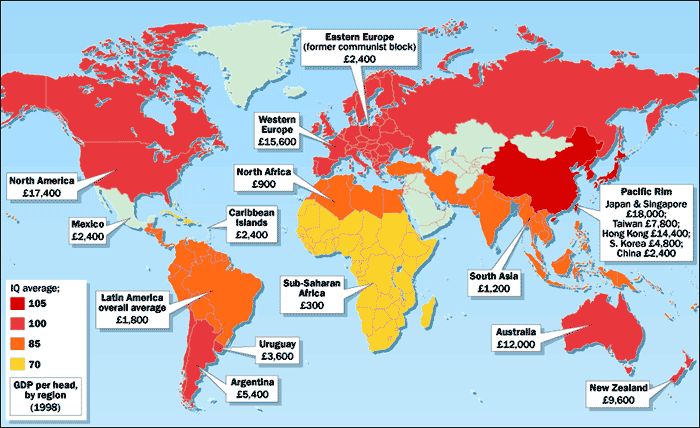
IQ Map of World

Before relatively recent contact with outside cultures, Subsaharan Africans did not invent the wheel, did not invent writing, developed minimal art, or agriculture, lacked musical instruments beyond simple percussion, and came up virtually empty in terms of math, science, and technology. Why the absence of invention and development?

The map of world IQ at top provides a tentative answer to the question, but the map raises a more central question: Why do SubSaharan African populations test so low, on average, on tests of IQ, executive function, and impulse control? Is it possible that a significant part of the development of the human "superbrain" -- which makes modern advanced civilisation possible -- developed after humans left the African birthplace?
The dispersal of modern humans from Africa to Europe some 50,000 to 60,000 years ago provides a “minimum date” for the development of language, Hoffecker speculated. “Since all languages have basically the same structure, it is inconceivable to me that they could have evolved independently at different times and places.”

A 2007 study led by Hoffecker and colleagues at the Russian Academy of Sciences pinpointed the earliest evidence of modern humans in Europe dating back 45,000 years ago. Located on the Don River 250 miles south of Moscow, the multiple sites, collectively known as Kostenki, also yielded ancient bone and ivory needles complete with eyelets, showing the inhabitants tailored furs to survive the harsh winters.

The team also discovered a carved piece of mammoth ivory that appears to be the head of a small figurine dating to more than 40,000 years ago. “If that turns out to be the case, it would be the oldest piece of figurative art ever discovered,” said Hoffecker, whose research at Kostenki is funded in part by the National Science Foundation.

The finds from Kostenki illustrate the impact of the creative mind of modern humans as they spread out of Africa into places that were sometimes cold and lean in resources, Hoffecker said. “Fresh from the tropics, they adapted to ice age environments in the central plain of Russia through creative innovations in technology.”

Ancient musical instruments and figurative art discovered in caves in France and Germany date to before 30,000 years ago, he said. “Humans have the ability to imagine something in the brain that doesn’t exist and then create it,” he said. “Whether it’s a hand axe, a flute or a Chevrolet, humans are continually recombining bits of information into novel forms, and the variations are potentially infinite.” _SB

The absence of sophisticated invention or innovation prior to the human diaspora out of Africa, or in SubSaharan Africa since that diaspora, suggests a potentially deep distinction in the way that humans inside SS Africa think in comparison to how Eurasian humans learned to think.

It would be good to be able to research this puzzle, but unfortunately, the straitjacket of Political Correctness prevents the raising of such questions -- even for purposes of objective scientific research. Which means that those of us who are curious will have to conduct our investigations under the table, so to speak.

Is that not always how it is, when intelligent and curious humans are faced with oppressive and authoritarian culture-reichs, such as the modern quasi-left postmodern PC culture?

Ancient Inventions

Inventions of Ancient China

Top 10 Ancient Inventions

Previously published at abu al-fin

Labels: , , , ,

Friday, December 29, 2006

Islam--Is It Only For Countries With Low IQ?

Hong Kong (PRC) 107 Russia 96 Fiji 84
South Korea 106 Slovakia 96 Iran 84
Japan 105 Uruguay 96 Marshall Islands 84
Taiwan (ROC) 104 Portugal 95 Puerto Rico (US) 84
Singapore 103 Slovenia 95 Egypt 83
Austria 102 Israel 94 India 81
Germany 102 Romania 94 Ecuador 80
Italy 102 Bulgaria 93 Guatemala 79
Netherlands 102 Ireland 93 Barbados 78
Sweden 101 Greece 92 Nepal 78
Switzerland 101 Malaysia 92 Qatar 78
Belgium 100 Thailand 91 Zambia 77
China (PRC) 100 Croatia 90 Congo-Brazzaville 73
New Zealand 100 Peru 90 Uganda 73
United Kingdom 100 Turkey 90 Jamaica 72
Hungary 99 Indonesia 89 Kenya 72
Poland 99 Suriname 89 South Africa 72
Australia 98 Colombia 89 Sudan 72
Denmark 98 Brazil 87 Tanzania 72
France 98 Iraq 87 Ghana 71
Norway 98 Mexico 87 Nigeria 67
United States 98 Samoa 87 Guinea 66
Canada 97 Tonga 87 Zimbabwe 66
Czech Republic 97 Lebanon 86 Congo-Kinshasa 65
Finland 97 Philippines 86 Sierra Leone 64
Spain 97 Cuba 85 Ethiopia 63
Argentina 96 Morocco 85 Equatorial Guinea 59


Table courtesy of Wikipedia
Map courtesy of R. Pongett

The tabular data above comes from Lynn and Vanhanen's IQ and the Wealth of Nations. For a good review of Richard Lynn's more recent and comprehensive Race Differences in Intelligence, look here.
Here is another fine analysis of the concept of GDP vs. IQ--with the element of free market rules thrown in.

Of muslim nations, Malaysia has the highest average IQ, 92. Malaysia's population contains 30% ethnic Chinese. Turkey has the second highest average IQ of muslim nations at 90. All other muslim nations have average IQ's of less than 90--some of them much less.

It is possible that some individual nations are misplaced on the above table, with average IQs either a bit higher or a bit lower than stated. But it is possible to detect trends by looking at different groupings of nations and their average IQ.

Given that population average IQ needs to be at least 90 for a modern technology based nation to function, immigration policy should be oriented toward inviting high value immigrants.

Observing what happened to Zimbabwe's prosperity after Robert Mugabe drove the most prosperous (and presumably most intelligent) farmers from their land, provides a good example of what NOT to do. Idi Amin's actions in Uganda provide another example. Fidel Castro's actions in Cuba provide a third. You don't want to drive out your intelligent and resourceful groups.

Update (26Dec06): Visit this Fourmilab page for a graphic illustration of the change in average global IQ with projected population trends. Accompanying the animated graphic is a thoughtful discussion of some of the issues involved in projecting trends in global intelligence.

Thanks to an Audacious Epigone commenter.

Labels: , ,

Saturday, September 16, 2006

Nothing to Fear but Stupidity Itself

Oscar Wilde said "there is no sin except stupidity." Voltaire said “The only way to comprehend what mathematicians mean by Infinity is to contemplate the extent of human stupidity." Einstein said, “The difference between genius and stupidity is that genius has its limits.” Source.

Looking at the map above, one can see that poverty and stupidity go together like hand and glove. Some countries have experienced severe poverty for periods of time--postwar Germany, Japan, and South Korea come to mind--then rebound out of poverty with time and outside assistance. Other countries such as Haiti are always impoverished, regardless of external assistance, opportunities, and internal resources. Then there are countries such as Zimbabwe which were once much better off, but now are among the most impoverished nations on earth.

International investors would be happy to take advantage of low worker wages in these perennially impoverished nations, as in Subsaharan Africa or muslim Central Asia, if they could expect a reasonable return on investment. The problems with employing workers in these nations are corruption and graft in dealing with government officials, and political instability--with the ever-present threat of nationalisation of the industry (as occurred recently in Bolivia to the natural gas fields). This type of government behaviour virtually guarantees that investors will stay away.

In addition, there is a shortage of trainable workers. If there are not enough people in the potential workforce intelligent enough to learn the skills and technologies involved in the industry--the situation is hopeless. A technological society requires an average population IQ of at least 90 (with 100 being the internationally standardised mean) to maintain itself. If the population average (mean) IQ is less than 90, all attempts to bring the nation as a whole into the modern technological world, are doomed.

The book IQ and the Wealth of Nations discusses this issue, and makes comparisons of average IQ between different nations. The authors admit that political and economic factors can artificially hold down a nation's wealth, even in the presence of high average IQ. Conversely, in a nation of relatively low average population IQ, an enlightened market economy can raise the nation's wealth above what it would be if the economy were more centrally commanded. Likewise, oppressive and/or unstable political regimes will depress a nation's wealth, even where the population average IQ is average or above.

It is important to optimise nutrition for mothers and children in these countries. But what if after optimising nutrition for mothers and children, significant population IQ average differences remain between nations? If it is clear that the nations are suffering because of lower population IQs, other underlying reasons for the differences should be determined and methods for removing the IQ deficits should be found.

The penalty for doing nothing may be severe.


When one contemplates how easily muslims are led into a frenzy by their clerics, one is forced to contemplate the relationship of stupidity with fanaticism.

Labels:

Friday, June 16, 2006

Crime and Diversity--Joined at the Hip?

________ Lifetime Likelihood of Incarceration by Race and Gender, US, in 2001.

Crime rates vary from one country to another, even from one region within a country to another. There are many reasons for why crime rates might be higher in one area. One variable shown by research to correlate with high crime is high diversity. In Europe, rates of crime and imprisonment for muslim immigrants from third world countries are high, and increasing rapidly.

There is an observed correlation between race and crime in several countries. Steve Sailer relates a fascinating anecdote of an encounter with a Russian emigrant:

A Russian immigrant called me up once to ask why almost no other American journalist ever mentioned the racial patterns he had seen with his own eyes everyday since he'd come to America. When I explained that the average writer was just lying, he replied:

Vladimir (audibly relieved): "You mean, he's hypocrite?"

Me: "Yeah, exactly. It would hurt his career to write for the public what he thinks in his private life."

Vladimir: "Thank God!"

Me: "Huh?"

Vladimir: "Hypocrite I understand. I grow up in Soviet Union. Lying to save your job, that's life. No, I was very worried smart people in America weren't hypocrites. You know, this country is supposed to be land of free, home of brave. I was scared that smart Americans weren't hypocrites, but instead were hallucinating. I am very happy to hear they're just hypocrites. Hypocrisy much less scary than mass hallucination."

Indeed.

....In crime statistics, Hispanics are often lumped in with non-Hispanic whites. This has the effect of narrowing the gap between the black and white crime rates by inflating the white rate. It also obscures the relatively high rate of Hispanic crime.

Bureaucrats are normally very scrupulous about breaking out data by Hispanic ethnicity. It’s impossible to avoid the conclusion that this is done to make diversity in general, and current immigration in particular, look better.

Fortunately, a liberal activist group called the National Center on Institutions and Alternatives crunched state-level data for a 2001 report that managed to break out the number of Hispanic prisoners in most states. The data is from 1997, but it appears to be the best we have.
Source.

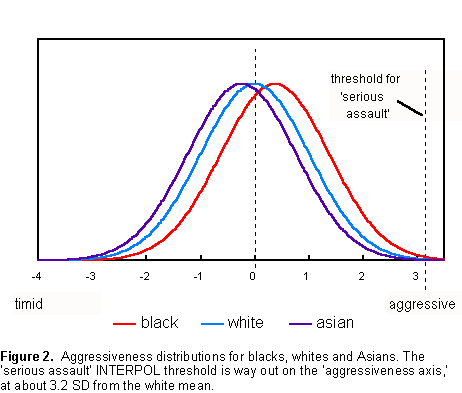
There is much more at the source above, including valuable links to statistics sources, and good statistical maps for visual learning.La Griffe Du Lion has an interesting post on aggressiveness and race. It also contains interesting graphs along with informative links.

This US Department of Justice site provides graphs of crime by race, for both victims and offenders. Unfortunately, as Steve Sailer remarked above, the "white" and "hispanic" statistics are conflated, making a valid stratification by ethnicity virtually impossible.

Why does increasing diversity bring increased crime rates? Such increased crime rates do not seem to happen when the newcomers are east asian. It is conceivable that IQ is at least part of the answer. Cultural factors can also clearly play a part. In the case of muslim immigrants, the religious factor is often prominent in increased crime by muslims in Europe.

This is a phenomenon that demands to be studied and understood. What are the chances that governments of North America and Europe will devote resources to seriously studying the association of diversity with increased crime? Virtually zero. Why? It has a lot to do with the cults of political correctness and multiculturalism that have taken over universities, the mass media, and many of the governments of the western world.

Labels: , ,

Monday, April 03, 2006

Sex and Gender Differences in the Human Brain

While the scientific findings that male and female brains are anatomically and functionally different, statistically, is still quite controversial on a political level, on a purely scientific level it is becoming well established. Doreen Kimura is one of several prolific women cognitive scientists who are brave enough to buck the political storm in order to pursue scientific truth. Camilla Benbow is another.

In this article published in Sexualities, Evolution and Gender, Kimura plainly lays out the basic argument and evidence.

Many reliable anatomical brain differences have been found to differentiate men and women, from basic structures such as the hypothalamus, to differences in systems connecting the two hemispheres, such as the anterior commissure. Some of these have been reviewed in my book......We don’t yet know the significance of such differences for cognitive function, but to describe them as fiction is to deny the careful investigations of many respected scientists (e.g., Allen and Gorski 1990, 1991; Allen, Hines, Shryne and Gorski 1989; Allen, Richey, Chai and Gorski 1991). Although we now have a fair understanding of how brain systems work in mediating certain cognitive functions such as memory, language, and the like, we are still far from understanding how individual differences, the variation in such functions from one type of person to another, are mediated by the brain. However, it must follow that if two groups (such as males and females, left-handers and right-handers, or masculine and feminine gender types) differ reliably in some behaviour not simply dependent on physical differences, then their nervous systems must also differ in some way. Where else could the behavioural differences reside? This is just as true of learned as of unlearned behaviours. Brain differences underlying cognitive differences need not, however, be visible in simple structural features. They may take the form of differing organizational mechanisms not apparent by simply viewing the external brain.

This Scientific American article by Kimura presents the argument more methodically, and at greater length.

Men and women differ not only in their physical attributes and reproductive function but also in many other characteristics, including the way they solve intellectual problems. For the past few decades, it has been ideologically fashionable to insist that these behavioral differences are minimal and are the consequence of variations in experience during development before and after adolescence. Evidence accumulated more recently, however, suggests that the effects of sex hormones on brain organization occur so early in life that from the start the environment is acting on differently wired brains in boys and girls. Such effects make evaluating the role of experience, independent of physiological predisposition, a difficult if not dubious task. The biological bases of sex differences in brain and behavior have become much better known through increasing numbers of behavioral, neurological and endocrinological studies.

Read the entire article here, it is quite fascinating.

This is a brief list of scholarly research supporting the concept of "innate differences" in neuroanatomy and cognition in males and females. It is a very abbreviated list, but it serves to introduce the evidence. For a much longer list, consult this reference list from one of Kimura's articles. Scroll down to the list, and continue scrolling. There are 111 citations, and that list is far from complete.

I have posted on this topic before--here, here, and here.

The research continues, and the weight of research--new and old--points to significant cognitive sex differences, or if you prefer, gender differences or gender disparities.

Politically, this is not a popular topic, and politically inclined "scientists" will more easily cling to the political line. It is difficult to get funding for this type of research, and publishing in some mainstream journals is difficult. Even university presidents can fall from grace if they forget the politically correct stance, and deviate from it. This has not discouraged the very persistent women and men of cognitive science.

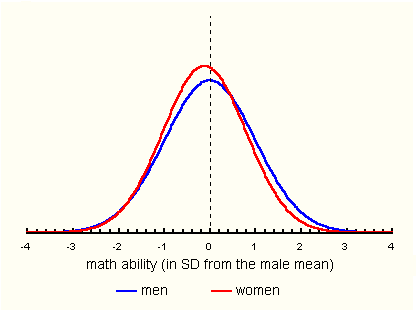
Neither men nor women are superior to the other as groups. Both groups have statistical strengths and weaknesses. A wise society will seek to understand its members, rather than try to sweep under the rug any scientific findings that are inconvenient to a dominant political viewpoint.

Addendum: This Guardian article by Simon Baron-Cohen contains a link to a test you can take to determine if you have a male brain or a female brain. Just looking at your genitalia or your chromosome map will not tell you that. Regardless of your chromosomes, your brain has a mind of its own, perhaps of a different gender than your body. Are you willing to find out?

Labels: ,

Older Posts