Sunday, July 01, 2012

Using Nuclear "Waste" to Provide Thousands of Years of Electrical Power and Industrial Process Heat

This article was previously published on the Al Fin Energy blog

Scientists at Argonne National Labs are developing ways of utilising 95% of the energy in Uranium fuel rods -- rather than the mere 4% or so currently being extracted. They are developing new techniques of chemical separation of waste from fuel, and more efficient ways of burning the recycled fuel after being separated from the waste.
When used fuel comes out of a light-water reactor, it’s in a hard ceramic form, and almost all of it is still just uranium – about 95 percent, along with one percent other long-lived radioactive elements, called actinides. Both of these can be recycled as fuel. The remaining four percent are fission products, which are truly unusable.

Pyroprocessing begins by chopping the ceramic fuel into little pieces and converting it into metal. Then it’s submerged in a vat of molten salts, and an electric current separates out uranium and other reusable elements, which can be shaped back into fuel rods.

The truly useless fission products stay behind to be removed from the electrorefiner and cast into stable glass discs. These leftovers do have to be put into permanent storage, but they revert back to the radioactivity of naturally occurring uranium in a few hundred years – far less than the thousands of years that untreated used fuel needs to be stored. _PO

One of the reasons why so little uranium is used is that almost every commercial reactor today is a type called a light-water reactor, or LWR. While LWRs are good at many things, they aren’t designed to wring every last watt of energy out of fuel. But LWRs aren’t the only type of reactor. Another class, called fast reactors, boasts the ability to “recycle” used fuel to get much more energy out of it. The main difference between the types of reactors is what cools the core. LWRs use ordinary water. Fast reactors use a different coolant, such as sodium or lead. This coolant doesn’t slow the neutrons as much, and consequently, the reactor can fission a host of different isotopes. This means that fast reactors can get electricity out of many kinds of fuel, including all of that leftover used fuel from LWRs. (LWRs can burn recycled fuel too, with some modification, but they aren’t as good at it.) _PO


More on pyroprocessing used nuclear fuel (PDF)

Extracting 30 times more energy from the same amount of nuclear fuel will help to make the same amount of fuel go much further. While we are being more efficient at using the nuclear fuel (and nuclear wastes) that we already have, we can learn many more ways to generate energy from mass.

The limits are in our heads.

Labels:

Saturday, May 19, 2012

General Fusion Gets New Funding to Pursue Unconventional Fusion Power Approach


For all its promise, the quest for net gain fusion has been a time consuming and costly endeavor. The ITER reactor is projected to take 10 years and 13 billion euros to construct. That doesn’t count the 25 years and counting since the project began and the millions poured in by contributors so far. Even when built, ITER’s super conducting magnets and other components would require 50 MW worth of input power to start and maintain the reaction. Similarly, costs for Laurence Livermore’s National Ignition Facility are estimated at upwards of $850 million and its reactor requires 500 trillion watts of laser light to kick-start fusion reactions.

Where General Fusion’s magnetized target method stands apart is in its relatively low-tech, low-cost mechanical means of compressing the plasma. “As an energy storage medium, compressed gas is orders of magnitude less expensive than capacitors,” Delage explains, “but it’s hard to release this energy quickly.”

...“Our sphere is in fact full of holes, like a Wiffle ball,” he explains. “Each hole is plugged with an ‘anvil’ and compressed gas is used to accelerate a 100 kg ‘hammer’ piston. This acceleration takes about 80 milliseconds. When the hammer piston impacts on the anvil piston, it moves a small amount and transfers the energy into the liquid metal in about 80 microseconds. That’s a timescale shorter than the lifetime of the magnetized target and an increase in power of 1000 times.” _Canadian Manufacturing _via_NBF

General Fusion has secured a new round of funding (PDF) and is prepared to take their unconventional approach to fusion as far as they can take it. No one needs to tell the General Fusion team or their investors that they are pursuing a long shot.

But then, the same applies to all the other small-scale fusion startups, who are trying to do an end-run around the huge multi-billion dollar approaches taken by ITER and Lawrence Livermore, etc.

The General Fusion website contains much more information about the science, technology, and the people behind this dark horse candidate to develop commercial fusion power.

Brian Wang provides a library of NextBigFuture articles devoted to the General Fusion effort

Labels: ,

Sunday, February 26, 2012

The Coming Energy Revolution c/o Gas-Cooled SMRs

Small modular nuclear reactors will have a revolutionary effect on the future of electrical power generation. But a particular type of small modular reactor -- the gas-cooled reactor -- is destined to revolutionise all aspects of future energy and fuels.
First, let's look at small modular nuclear reactors:
SMRs have a number of advantages over conventional reactors. For one thing, SMRs are cheaper to construct and run. This makes them very attractive to poorer, energy-starved countries; small, growing communities that don't require a full-scale plant; and remote locations such as mines or desalination plants. Part of the reason for this is simply that the reactors are smaller. Another is that, not needing to be custom designed in each case, the reactors can standardized and some types built in factories that are able to employ economies of scale. The factory-built aspect is also important because a factory is more efficient than on-site construction by as much as eight to one in terms of building time. Factory construction also allows SMRs to be built, delivered to the site, and then returned to the factory for dismantling at the end of their service lives - eliminating a major problem with old conventional reactors, i.e. how to dispose of them.

SMRs also enjoy a good deal of design flexibility. Conventional reactors are usually cooled by water - a great deal of water - which means that the reactors need to be situated near rivers or coastlines. SMRs, on the other hand, can be cooled by air, gas, low-melting point metals or salt. This means that SMRs can be placed in remote, inland areas where it isn't possible to site conventional reactors. _David Szondy
It is easy to see why the scalable nature of SMRs allows them to fit a wide variety of energy markets. Better economies of scale and increased reliability are possible from precise factory controlled construction. But why do gas-cooled SMRs, in particular, promise such a revolutionary impact on the future of energy and fuels?

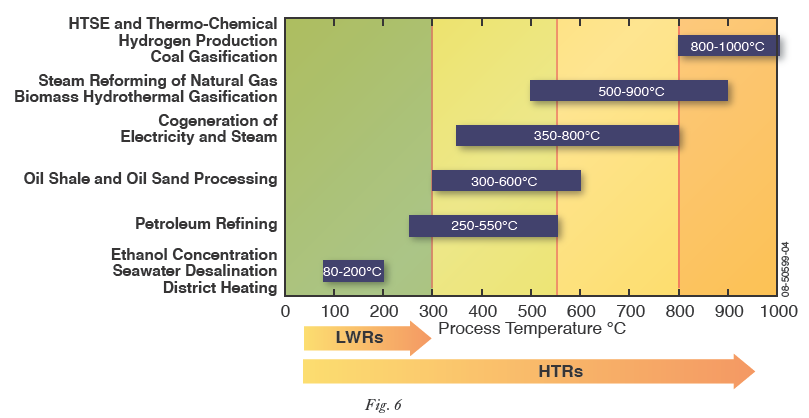
It comes down to the high quality, high temperature process heat that gas-cooled reactors provide. Here are some of the things that high quality process heat can do:
  1. Unlock the trillions of barrels oil equivalent in oil sands (PDF)
  2. Unlock the trillions of barrels oil equivalent in coal to liquids and gas to liquids (PDF)
  3. Unlock the trillions of barrels oil equivalent in oil shale kerogens 
  4. Provide abundant industrial process heat for production of fertilisers, refining fuels, making plastics, etc 
  5. Split CO2 into CO to use as a hydrogen carrier 
  6. Overturn conventional fears of EROEI and Peak Oil 
_Source
Brian Wang has also taken a look at this topic

One particular gas cooled modular reactor has been selected by the Next Generation Nuclear Plant Industry Alliance as the best design for the category:
The Alliance said that it had selected an unspecified Areva reactor concept, presumably based on the Antares design, "as the optimum design." It said, "The Areva HTGR technology's capability and modular design would support a broad range of market sectors, providing highly-efficient energy to industries such as electrical power generation, petrochemicals, non-conventional oil recovery and synthetic fuel production." Areva, it said, "has the technical and design capabilities to develop a HTGR for the process heat co-generation and generation markets."

It added that "additional investors are being pursued to fully capitalize a venture in order to build an initial fleet of HTGR plants for industry." The Alliance noted, "Deploying next generation nuclear technology is a critical step in solving the long-term needs for secure sources of energy, conserving fossil fuels and slowing the growth of greenhouse gas emissions. Clean, safe nuclear energy from HTGR would increase US energy independence and extend the life of domestic oil and natural gas resources." _WorldNuclearNews
More here

Perhaps a stimulus from the private sector will help to spur the revolution that the US federal government under Obama appears to be resisting with all its might. Regardless, it is critical for a wide range of intelligent people within various industries and sectors of the economy to understand the importance of this potential qualitative transition in possibilities for production of future energies and fuels.

Nuclear energy systems that utilise efficient fuel burn and recycling (with combined Gen III and Gen IV + reactor synergies) offer thousands of years of electrical power and optimised fuels production. Only rational nuclear energy possesses the energy density and massive fuel supplies to allow humans to transcend fears of energy scarcity in order to move into a future of relative abundance.

Previously published on Al Fin and Al Fin Energy

Labels:

Monday, February 20, 2012

Thorium vs. Uranium: Global Energy Futures

Thorium is approximately three times as abundant as uranium in the earth’s crust, reflecting the fact that thorium has a longer half-life. In addition, thorium generally is present in higher concentrations (2-10%) by weight than uranium (0.1-1%) in their respective ores, making thorium retrieval much less expensive and less environmentally damaging per unit of energy extracted. Countries with significant thorium mineral deposits include: Australia, India, Brazil, USA, Canada, China, Russia, Norway, Turkey, Venezuela, Sri Lanka, Nigeria, South Africa, and Malaysia.

Naturally occurring thorium has one isotope- thorium-232. In the DBI reactor, the initial start up fuel mix is a combination of thorium and uranium-235. The uranium acts as the “seed” source of neutrons needed to achieve criticality for the first reactor. This combination of fuels decreases the time and capital required to start the thorium fuel breeding cycle. As the DBI reactor design begins producing electricity, Uranium-233, bred from the Thorium-232, increased core reactivity and power output. Over time, the original uranium-235 is burned up and subsequently the reactor is fuelled only with Thorium-232. Over the life of the DBI reactor design (approx. 60 years), about 3% of the original load mass (thorium only) will be added every 18 months. Depending upon operational choices available with the DBI designs, no or very little additional uranium will be needed. _DBI
The thorium cycle is far more efficient and simpler than the uranium cycle. So besides the fact that significantly more thorium reserves are present than uranium, it is possible to extract far more of the potential energy from the thorium -- with much less effort -- than from uranium.
Thorium is well distributed globally, providing an ample supply for industrial and emerging nations well into the future.

More information on the future of thorium energy:  Flibe

Labels: ,

Wednesday, July 06, 2011

Small Fusion Reactors: An Alternative to Fission?

General Fusion

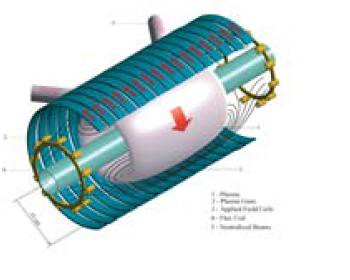
General Fusion is a small startup headquartered near Vancouver, BC. The compression of plasma to achieve fusion is accomplished by a coordinated spherical plasma compression, using pneumatics and advanced switching.
Helion

Helion Energy is located in Redmond, Washington. It is based on a principle of "colliding plasmas," and like all the rest of the small fusion approaches, it is a long shot.
Bussard IEC Fusion

Bussard inertial electrostatic confinement fusion (EMC2 Fusion) involves an electrostatic plasma confinement to achieve fusion. The history and development of the concept is explained in a video reached via the link above. The Bussard IEC has been financed almost entirely by the US Navy. EMC2 is based near Santa Fe, New Mexico.
Dense Plasma Focus Fusion

Lawrenceville Plasma Physics is based in New Jersey. The dense plasma focus approach uses a special pulsing "spark plug" to ionise a gas, and to form a plasmoid "pinch," with the emission of high energy photons, ions, and fusion neutrons.
HyperV

Hyper V Technologies utilises a spherical array of mini railguns to accelerate plasma beams into a central target of deuterium or deuterium-tritium, to achieve fusion (hopefully).
TriAlpha

TriAlpha is an Irvine, California venture, which has been fairly successful in the venture capital game. TriAlpha is a bit secretive with non-investors, but you can read their patent for yourselves. The concept seems to involve the highly sophisticated evolution of an earlier colliding beam fusion approach.

Fusion reactors can be prolific neutron generators, and could be utilised for the transmutation of nuclear wastes into harmless compounds. They could also generate a number of differen highly energetic particles and high energy photons, and used for a number of purposes -- including as space propulsion. Another potential product of fusion reactions is heat. But what is most desired from fusion reactors is abundant, cheap, clean electrical power.

The energy from fusion is higher than the energy from fission, so that less fuel is required to generate equivalent energies. Fusion is generally safer, with less radioactive waste remaining to be disposed of.

Many billions of dollars have been spent by governments in a vain attempt to master the power of the stars on a more human scale. If one of the small startups manages to achieve with $millions what huge government budgets of $billions could not achieve, a revolution would have been ignited which would likely not stop with just cheap, clean, abundant energy.

Labels: ,

How to Survive an Apocalypse in the Suburbs

The suburbs may not seem to be the best place to survive an apocalypse, but some people think it can be done.
Who knows how everything will shake out when the world goes to hell, but the suburbs may be well positioned to thrive with fewer resources, as Brown points out. Suburbs are close enough to the city to be convenient and encourage community building, yet spread out enough to offer yards and substantial garden space. (Suburban soil is also usually less contaminated than urban soil.) The houses are large enough to accommodate multigenerational households and cottage industries, which some demographers predict as coming trends. _CityPaper

Popsci

But you and I know that to well and truly survive an apocalypse in the suburbs, you are going to need a lot of juice -- in more senses than one. You will need plenty of fluids, true. You will also need plenty of heat and electrical power to survive the winters and power air conditioners through the summer. In a third sense of the word "juice", you will need plenty of clout and respect. And what better way to gain the respect of one's extended neighbors, than to have your own functioning nuclear power plant in your backyard?

Consider the thorium molten salt reactor, pictured above:
The MSR design has two primary safety advantages. Its liquid fuel remains at much lower pressures than the solid fuel in light-water plants. This greatly decreases the likelihood of an accident, such as the hydrogen explosions that occurred at Fukushima. Further, in the event of a power outage, a frozen salt plug within the reactor melts and the liquid fuel passively drains into tanks where it solidifes, stopping the fission reaction. “The molten-salt reactor is walk-away safe,” Kutsch says. “If you just abandoned it, it had no power, and the end of the world came--a comet hit Earth--it would cool down and solidify by itself.”

Although an MSR could also run on uranium or plutonium, using the less-radioactive element thorium, with a little plutonium or uranium as a catalyst, has both economic and safety advantages. Thorium is four times as abundant as uranium and is easier to mine, in part because of its lower radioactivity. The domestic supply could serve the U.S.’s electricity needs for centuries. Thorium is also exponentially more efficient than uranium. “In a traditional reactor, you’re burning up only a half a percent to maybe 3 percent of the uranium,” Kutsch says. “In a molten-salt reactor, you’re burning 99 percent of the thorium.” The result: One pound of thorium yields as much power as 300 pounds of uranium--or 3.5 million pounds of coal.

Because of this efficiency, a thorium MSR would produce far less waste than today’s plants. Uranium-based waste will remain hazardous for tens of thousands of years. With thorium, it’s more like a few hundred. As well, raw thorium is not fissile in and of itself, so it is not easily weaponized. “It can’t be used as a bomb,” Kutsch says. “You could have 1,000 pounds in your basement, and nothing would happen.”

Without the need for large cooling towers, MSRs can be much smaller than typical light-water plants, both physically and in power capacity. _PS
And the advantages of the thorium molten salt reactor go on and on. Even many greenies are on board for thorium MSRs.

It is likely to be touch and go to get Obama's nuclear regulatory commission to license the safer, newer, cheaper nuclear plants, but nuclear engineer Kirk Sorensen has founded a company named Flibe, to build and market the devices. Even if he has to go to China to build the reactors, you can always have one smuggled into your country of choice and installed in your back yard under a small carnival tent -- to hide it from annoying satellites.

Remember, if you have a reactor like this, you will have all the juice you could possibly need. You could even build a giant dome over your entire neighborhood and give it the climate of Tahiti year-round, if you like. Tropical fruits taste quite good, particularly in the middle of typical apocalyptic mass food shortages.

But don't get cocky. Once residents of surrounding suburbs and neighboring cities catch on to the fact that you had the foresight to prepare for the apocalypse, they will want a large piece of what you have. That is where juice -- and knowing how to use it -- truly comes in handy.

More on this topic in a future posting.

Labels: ,

Older Posts