Sunday, November 25, 2012

The Last Resort: Island Retreat Away from Zombie Horde

Tucked away on a tiny island off the Maine coast, this self-sufficient steel-clad dwelling offers exceptional protection from the distant zombie horde.
Zombies tend to cluster in and around cities -- where most of their prey can be easily found. By putting distance between yourselves and the horde, you can prolong your survival.

Islands do not provide perfect protection from zombies, since the undead cannot drown. But zombies are poor swimmers, have difficulty operating boats, and are often swept away by strong ocean and tidal currents.

The featured dwelling is covered by steel sheeting, and includes a series of steel shutters that can be rolled shut to provide extra protection in case of an inadvertent zombie breech of normal defences.
The house is situated on an tiny sleeve of rock tucked close to the water. The sturdy steel cladding was chosen for a good reason — the northern squall can be relentless. The cabin [9] has a series of rolling [zombie proof] panels that close it against the elements. When the zombies clear and the sun shines, a small solar-electric panel mounted to the southern facing roof feeds 12v DC to the batteries, which in turn power lights, a super efficient Sunfrost Refrigerator [10], and a small water pump. A large rainwater catchment tank provides more than enough water for the home, and a small on-demand water heater supplies an outdoor shower and the sink. _Inhabitat
Self sufficiency is a must in the age of zombies. Normal transportation re-supply is rapidly broken down along with police protection and civil services -- as more and more of the human infrastructure is eaten or converted to an undead state.

Don't let the zombies have the last laugh. Be prepared.

Labels: ,

Sunday, October 28, 2012

Novel Anti-Zombie Shelter Ideal for Deserts and Polar Regions

The novel anti-zombie shelter pictured below incorporates a number of features which should help protect you and your loved ones in the event of a zombie apocalypse.
The staircase retracts -- much like a drawbridge -- whenever zombies approach across the sand or ice. In addition, if zombies somehow make their way inside, the individual segments can rotate. This allows you to trap and isolate zombies inside particular segments. The rotating segments can also confuse zombies into thinking they are going the wrong way, causing them to reverse directions until exhauste, finally falling through special trap doors to the icy sands below.

Although not well portrayed in the image, the leg supports are capable of moving independently -- like the legs of a millipede -- propelling you and your shelter across the arid sands from oasis to oasis. The shelter is easily able to outpace a shambling zombie horde, as long as its energy packs are kept charged.

Finally, the shelter is able to safely submerge itself, hidden under sand, ice, earth, or water -- in the event of a mega-zombie outbreak.

Hope for the best. Prepare for the worst.

Labels: , ,

Monday, October 15, 2012

Swiss Survivors Huddle In Hobbit Holes to Escape Zombies

They said that Switzerland would be the last nation on Earth to fall to the zombie apocalypse. They said that because of the natural geographic boundaries that separate the Swiss from everyone else. But little by little, zombies have been seen infiltrating the mountain redoubt, causing Swiss survivalist to devise a fallback plan: Hobbit Hole housing.
The Earth Houses are so called because they're designed to reside within their environment, blending into the natural contours of the land rather than merely set down on top of it. They're also covered with clumps of earth, which makes a lot of sense in terms of insulation, though such a design will clearly not fit in with everybody's aesthetic sensibilities.

Because of the way the houses are built into the land, no one would spot the estate who wasn't actively looking for it.

The plot of land the Earth Houses are built on covers 4,000 square meters (43,055 sq ft), with each individual house covering between 60 meters squared (646 sq ft) and 200 meters squared (2,153 sq ft). There are three houses consisting of three rooms, one house of four rooms, one of five rooms, three of six rooms, and one of seven rooms. _Gizmag
The zombie-escape houses are surrounded by conventional houses, which are likely to attract zombies by their very conventionality. While their neighbors are being eaten by the horde, the survivors can hide out in relative comfort, waiting for the zombie masses to move on to more obvious targets.

Should any zombies stumble across the survivalist hidey holes by mistake, they are likely to stumble straightaway into the central pond -- where their loud thrashing about in the water will attract the attention of survivors. A quick double tap to the head should eliminate the immediate problem, and prevent the zombie's loud struggles from attracting others of its kind.

Finally, the dispatched zombie will be dried and ground into powder, to be used as zombie repellant. The repellant is liberally poured around the perimeter of the surival estate -- well away from the residences. This ring of protection is replenished after every heavy rain or snowfall.

A few additional projects -- such as a deep moat filled with zombie-eating sharks, and a 20 foot tall solid wall topped by a high voltage electrified fence -- should provide additional protection.

Labels: ,

Wednesday, June 06, 2012

City In the Sky vs. Floating Islands and Cities

The images of the City In the Sky come courtesy of Inhabitat. The idea is to elevate parks, gardens, and perhaps residences high above street level noise, pollution, and crime.

Towers are expensive to build, and once built they cannot be easily moved.


Contrast the sky city with a floating city, which is close to the water, and which can be moved if necessary.

Images of floating islands and cities courtesy of Gizmag:

Dutch Docklands Maldives


Floating islands could be located anywhere from the tropics to the polar regions -- as long as the possibility of encountering ice is accounted for. One could even put a floating island on an alpine lake, as a vacation home away from home.
Always be aware that zombies can travel through the water, and cannot be drowned. If you are looking for shelter from zombies, the tower approach may well be superior to the floating island.

Labels: ,

Friday, April 27, 2012

Instant Zombie-Proof Dormitory, Hotel, Village

All images via Gizmag

The steel shipping container is a strong and versatile architectural starting point. Using the ubiquitous steel structures, one can build a house, a workshop, an artist's studio, an underground survival bunker, or an entire dormitory, hotel, or village.

The structures can be stacked, cantilevered, buried, bermed, or perched on a pedestal.
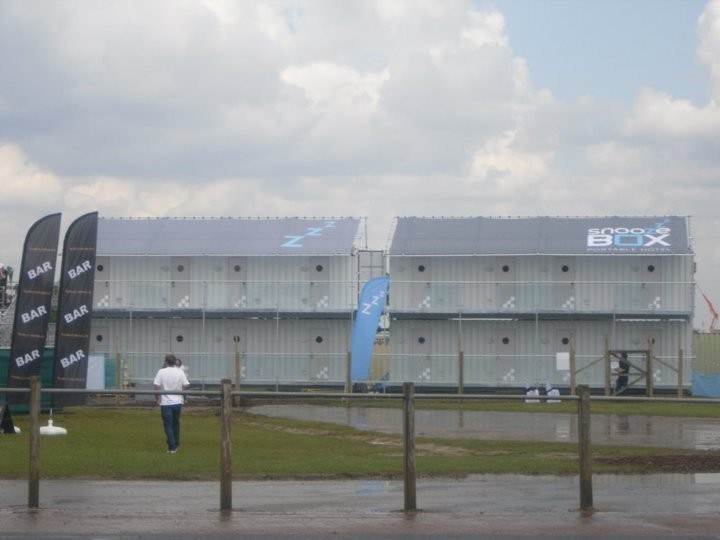
... British company Snoozebox has come up with yet another clever use for [shipping containers] – a modular, scalable portable hotel system made up of multiple tiered containers, that can be set up anywhere within 48 hours.

Each climate-controlled Snoozebox room features a double bed, wet room, flat screen TV, free Wi-Fi, two power outlets, a safe, and key card entry. Maid service and a continental breakfast are also provided. Currently, there are four rooms in each container, although a couple of other options should be available soon – the company plans on offering larger Luxury rooms that each occupy half a container, along with cheaper five-per-container Budget rooms. The containers themselves are standard ISO (International Organization for Standardization) size, meaning that they can be stacked and shipped anywhere by road, rail, air or water. The system includes its own infrastructure, so no electricity, water or sewage access is necessary. It can also be leveled by its installation crew, so absolutely flat terrain isn’t a requirement. _Gizmag

Such self-contained dorm/hotel/village systems could be set up anywhere in the wilderness, desert, or polar areas where power and sanitation could be provided. Above, you can see the interior layout of individual container units for the "Snoozebox" system.

Shipping containers are built of strong steel structural material, easily capable of holding off an extended and determined zombie attack, as long as sufficient food, water, sanitation, temperature control, and clean air are available.

A multi-unit installation would be suitable for remote drilling or mining crews, remote education or training centers, or for large scale refugee camps when flight from zombie-infested cities is necessary.

Labels: ,

Friday, February 17, 2012

New Adventures in Zombie-Proofed Homes: The Oil Silo

The Oil Silo Home, designed by pinkcloud.dk in Berlin, recycles oil silos by transforming them into affordable [zombie-proof -- ed.] houses!

An oil silo is a storage container for compressed liquefied petroleum gas. There are approximately 49,000 oil silos in over 660 oil refineries worldwide! As the [zombie - ed.] population increases at an exponential rate, oil discovery decreases at an exponential rate. Soon all existing oil silos will be [needed for zombie-proof housing -- ed.].

The Oil Silo Home is a 100% self-supporting housing solution for the [zombie infested - ed.] world. It’s highly structurally stable, waterproof, efficient to assemble and disassemble, and has the capacity for prefabrication and mass production. __Pinkcloud.dk
The oil silo home is supported above ground by strong steel pillars. It is acessible by a stairway which can be retracted in case of zombie sightings.
This cutaway view reveals internal space options. One can also see the rooftop defensive position, which allows household snipers optimal views of the surrounding free-fire zones.
Depending upon the climate zone, a variety of modular external sheathings are available, in a wide array of bullet-proofing and fire resistance. While zombies are not able to use firearms or sophisticated weaponry, untransformed humans certainly can. Zombies may be the greatest concern for survival, but human rivalries will still remain, occasionally turning violent.
This image demonstrates one possible means of re-constructing an oil silo into a relatively zombie-proofed house (click for full size). It is recommended that homeowners allow Al Fin zombie-proofers to customise the final residence, for optimal safety.
Oil silos can be converted into multiple unit housing, for extended families and for cooperative, non-family alliances. It is recommended that the most expendable and least trustworthy members of the group be housed in the lower-most unit.
Oil silos can be converted in such a way as to allow optimal natural lighting, as pictured above. Likewise, they can be converted for hilltop placement with partial or complete earth coverage -- for both disguise and weather protection in severe climate locations.

In the age of zombies, the need for secure shelter has never been more acute. Hope for the best, plan for the worst.

Labels: , ,

Thursday, February 16, 2012

Elevating Japanese Villages to Safeguard from Zombie Attack


Japan suffered a massive devastation from recent earthquakes and tsunamis. These natural disasters highlight some of the dangers of living at ground level. Even worse than these disasters, however, is the threat of zombie attack -- which can occur far from shorelines.
Tōhoku Sky Village is not just an architect's flight of fancy: one municipality in the affected region is making moves towards building one in its locality and others could follow.
Most islands will be used for residential purposes, with between 100 and 500 houses and apartments. Fuel stations, waste disposal and storage facilities, and car parks are on lower floors. Commercial islands, meanwhile, will house factories and processing facilities for industries such as fisheries and agriculture. As well as lifting residents high above the destructive power of [zombies - ed.], the design comes with a number of safety features. A reinforced gate at the back of each island automatically closes after a [zombie] warning, while steps up the sides let people climb to safety. _New Scientist
The best power source for these fortress villages would be off-grid small modular reactors, in deep underground vaults, reinforced by concrete and re-bar.
Each three-storey island would offer 90,000 square metres of usable space and be bolted deep into the bedrock via vast steel pillars. The exterior walls are made of 50-centimetre-thick reinforced concrete, while utility spaces on the bottom floor are compartmentalised in a radial formation for even stress distribution - rather like the spokes in a bicycle wheel. _NS
High voltage conductors will be used to line the steep, high outer walls of the anti-zombie fortresses, capable of frying any zombie invaders to a deep black crisp. When zombies are crisped in this manner, other zombies lose their natural aversion to eating them. Oddly enough, when zombies consume other zombies as a zombie crisp, they tend to sleep for hours or days on end, allowing for safe & easy dispatch and disposal by special squads of villagers known as zlayer zquads.

Labels: , ,

Tuesday, December 06, 2011

Live Out the Zombie Apocalypse in Remote Survival Pod

Image Source

This unique mountain survival retreat is made by the Leap Factory, and was placed in the French Alps by helicopter. It is almost impossible for zombies to access this retreat, and any who survive to reach your altitude can be easily dispatched by a dull axe or rusty sword.
Image Source

LEAPfactory’s Gervasutti refuge represents the pinnacle of the Italian firm’s achievement. LEAP refers to Living, Ecological, Alpine Pods, their speciality, and their latest pod is also one of their greatest. It has 6 contact points with the ground and weighs 5,500 pounds, while the elongated shape creates nearly 100 square feet of hi-comfort interior space that sleeps up to 12 people.

Everything – from the exterior shell to the interior fittings – is modular so that when the time comes, the refuge can be relocated elsewhere. The solar panels installed on the roof produce 2.5 Kwh of solar energy – making it completely self-sufficient – and it only took two days to install. This truly is a remarkable achievement in modular design… now we just have to get there! _Inhabitat
But the whole reason for this remote survival retreat is that it is difficult to reach -- for normal humans as well as zombies.

You see, if you find yourself among a group of humans that is confronted by a hungry polar bear, you do not have to be faster than the bear -- you merely need to be faster than at least one of the humans.

The same principle applies to zombies. Choose your perch wisely.

Labels: ,

Saturday, October 15, 2011

Is Your Home Secure from Zombies, Collapse, and Natural Disaster?


Practical Tactical: Home Fortress - Episode 102

Aired: August 13, 2010
| Views: 0 | Comment

Go behind the walls of what is considered to be one of the safest houses in the world. S.A.F.E. Founder and President, Al Corbi gives us a look at the safety measures in place in this domestic fortress. Later, join Corbi and his team... (19:00)


We have looked at homes that are fairly secure against zombie attack, and others that are secure against most natural disasters. We have also looked at ways that you can prepare for extended economic collapse, civil disorder, and loss of basic services.

But what we really want is a way to protect against all the likely and somewhat possible occurrences. Here we look at some of the state of the art technology involved in securing a home against intruders, attackers, and natural disasters.

The home featured in the video above is located in the Hollywood Hills, above Los Angeles. Los Angeles tends to erupt periodically in mass occurrences of civil disorder, so installing features such as these is a logical precaution for any homeowner in the LA area.

To make such a home even more secure, one would go underground to provide multiple secure storage areas for food etc., a secure water supply, safe backup power supplies, and escape tunnels when flying out by helicopter is not feasible.

Ideally, you would want to locate a fallback home with similar security features ina more remote location, surrounded by a wide assortment of measures which would make it difficult for a large force to approach your "fortress" in an organised and deliberate manner.

The city home described above is located inside a gated fence -- presumably with a range of anti-vehicular defences incorporated to prevent the approach of a large car bomb.

Notice that the builders incorporated a means of rapid evacuation by air, for when the excrement truly contacts the rotating blades. For your city home, you would want some type of VTOL aircraft to be on site and ready to go any time that you or your family are on site. Particularly if located in a city such as LA, Chicago, London, etc.

Home security doesn't have to cost as much as the home shown above. But it will require a good deal of thought.

Labels: ,

Wednesday, September 28, 2011

The Zombie-Proofed House

All Images from All-that-is-interesting

Above you can see the zombie-proof house with all shutters fully closed. In this setting, the only access into the house is via a drawbridge, which must be lowered for entry.
Now you can see the shutters as they begin opening. Notice the large front heavy steel shutter which is electrically controlled.
Concrete shutters are now fully opened, revealing the side windows and front entrance and windows.
Here you can see the lowering of the drawbridge -- the only access to the house when all shutters are closed in full zombie-proof mode.
This is the house as it would normally be seen, with no zombies in the vicinity. Regular patrols by ground and from the air are mandatory, to assure the absence of zombies. A constant seismic surveillance is likewise necessary, to guard against the dreaded tunneling zombies.
After the sun goes down, the house would normally be fully closed in, due to the increased threat of nocturnal zombie attack. Immediately after this photograph was taken, a zombie spotting was reported two houses down, requiring an immediate shuttering-in. Eternal vigilance becomes second nature inside the zombie zone.

First published at Al Fin, the Next Level

Labels: , ,

Saturday, June 18, 2011

$74,000 for a Tiny Piece of God's Country

Rio Grande River Valley Near Taos

Images via Zillow

Somewhere within 20 miles of Taos, New Mexico, sits a tiny 320 sq ft dome with a lovely view of the Sangre de Cristo mountains. Also nearby is the scenic Rio Grande River Gorge. Skies over the dome are almost always clear -- deep blue in the daytime and incredibly starry at night. The dome sits on 10 acres of land, all for $74,000. But you will need to get used to living off the grid.
“There’s quite a few people who are interested in building dome homes,” explained listing agent John Kejr of Dreamcatcher Real Estate. “There are a probably a couple of dozen different companies that have [the kits].”

Dennis Johnson of Natural Space Domes in Minnesota sells kits for building a dome home — either the entire pre-fabricated kit with framework and sheeting and interior panels or a basic kit, which just includes the metal connection brackets.

While a small dome home kit, like the one in Taos, costs somewhere under $5,000, three, four and five-bedroom plus homes can cost anywhere from $25,000 to $100,000, and Johnson claims they’re relatively easy to build and someone without a lot of construction experience can build one.

“The dome is a connect-the-dots kind of thing, a very easy system,” he said. “It’s like a giant Tinkertoy set.”

...The home is near the Rio Grande river and has “spectacular views” of the mountains, Kejr said, but be prepared to use an all-wheel drive vehicle to access the property during heavy rainstorms due to muddy conditions. _Zillow

Hmmm. Remote location, off-grid, difficult to access in wet or wintry weather? Generally fine weather. Beautiful view of the Sangre de Cristos and relatively near access to the river gorge and to prime winter skiing?

Who could ask for a better location for surviving the next apocalypse?

Labels:

Tuesday, March 08, 2011

An Arch of Towering Dimensions

Inhabitat

Think of it as a skyscraper laid on its side, shaped into a dome with large holes in it. There is a lot of living and working room implied, depending upon the thickness of the dome itself, and its diameter.
This proposed arched building is a unique solution to the question of how to create density without dominating a skyline or swallowing green space. Proposed for the city of Rennes, France, the gargantuan inhabited dome placed second in this year’s eVolo skyscraper competition. Designed by Yoann Mescam, Paul-Eric Schirr-Bonnans, and Xavier Schirr-Bonnans, Flat Tower envelops a vast green space, has the ability to collect sun and rainwater and is also a sustainable solution to developing appropriately large scale developments. _Inhabitat

Inhabitat

It is easy to imagine a seastead dome of this type, arching over a floating base of sufficient buoyancy. The lower, semi-submerged portion may be a mirror-image inverted dome, or another shape more conducive to cross-water directional travel.

The most important consideration is often to nudge oneself out of conventional, rutted ways of thinking, into a workspace for envisioning novel structures, mechanisms, and devices.

Labels:

Monday, February 28, 2011

A New Approach to "Cliff Dwelling"

All images via Inhabitat
This return to cave-like cliff dwellings is inspired by Brazil's teeming populations of shanty towns, or favelas. As the current wave of tall and ultra-tall buildings rises and subsides, humans in depressed economies will find it too expensive to afford the maintenance required to keep the buildings functioning. But they may have a use -- providing neo-cavemen rooms with a view.
Inspired by favelas or Brazilian shanty towns, the structures are box-like homes that can be attached onto the facades of other buildings. Reyes’ concept is unique in that it actually enlists able-bodied survivors to assist with the implementation of the shelters – a cool idea, since it empowers them to take action instead of simply sitting around, waiting for help. Reyes envisions that the pre-constructed structures could be airlifted by helicopter to sites where they are needed and then guided into place with the help of survivors. They “clip” onto building facades using leverage.

Each shelter would contain beds, lighting, storage and a skylight and be made of recycled materials from local construction sites. There would also be attachments for solar energy, water purification and organic farming. Finding muse in the famous favela paintings of Rio de Janeiro, Reyes also hopes that survivors will be able to use the walls of their shelters as canvases once they are settled in, using painting as a creative outlet as they begin the process of healing. _Inhabitat

Like cliffside cavemen in the past, the neo-cavemen may find living high above the teeming masses and ground-level predators, to be safer.

Nations with average population IQs below 90 -- and without a market dominant high-IQ minority to run things -- will lose the ability to sustain advanced technologies with the coming anarchy. The high tech infrastructure still remaining after such societies collapse will be scavenged and parasitised as needed, as pockets of humanity across the third world revert to the caves.


Images via Inhabitat

Cross-posted at Al Fin

Labels:

Sunday, February 27, 2011

Seasteading: Getting Beyond The Celebrity-Seeking Dilettante Phase

More Designs Here

Up to this point, seasteading seems to be more about appearances and fads than about actually building a seastead as an ongoing concern -- as a real alternative to government monopoly. The Seasteading Institute has promoted a number of conferences and a good deal of media coverage, but when it comes to the nitty-gritty of making a life on the ocean, most of the ideas one finds on the site lack heft. The bottom line is that a seastead will have to pay for itself.

It is clear that aesthetics is playing far too great a role -- and economics far too small a role -- in many of the themes and schemes thrown around in popular seasteading circles. After all, there is no need to reinvent the wheel in terms of basic marine structure. Actual commercial enterprises such as the oil & gas industry and marine mining concerns, have made significant engineering advances and continue to do so, in terms of habitable ocean-going vessels which are also commercial platforms.

One exciting material prospect for building working seasteads, is pre-stressed concrete:
Through innovation with precast and prestressed concrete, some latest trends are now focused toward the development and construction of floating ocean platforms used to extract minerals, energy, and other natural resources.

Precast and prestressed concrete platforms have been constructed to support phosphate processing plants, floating liquefied propane gas (LPG) processing and storage facilities, and oil exploration platforms that are transported afloat and grounded for drilling.

For ocean platforms, the size and weight of prestressed and precast concrete construction will provide the greatest dynamic stability due to its large inertial advantage. Long-term durability of concrete construction in an ocean environment has been proven by actual service of existing prestressed precast concrete platforms over the last several decades. _civil-online
By taking advantage of the lessons already learned and earned by offshore industries, seasteaders who are serious about pulling their own weight can find starting opportunities and niches. Just as in a successful marriage, the means of supporting the group comes first, then the details of housing, recreation, etc.

Labels: ,

Sunday, January 16, 2011

72,000 Square Foot Concrete Country Cabin -- Your Tax Dollars at Work

CCHeadliner

How does a person afford to build a house larger than the White House (55,000 sq. ft), even larger than Bill Gates' mansion (66,000 sq ft)? All you have to do is to own a company that maintains big contracts with the US Defense Dept and several other US government agencies. Under President Obama, the government is central to all wealth formation and disbursal. More on the huge 72,000 square feet country cabin:
Beginning with a 23,000-square-foot basement, the house’s ground level is only slightly smaller and the second story is a little less than 22,000 square feet.

Garage space alone accounts for 4,000 square feet.

Interior plans include two elevators; 15 bedrooms; 14 bathrooms; a two-story, 1,600-square-foot library and two-story, 1,970-square-foot great hall.

The master bedroom is 1,275 square feet.

...“It’s all concrete, and I’ve heard it’ll have bulletproof glass and a concrete roof,” said Steve Johnson, neighbor to the Woods Fork Road property.

...Records show the building is owned by the Steven T. Huff Family, LLC, but exactly who Steven T. Huff is, is largely unknown. His brother, Joe Huff, Ozark, verified the ownership of the property but was reluctant to disclose any more information.

“The technology involved with the construction is proprietary in nature,” Joe Huff said. “it’s not information we are prepared to talk about right now.”

Joe Huff also verified that the structure is being built as a personal residence and identified himself as the “project manager.” However, available information online and in public records indicate Steven Huff is involved in technological engineering.

The property’s deed says the Steven T. Huff Family, LCC is located in Leesburg, Va. Available online records of political campaign contributions show a Steven T. Huff of Leesburg to be an engineer and chief technology officer of Overwatch Systems, Ltd. According to the Overwatch website, the company “delivers multi-source intelligence (multi-INT), geospatial analysis and custom intelligence solutions to the Department of Defense, national agencies and civilian organizations. ... More than 25,000 analysts in the U.S. Department of Defense and the larger intelligence community utilize Overwatch solutions.”

A company overview of Overwatch on the Bloomberg Businessweek website says Overwatch was formerly known as Sensor Systems.

Overwatch also owns the Medical Numerics company, which, according to its website, “enjoys powerful collaborations with the world’s leading medical imaging research organizations, including The United States National Institutes of Health, Harvard Medical School, Yale University, UCLA School of Medicine, Johns Hopkins University, Georgetown University, and Oxford University.”

The Medical Numerics website says Steven Huff founded Sensor Systems—now Overwatch—in 1993. _CCHeadliner

The home is located near Highlandville, Missouri.

Labels:

Thursday, January 06, 2011

All Quiet on the Watchtower?

Martello towers were built, at great cost, along the coasts of Kent, Sussex, Essex and Suffolk at the time of the Napoleonic wars. Originally, there were 103 of these 30ft-high towers, with walls 13ft thick and roof-mounted cannons capable of shooting lead balls a mile out to sea. _Guardian
Guardian

These coastal towers still stand guard along the English coast, watching against the risk of Napoleon re-born. If you imagine yourself as a modern-day watchman, protector against the invading destroyer, one of these towers may be reserved just for you.
The overall effect is magical: brick fort on the outside, palatial home within. The main space, approached from the entrance lobby, is breathtaking, with the climb up the spiral stairs enjoyably spooky, and the top floor a revelation: all light, space and comfort, with little hint of ostentation. But then you don't need decoration when you have the sea and all its moods just beyond the parapet, with ships hoving in and out of view, and sunlight playing over that lichen-encrusted brickwork throughout the day. _Guardian

Some refurbishment will be required, however. Back in the day of Napoleon, they lacked such modern amenities as satellite television, the internet, electricity, and . . . flush toilets. Interior designs and standards of interior thermal control may have changed a bit as well.

Think it over. If Europe and the UK experience half the tumult that seems to be headed that way, you may be happy to be living in a fortress by the time the storm passes over.

Labels:

Thursday, September 16, 2010

Make Mine a Hemp and Lime

The building seen at left is a HemPod.  It was made by University of Bath researchers to demonstrate the usefulness of simple, renewable materials for high-performance, high-value, low maintenance and upkeep housing.
Called the "HemPod," this one-storey building has highly insulating walls made from the chopped woody core, or shiv, of the industrial hemp plant mixed with a specially developed lime-based binder.
The hemp shiv traps air in the walls, and the hemp itself is porous, making the walls incredibly well insulated. The lime-based binder sticks together and protects the hemp and makes the building material highly fire resistant.

..."The walls are breathable and act as a sort of passive air-conditioning system, meaning that the internal humidity is kept constant and the quality of the air within the house is very good. The walls also have a 'virtual thermal mass' because of the remarkable pore structure of hemp shiv combined with the properties of the lime binder, which means the building is much more thermally efficient and the temperature inside the house stays fairly constant."
Professor Pete Walker, Director of the BRE Centre for Innovative Construction Materials, added: "The aim of the project is to provide some robust data to persuade the mainstream building industry to use this building material more widely.

"Hemp grows really quickly; it only takes the area the size of a rugby pitch to grow enough hemp in three months to build a typical three-bedroom house.

..."Every part of the plant can be used, so there's no waste -- the shiv is used for building, the fibres can make car panels, clothing or paper, and the seeds can be used for food or oil. So it's a very efficient, renewable material.

"Lime has been used in construction for millennia, and combining it with industrial hemp is a significant development in the effort to make construction more sustainable."
Environmentally-friendly building materials are often more expensive than traditional materials, but the Renewable House project (www.renewable-house.co.uk) funded by the Department of Energy and Climate Change (DECC) and the National Non-Food Crops Centre (NNFCC) demonstrated a cost of around £75,000 (excluding foundations) to build a three-bedroom Code 4 house from hemp-lime making it competitive with conventional bricks and mortar. _SD
Manyof the same features of "breathable walls" and built-in thermal mass can be found in more primitive materials such as slip-form compressed straw-clay walled buildings. But it seems more likely that more processed hemp materials combined with a lime binder would be far more durable than the clay slip walls. It will be interesting to see the data that comes out of this experiment.

Labels:

Wednesday, July 14, 2010

If You Build It, They Will Come

The builder of this 8,000 square foot treehouse was told in a vision that if he built it, he would never run out of materials. So he did, and he didn't, and yes, they do come -- 400-500 a week come to visit this rustic record-setting treehouse near Crossville, Tennessee.
Although he never bothered to measure Minister’s House (he estimates it must be about 8,000 to 10,000 square feet), he did count the nails he had to hammer into it, 258,000. It cost the 56-year-old landscape architect around $12,000 to construct the world’s biggest treehouse.
400-500 people visit Minister’s House every week, most of them tourists from out of state who heard about a 10-story-treehouse somewhere in Tennessee. _Oddity

Labels:

Sunday, July 11, 2010

The Lifespan of These Homes is Measured in Centuries


Well-made monolithic domes, as described in the video, are expected to last for centuries. As described at the dometech.com website:
Lifespan
With the exterior protection of polyurethane insulation and the waterproof roof membrane, the steel reinforced concrete dome will not weather or decay. The life span of these buildings will be measured in centuries.
Strength
The monolithic concrete dome is probably the strongest building that can be built with a specific amount of time and materials. This means it has very high resistance to the natural forces of earthquakes, hurricanes, tornadoes, and floods. _dometech
Monolithic domes are also relatively safe in a wildfire, due to the fireproof internal thin-shell construction. The external foam is apt to melt or burn unless protected by layers of fireproof material, but you should be safe inside the shell.
Another type of long-lived concrete home is built by Formworks, an example of which is pictured above.
The Formworks structural life-span is rated at 200-1000 years. That is five to ten times the structural life span of most homes. Plus - depending on what external features are chosen, the Formworks homeowner can reasonably expect a reduction of ninety-percent (90%) or more of the maintenance that is required on a conventional home of the same size. _formworks
Some experiences of people living in Formworks homes

Here is yet another type of concrete home from Conrad'sCastles:
Low maintenance.
With poured-in-place concrete walls, there are no worries about rotting wood, termites, or settling problems that can cause a lot of interior damage. This means you have fewer headaches, more money, and more enjoyable weekends!
Strength and safety for your family.
Because of the concrete structure, these homes survive fires, tornadoes, hurricanes, and even earthquakes. What more could you want for your family? This also means cheaper homeowner’s insurance.
Peace and quiet.
You won’t believe how little outside noise you will hear in a concrete home! Noise from traffic or the neighbors’ barking dogs is practically gone. _Conradscastles

An arched or domed shape provides strength and uninterrupted interior space. Earth sheltering on top of the concrete provides further protection from fire and weather, as long as proper water-proofing is used. Monolithic domes, for example, are strong enough to be buried beneath about 30 feet of earth.

Homes that can last up to 1,000 years may seem like overkill. Of course if you plan to live in a house the rest of your life, you may wish it to be practically indestructible.

Previously published at Al Fin, the Next Level

Labels:

Sunday, May 16, 2010

750,000 Concrete Mushroom Bunkers from Commie Paranoia Days


Concrete Mushrooms Preview - Albania's 750,000 inherited bunkers. from Concrete Mushrooms on Vimeo.
Back in the commie paranoia days of Albania's Enver Hoxha, the fear of invasion from imperialist capitalist outsiders was topmost in the mind of leadership. To better defend Albania from the hordes of capitalists who were massing at the gates, Hoxha built hundreds of thousands of concrete mushroom bunkers. Many years later, now, and the invasion never came. So what does the dirt-poor country of Albania do with almost a million concrete mushroom bunkers?
Some people are creating hotels and resorts from the lumps of concrete. Others turn the monstrosities into wineries or restaurants. Let your imagination run wild. The mushrooms are there. You may as well think of a use for them.
H/T and photo credit: ImpactLab

Labels:

Older Posts