Dan Fogelberg 1951-2007
His life was always about music. He left a fine legacy of work behind. He did what he loved.
Labels: Online Music Videos
posted by al fin at 4:34 PM
0 comments


An assorted mix of posts, some original, some favourites previously published in other Al Fin blogs.
Labels: Online Music Videos
posted by al fin at 4:34 PM
0 comments
 Welcome to the future, where city streets are war zones between drug gangs and sectarian militias. A world whose cities are like Beirut of the 1980s, where the sounds of firefights, car bombs, and bloody martyrdom greet one's ears more commonly than sounds of birds singing or children playing.
 Financially and morally depleted by the Obama administration of the early 2000s, the United States had lost all ability to keep trade routes safe, or to ride herd on trans-national criminal organisations and religious terrorist groups. At street level, it has become a free-for-all, worldwide.
  The rise of China as world hegemon in the early 2020s paved the way for entrenchment of large-scale corruption across Europe, North America, and Oceania -- regions formerly supportive of property rights and rule of law. Then as China itself fragmented into warring factions in the late 2020s, the entire world became a place without law. The teeming masses of the third world discovered that the developed world lacked the will to defend its borders. Soon there was no distinction between third world and first world.
Labels: science fiction
posted by al fin at 12:52 PM
1 comments
Labels: Online Music Videos
posted by al fin at 2:15 PM
0 comments

The bees' rules for decision-making--Source—so impressed Seeley that he now uses them at Cornell as chairman of his department.
- seek a diversity of options,
- encourage a free competition among ideas,
- and use an effective mechanism to narrow choices
"In biology, if you look at groups with large numbers, there are very few examples where you have a central agent," says Vijay Kumar, a professor of mechanical engineering at the University of Pennsylvania. "Everything is very distributed: They don't all talk to each other. They act on local information. And they're all anonymous. I don't care who moves the chair, as long as somebody moves the chair. To go from one robot to multiple robots, you need all three of those ideas."
....Within five years Kumar hopes to put a networked team of robotic vehicles in the field. One purpose might be as first responders. "Let's say there's a 911 call," he says. "The fire alarm goes off. You don't want humans to respond. You want machines to respond, to tell you what's happening. Before you send firemen into a burning building, why not send in a group of robots?"
Taking this idea one step further, Marco Dorigo's group in Brussels is leading a European effort to create a "swarmanoid," a group of cooperating robots with complementary abilities: "foot-bots" to transport things on the ground, "hand-bots" to climb walls and manipulate objects, and "eye-bots" to fly around, providing information to the other units.
The military is eager to acquire similar capabilities. On January 20, 2004, researchers released a swarm of 66 pint-size robots into an empty office building at Fort A. P. Hill, a training center near Fredericksburg, Virginia. The mission: Find targets hidden in the building.
Zipping down the main hallway, the foot-long (0.3 meter) red robots pivoted this way and that on their three wheels, resembling nothing so much as large insects. Eight sonars on each unit helped them avoid collisions with walls and other robots. As they spread out, entering one room after another, each robot searched for objects of interest with a small, Web-style camera. When one robot encountered another, it used wireless network gear to exchange information. ("Hey, I've already explored that part of the building. Look somewhere else.")
In the back of one room, a robot spotted something suspicious: a pink ball in an open closet (the swarm had been trained to look for anything pink). The robot froze, sending an image to its human supervisor. Soon several more robots arrived to form a perimeter around the pink intruder. Within half an hour, all six of the hidden objects had been found.
...."It's much harder for a predator to avoid being spotted by a thousand fish than it is to avoid being spotted by one," says Daniel Grünbaum, a biologist at the University of Washington. "News that a predator is approaching spreads quickly through a school because fish sense from their neighbors that something's going on."
When a predator strikes a school of fish, the group is capable of scattering in patterns that make it almost impossible to track any individual. It might explode in a flash, create a kind of moving bubble around the predator, or fracture into multiple blobs, before coming back together and swimming away.
Animals on land do much the same, as Karsten Heuer, a wildlife biologist, observed in 2003, when he and his wife, Leanne Allison, followed the vast Porcupine caribou herd (Rangifer tarandus granti) for five months. Traveling more than a thousand miles (1,600 kilometers) with the animals, they documented the migration from winter range in Canada's northern Yukon Territory to calving grounds in Alaska's Arctic National Wildlife Refuge.
"It's difficult to describe in words, but when the herd was on the move it looked very much like a cloud shadow passing over the landscape, or a mass of dominoes toppling over at the same time and changing direction," Karsten says. "It was as though every animal knew what its neighbor was going to do, and the neighbor beside that and beside that. There was no anticipation or reaction. No cause and effect. It just was."
One day, as the herd funneled through a gully at the tree line, Karsten and Leanne spotted a wolf creeping up. The herd responded with a classic swarm defense.
...For each caribou, the stakes couldn't have been higher, yet the herd's evasive maneuvers displayed not panic but precision. (Imagine the chaos if a hungry wolf were released into a crowd of people.) Every caribou knew when it was time to run and in which direction to go, even if it didn't know exactly why. No leader was responsible for coordinating the rest of the herd. Instead each animal was following simple rules evolved over thousands of years of wolf attacks.
That's the wonderful appeal of swarm intelligence. Whether we're talking about ants, bees, pigeons, or caribou, the ingredients of smart group behavior—decentralized control, response to local cues, simple rules of thumb—add up to a shrewd strategy to cope with complexity.
"We don't even know yet what else we can do with this," says Eric Bonabeau, a complexity theorist and the chief scientist at Icosystem Corporation in Cambridge, Massachusetts. "We're not used to solving decentralized problems in a decentralized way. We can't control an emergent phenomenon like traffic by putting stop signs and lights everywhere. But the idea of shaping traffic as a self-organizing system, that's very exciting."
Social and political groups have already adopted crude swarm tactics. During mass protests eight years ago in Seattle, anti-globalization activists used mobile communications devices to spread news quickly about police movements, turning an otherwise unruly crowd into a "smart mob" that was able to disperse and re-form like a school of fish.
The biggest changes may be on the Internet. Consider the way Google uses group smarts to find what you're looking for. When you type in a search query, Google surveys billions of Web pages on its index servers to identify the most relevant ones. It then ranks them by the number of pages that link to them, counting links as votes (the most popular sites get weighted votes, since they're more likely to be reliable). The pages that receive the most votes are listed first in the search results. In this way, Google says, it "uses the collective intelligence of the Web to determine a page's importance."
Wikipedia, a free collaborative encyclopedia, has also proved to be a big success, with millions of articles in more than 200 languages about everything under the sun, each of which can be contributed by anyone or edited by anyone. "It's now possible for huge numbers of people to think together in ways we never imagined a few decades ago," says Thomas Malone of MIT's new Center for Collective Intelligence. "No single person knows everything that's needed to deal with problems we face as a society, such as health care or climate change, but collectively we know far more than we've been able to tap so far."
Labels: academic lobotomy, childhood competence, psychological neoteny
posted by al fin at 9:17 AM
0 comments
Labels: Online Music Videos
posted by al fin at 9:13 AM
0 comments
Labels: Online Music Videos
posted by al fin at 4:11 PM
0 comments
Labels: Online Music Videos
posted by al fin at 6:48 AM
0 comments
Labels: Online Music Videos
posted by al fin at 11:10 AM
0 comments
Labels: Online Music Videos
posted by al fin at 10:39 AM
0 comments
Last thing I remember, I was
Running for the door
I had to find the passage back
To the place I was before ....
Eagles: Hotel California
And the end of all our exploring will be to arrive where we started and know the place for the first time.
T. S. Eliot, Little Gidding
Labels: Online Music Videos, power of innocence
posted by al fin at 10:06 AM
0 comments
Labels: Beatles, Online Music Videos
posted by al fin at 11:06 AM
0 comments
Labels: Beatles, Online Music Videos, popular culture
posted by al fin at 3:27 PM
0 comments
Labels: Beatles, Online Music Videos, Orderly Brits
posted by al fin at 9:17 AM
0 comments
Labels: Islam
posted by al fin at 5:44 AM
0 comments
Labels: Idiocracy
posted by al fin at 5:43 PM
0 comments
 This really is a fascinating concept--using data-linked artificial sex organs, a man and a woman can pleasure each other over great distances. They can even record a "pleasure session" using the artificial sex organ interface and a data storage device, then transfer the "pleasure file" to their partner, who then replays the session using his or her own artificial sex organ as the interface.
posted by al fin at 2:39 PM
0 comments
 Most of you already know that manure can produce methane via microbial digestion. In fact many dairy farmers are taking advantage of this process to create much of their own electricity with methane powered generators.
posted by al fin at 2:31 PM
0 comments
 "Life Hacks" are simply personal shortcuts for getting the job done. Some may be elegant, others may be quick and dirty, but the end result is what is important.
posted by al fin at 6:06 PM
0 comments
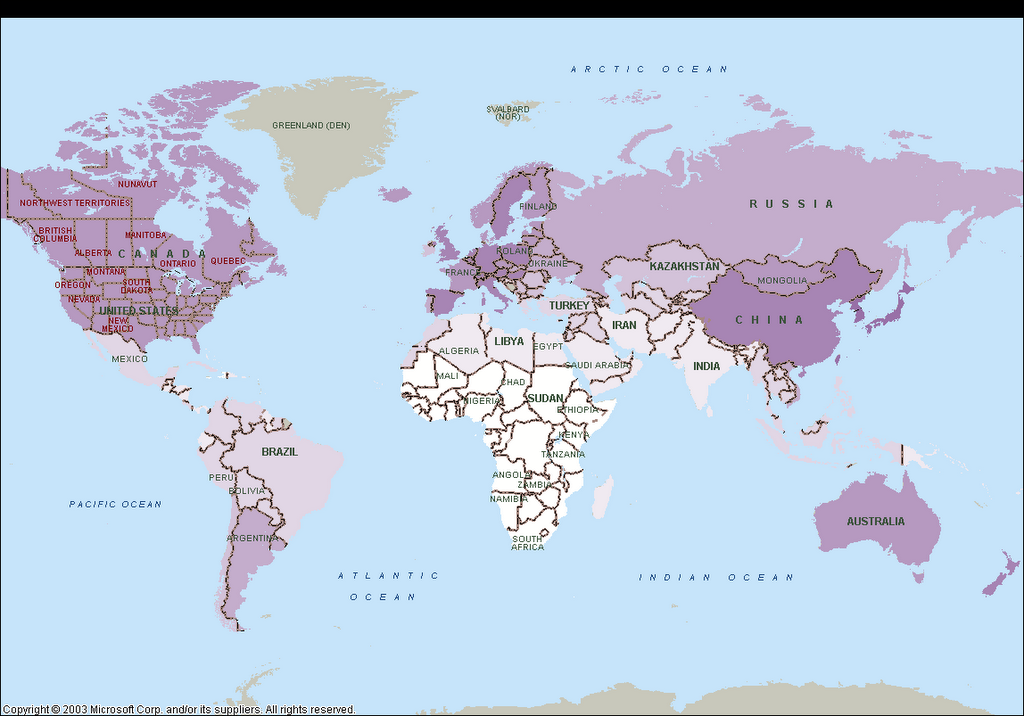
| Hong Kong (PRC) | 107 | Russia | 96 | Fiji | 84 |
| South Korea | 106 | Slovakia | 96 | Iran | 84 |
| Japan | 105 | Uruguay | 96 | Marshall Islands | 84 |
| Taiwan (ROC) | 104 | Portugal | 95 | Puerto Rico (US) | 84 |
| Singapore | 103 | Slovenia | 95 | Egypt | 83 |
| Austria | 102 | Israel | 94 | India | 81 |
| Germany | 102 | Romania | 94 | Ecuador | 80 |
| Italy | 102 | Bulgaria | 93 | Guatemala | 79 |
| Netherlands | 102 | Ireland | 93 | Barbados | 78 |
| Sweden | 101 | Greece | 92 | Nepal | 78 |
| Switzerland | 101 | Malaysia | 92 | Qatar | 78 |
| Belgium | 100 | Thailand | 91 | Zambia | 77 |
| China (PRC) | 100 | Croatia | 90 | Congo-Brazzaville | 73 |
| New Zealand | 100 | Peru | 90 | Uganda | 73 |
| United Kingdom | 100 | Turkey | 90 | Jamaica | 72 |
| Hungary | 99 | Indonesia | 89 | Kenya | 72 |
| Poland | 99 | Suriname | 89 | South Africa | 72 |
| Australia | 98 | Colombia | 89 | Sudan | 72 |
| Denmark | 98 | Brazil | 87 | Tanzania | 72 |
| France | 98 | Iraq | 87 | Ghana | 71 |
| Norway | 98 | Mexico | 87 | Nigeria | 67 |
| United States | 98 | Samoa | 87 | Guinea | 66 |
| Canada | 97 | Tonga | 87 | Zimbabwe | 66 |
| Czech Republic | 97 | Lebanon | 86 | Congo-Kinshasa | 65 |
| Finland | 97 | Philippines | 86 | Sierra Leone | 64 |
| Spain | 97 | Cuba | 85 | Ethiopia | 63 |
| Argentina | 96 | Morocco | 85 | Equatorial Guinea | 59 |
 Here is another fine analysis of the concept of GDP vs. IQ--with the element of free market rules thrown in.
Labels: demographics, IQ, Islam
posted by al fin at 4:46 AM
0 comments
| This is a great prank if your professor has a sense of humour. It's good for a belly laugh or two. No doubt this kind of prank is pulled at madrasas every day. | |
posted by al fin at 11:43 AM
0 comments
| Living la vida loca in the worker's paradise, courtesy of fearless leader. This sounds like Jimmy Carter's idea of the perfect world. No Billy Beer, though. | |
posted by al fin at 1:06 PM
0 comments
 What is a Blog Carnival, you ask? A Blog Carnival is simply a blog posting that brings together in one place links to some of the best recent blog articles on a given topic.
posted by al fin at 9:28 AM
0 comments
 The causes of Arab underdevelopment identified in the report are lack of freedom, marginal participation of women in public life and educational backwardness.Arab people enjoy least freedom compared to any other region in the world — less than even the countries bordering southern Sahara. Civil rights are mostly ignored though they are incorporated in constitutions and legislations in those countries. There are several impediments for the free functioning of the agencies that are supposed to ensure these rights. Arab women get the least opportunity to participate in the economic and political activities compared to any other place in the world. The level of education among Arab women is the lowest in the world. More than 50 percent of them are illiterate. One of the most alarming facts revealed by the report is the backwardness of Arabs in the field of science. The level of education in the region is falling while the per capita spending on scientific research and development is the lowest in the world. In 1996, it was 0.4 percent of the GNP which is one-third of what Cuba spent on scientific research. In 1994, Israel allocated 6.35 percent for the GNP for research programs while in Japan it was 6.9 percent. Naturally, the educational backwardness increases the rate of illiteracy among Arabs. More than 65 million people, which accounts for 43 percent of the Arab population, are illiterate.Source.
Labels: arab dysfunction, demographics, Islam
posted by al fin at 4:52 PM
0 comments
 Arabs are lagging in education, economy, democracy and freedom of expression, and computers. 2003—In Arab countries, with a combined population of 284 million, a “best seller” may have a print run of just 5,000 copies, due to censorship and other constraints on independent publishers. Translations of foreign works into Arabic lag far behind figures in the rest of the world: five times more books are translated yearly into Greek, a language spoken by just 11 million people, than into Arabic. Just 53 newspapers per 1,000 citizens are published daily in the region, compared to 285 papers per 1,000 people in the developed nations, and there are only 18 computers per 1,000 people in the Arab world, as compared to the global average of 78 per 1,000.
 After dismal reports in 2002, 2003, and 2004, the UN HDR appears to have given up on the arab world. Who can blame them? Since World War II, the Arab world has lagged the rest of the planet in economic growth. For example, 300 million Arabs, and all that oil, generate less economic activity than Spain, and its population of 40 million. The main problem has been bad government. Too many dictators, and too much government restrictions on the economy. Too much corruption and waste. Even higher oil prices don't help, as it simply provides more money to be wasted on consumption, rather than business investment.
 "Once people feel there are positive effects from the democratic process, they will want the same. Especially countries like Egypt who felt they were ahead of Iraq but are now lagging behind,” he said. Many arabs must be wondering if it takes an emasculating invasion from abroad and low level civil war to bring democracy to an arab country.
Labels: arab dysfunction, Islam
posted by al fin at 6:34 PM
0 comments
Primary interest is seeing that the best of humanity survives long enough to reach the next level.


