Friday, December 29, 2006

Islam--Is It Only For Countries With Low IQ?

Hong Kong (PRC) 107 Russia 96 Fiji 84
South Korea 106 Slovakia 96 Iran 84
Japan 105 Uruguay 96 Marshall Islands 84
Taiwan (ROC) 104 Portugal 95 Puerto Rico (US) 84
Singapore 103 Slovenia 95 Egypt 83
Austria 102 Israel 94 India 81
Germany 102 Romania 94 Ecuador 80
Italy 102 Bulgaria 93 Guatemala 79
Netherlands 102 Ireland 93 Barbados 78
Sweden 101 Greece 92 Nepal 78
Switzerland 101 Malaysia 92 Qatar 78
Belgium 100 Thailand 91 Zambia 77
China (PRC) 100 Croatia 90 Congo-Brazzaville 73
New Zealand 100 Peru 90 Uganda 73
United Kingdom 100 Turkey 90 Jamaica 72
Hungary 99 Indonesia 89 Kenya 72
Poland 99 Suriname 89 South Africa 72
Australia 98 Colombia 89 Sudan 72
Denmark 98 Brazil 87 Tanzania 72
France 98 Iraq 87 Ghana 71
Norway 98 Mexico 87 Nigeria 67
United States 98 Samoa 87 Guinea 66
Canada 97 Tonga 87 Zimbabwe 66
Czech Republic 97 Lebanon 86 Congo-Kinshasa 65
Finland 97 Philippines 86 Sierra Leone 64
Spain 97 Cuba 85 Ethiopia 63
Argentina 96 Morocco 85 Equatorial Guinea 59


Table courtesy of Wikipedia
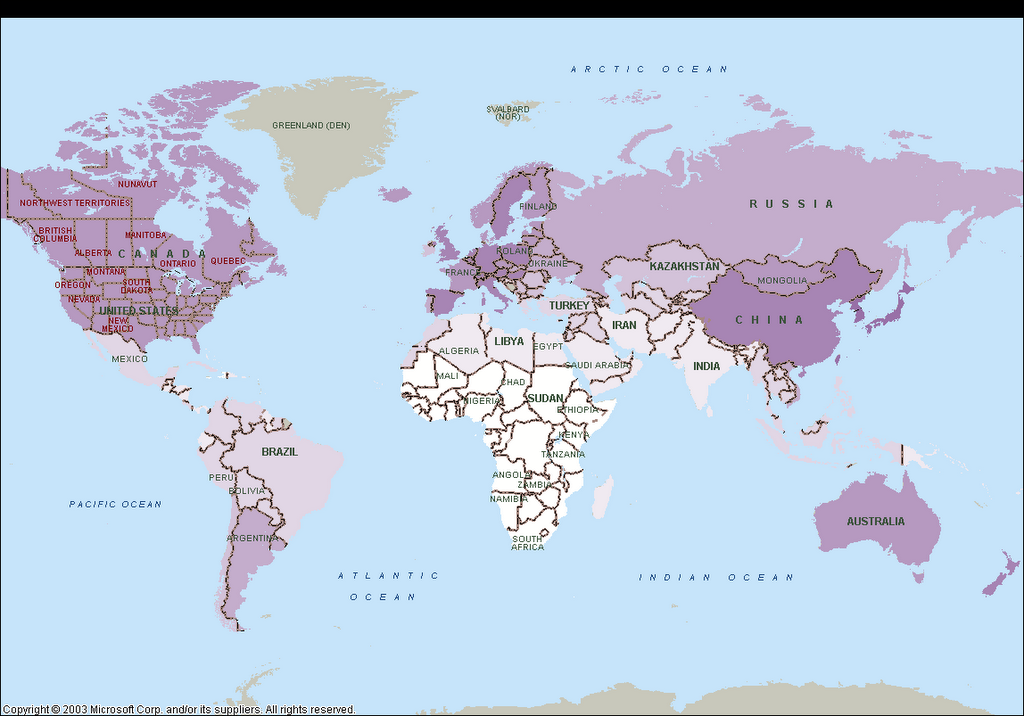
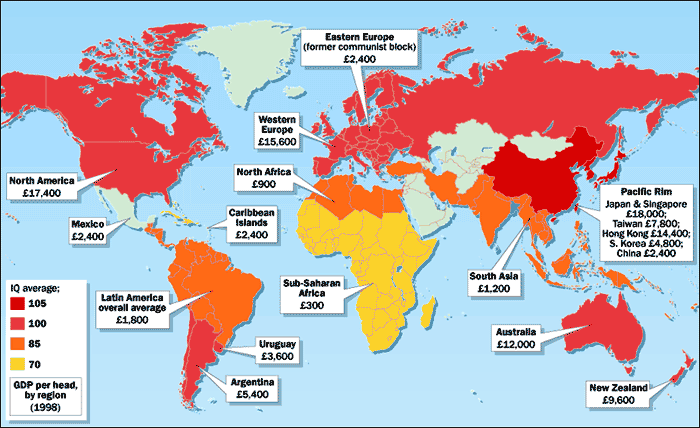
Map courtesy of R. Pongett

The tabular data above comes from Lynn and Vanhanen's IQ and the Wealth of Nations. For a good review of Richard Lynn's more recent and comprehensive Race Differences in Intelligence, look here.
Here is another fine analysis of the concept of GDP vs. IQ--with the element of free market rules thrown in.


Of muslim nations, Malaysia has the highest average IQ, 92. Malaysia's population contains 30% ethnic Chinese. Turkey has the second highest average IQ of muslim nations at 90. All other muslim nations have average IQ's of less than 90--some of them much less.

It is possible that some individual nations are misplaced on the above table, with average IQs either a bit higher or a bit lower than stated. But it is possible to detect trends by looking at different groupings of nations and their average IQ.

Given that population average IQ needs to be at least 90 for a modern technology based nation to function, immigration policy should be oriented toward inviting high value immigrants.

Observing what happened to Zimbabwe's prosperity after Robert Mugabe drove the most prosperous (and presumably most intelligent) farmers from their land, provides a good example of what NOT to do. Idi Amin's actions in Uganda provide another example. Fidel Castro's actions in Cuba provide a third. You don't want to drive out your intelligent and resourceful groups.

Update (26Dec06): Visit this Fourmilab page for a graphic illustration of the change in average global IQ with projected population trends. Accompanying the animated graphic is a thoughtful discussion of some of the issues involved in projecting trends in global intelligence.

Thanks to an Audacious Epigone commenter.

Labels: , ,

Friday, December 22, 2006

Lecture Prank

This is a great prank if your professor has a sense of humour. It's good for a belly laugh or two.

No doubt this kind of prank is pulled at madrasas every day.

Tuesday, December 19, 2006

North Korea report by BBC July 2006

Living la vida loca in the worker's paradise, courtesy of fearless leader. This sounds like Jimmy Carter's idea of the perfect world. No Billy Beer, though.

Saturday, November 25, 2006

My Favourite Carnivals

What is a Blog Carnival, you ask? A Blog Carnival is simply a blog posting that brings together in one place links to some of the best recent blog articles on a given topic.

My Favourite Blog Carnivals are:

Tangled Bank Science Carnival
Encephalon Neurocarnival
Grand Rounds Medical Carnival

Blog Carnivals typically travel from blog to blog, which is an excellent way of getting to know new blogs. Following the carnival links themselves is a fine way to acquaint oneself with new and worthy blogs.

Carnivals come and go. The Carnival of Tomorrow is a fine blog carnival for futurist and singularitarian bloggers that is temporarily in stasis. Al Fin was fortunate to be included in a few COTs during COT's vibrant phase.

Go ahead and look at lists of carnivals here and here. You may very well find carnivals that suit your taste, and that might become your favourites. Or, you may discover a carnival for which you are uniquely suited as a contributor.

Enjoy.

Sunday, November 19, 2006

Arabs--Caught in a Trap of Illiteracy and Primitiveness

The causes of Arab underdevelopment identified in the report are lack of freedom, marginal participation of women in public life and educational backwardness.Arab people enjoy least freedom compared to any other region in the world — less than even the countries bordering southern Sahara. Civil rights are mostly ignored though they are incorporated in constitutions and legislations in those countries. There are several impediments for the free functioning of the agencies that are supposed to ensure these rights. Arab women get the least opportunity to participate in the economic and political activities compared to any other place in the world. The level of education among Arab women is the lowest in the world. More than 50 percent of them are illiterate. One of the most alarming facts revealed by the report is the backwardness of Arabs in the field of science. The level of education in the region is falling while the per capita spending on scientific research and development is the lowest in the world. In 1996, it was 0.4 percent of the GNP which is one-third of what Cuba spent on scientific research. In 1994, Israel allocated 6.35 percent for the GNP for research programs while in Japan it was 6.9 percent. Naturally, the educational backwardness increases the rate of illiteracy among Arabs. More than 65 million people, which accounts for 43 percent of the Arab population, are illiterate.Source.

* Islamists who do not recognize that humanistic ideas can serve as a basis for society. In their view, everything has existed in the past, and is present in the holy text [the Koran]. The present and future are not in our hands, but in the hands of a force that propels us like puppets. According to these Islamists, the proper way to live is to return to the times of our forefathers, in the seventh century, and to adopt the principle of the Shura [the consultative council] of early Islam.

When it is argued that the Shura never convened in the early Islamic era, that its representatives were appointed and not elected, that the idea of a society like that of the forefathers is imaginary with no basis in historical fact... they have no answer except to curse those raising these questions and to accuse them of heresy.

Al-Houni concludes that there is no point in arguing with Islamists so long as the starting points are different. The Islamists consider the past to be the pinnacle of humanity, whereas Al-Houni's starting point is human experience and history as an unending process.
Source.

Arabs seem to be caught in their own traps of illiteracy and primitive modes of thinking. There may be no escape whatsoever. Sadly, the young generation is huge, illiterate, and oddly drawn to violent and irrational strains of Islam. It does not look good for the arab world, and anyone who must deal with it.

Labels: , ,

Sunday, September 24, 2006

What is Wrong With Arabs?

Arabs are lagging in education, economy, democracy and freedom of expression, and computers. 2003—In Arab countries, with a combined population of 284 million, a “best seller” may have a print run of just 5,000 copies, due to censorship and other constraints on independent publishers. Translations of foreign works into Arabic lag far behind figures in the rest of the world: five times more books are translated yearly into Greek, a language spoken by just 11 million people, than into Arabic. Just 53 newspapers per 1,000 citizens are published daily in the region, compared to 285 papers per 1,000 people in the developed nations, and there are only 18 computers per 1,000 people in the Arab world, as compared to the global average of 78 per 1,000.

The first Arab Human Development Report in 2002 was a bombshell dropped onto the entire arab world. The report notes that while oil income has transformed the landscapes of some Arab countries, the region remains "richer than it is developed." Per capita income growth has shrunk in the last 20 years to a level just above that of sub-Saharan Africa. Productivity is declining. Research and development are weak or nonexistent. Science and technology are dormant.

Intellectuals flee a stultifying -- if not repressive -- political and social environment, it says.

Arab women, the report found, are almost universally denied advancement. Half of them still cannot read or write. The maternal mortality rate is double that of Latin America and four times that of East Asia.


The followup report in 2003 showed the situation to be no better. A group of Arab intellectuals issued a report yesterday that found the Arab world lacking in three areas they deemed fundamental to development: freedom of expression, access to knowledge and women's rights.
The group, criticized by Arab officials for a similar report last year, said the challenges caused by the deficiencies "may have become even graver" since 2002.

After dismal reports in 2002, 2003, and 2004, the UN HDR appears to have given up on the arab world. Who can blame them? Since World War II, the Arab world has lagged the rest of the planet in economic growth. For example, 300 million Arabs, and all that oil, generate less economic activity than Spain, and its population of 40 million. The main problem has been bad government. Too many dictators, and too much government restrictions on the economy. Too much corruption and waste. Even higher oil prices don't help, as it simply provides more money to be wasted on consumption, rather than business investment.

An Economist article, titled "Self-Doomed to Failure," captures the pathetic state of the arab world. The barrier to better Arab performance is not a lack of resources, concludes the report, but the lamentable shortage of three essentials: freedom, knowledge and womanpower. Not having enough of these amounts to what the authors call the region's three “deficits”. It is these deficits, they argue, that hold the frustrated Arabs back from reaching their potential—and allow the rest of the world both to despise and to fear a deadly combination of wealth and backwardness.

•Freedom. This deficit, in the UNDP's interpretation, explains many of the fundamental things that are wrong with the Arab world: the survival of absolute autocracies; the holding of bogus elections; confusion between the executive and the judiciary (the report points out the close linguistic link between the two in Arabic); constraints on the media and on civil society; and a patriarchal, intolerant, sometimes suffocating social environment.

The area is rich in all the outward trappings of democracy. Elections are held and human-rights conventions are signed. But the great wave of democratisation that has opened up so much of the world over the past 15 years seems to have left the Arabs untouched. Democracy is occasionally offered, but as a concession, not as a right.


....•Knowledge. “If God were to humiliate a human being,” wrote Imam Ali bin abi Taleb in the sixth century, “He would deny him knowledge.” Although the Arabs spend a higher percentage of GDP on education than any other developing region, it is not, it seems, well spent. The quality of education has deteriorated pitifully, and there is a severe mismatch between the labour market and the education system. Adult illiteracy rates have declined but are still very high: 65m adults are illiterate, almost two-thirds of them women. Some 10m children still have no schooling at all.

One of the gravest results of their poor education is that the Arabs, who once led the world in science, are dropping ever further behind in scientific research and in information technology. Investment in research and development is less than one-seventh of the world average. Only 0.6% of the population uses the Internet, and 1.2% have personal computers.

....•Women's status. The one thing that every outsider knows about the Arab world is that it does not treat its women as full citizens. The report sees this as an awful waste: how can a society prosper when it stifles half its productive potential? After all, even though women's literacy rates have trebled in the past 30 years, one in every two Arab women still can neither read nor write. Their participation in their countries' political and economic life is the lowest in the world.

Governments and societies (and sometimes, as in Kuwait, societies and parliamentarians are more backward than their governments) vary in the degrees of bad treatment they mete out to women. But in nearly all Arab countries, women suffer from unequal citizenship and legal entitlements. The UNDP has a “gender-empowerment measure” which shows the Arabs near the bottom (according to this measure, sub-Saharan Africa ranks even worse). But the UN was able to measure only 14 of the 22 Arab states, since the necessary data were not available in the others. This, as the report says, speaks for itself, reflecting the general lack of concern in the region for women's desire to be allowed to get on.

...With so many paths closed to them, some are now turning their dangerous anger on the western world.


Meanwhile in an ethnically divided Iraq with sectarian divisions, the first tentative steps have been taken toward democracy, as the rest of the arab world looks on with a wary curiousity. A few cautious voices believe that, in time, the Iraqi elections will put pressure on neighboring countries to democratize.

In Cairo, Hisham Qassem, chairman of a human rights organization and chief executive officer of a new Arab daily newspaper, believes that both the Iraqi and Palestinian elections have given impetus to democratic reform.
"Once people feel there are positive effects from the democratic process, they will want the same. Especially countries like Egypt who felt they were ahead of Iraq but are now lagging behind,” he said.
Many arabs must be wondering if it takes an emasculating invasion from abroad and low level civil war to bring democracy to an arab country.

It takes more than democracy to bring the arab world out of the stone age. It will take economic reform. Since Saddam was tossed out in 2003, the economy has been governed by Western rules. As a result, GDP per capita doubled by the end of 2005, and the GDP is expected to grow another 49 percent by 2008. All this despite continued attacks by Sunni Arab rebels on oil facilities and other economic targets. It's much easier to start a business in Iraq now, even though there's still a lot of corruption. The big change is that now the corruption is illegal, and there is even progress in prosecuting the government officials who take bribes or try to shake down businessmen. Lebanon is the only other Arab state to run its economy in a Western fashion, and they have thrived.

It takes education reform and freedom of expression and the press. It will take implementation of full freedoms for women. Finally, it will take religious reform. Stone aged customs, traditions, and religious restrictions virtually guarantee that arabs will remain backward, laggards of the world.

Update: Here is more from a recent UN ILO report. Arabs living in the middle east and north africa are oddly resistant to modernisation and transitioning out of the stone age. Very strange, when you see how successful arabs can be when they migrate to a free environment. I suppose blaming the US and Israel will gain them at least another half century of stone age existence.

Labels: ,

Saturday, September 16, 2006

Nothing to Fear but Stupidity Itself

Oscar Wilde said "there is no sin except stupidity." Voltaire said “The only way to comprehend what mathematicians mean by Infinity is to contemplate the extent of human stupidity." Einstein said, “The difference between genius and stupidity is that genius has its limits.” Source.

Looking at the map above, one can see that poverty and stupidity go together like hand and glove. Some countries have experienced severe poverty for periods of time--postwar Germany, Japan, and South Korea come to mind--then rebound out of poverty with time and outside assistance. Other countries such as Haiti are always impoverished, regardless of external assistance, opportunities, and internal resources. Then there are countries such as Zimbabwe which were once much better off, but now are among the most impoverished nations on earth.

International investors would be happy to take advantage of low worker wages in these perennially impoverished nations, as in Subsaharan Africa or muslim Central Asia, if they could expect a reasonable return on investment. The problems with employing workers in these nations are corruption and graft in dealing with government officials, and political instability--with the ever-present threat of nationalisation of the industry (as occurred recently in Bolivia to the natural gas fields). This type of government behaviour virtually guarantees that investors will stay away.

In addition, there is a shortage of trainable workers. If there are not enough people in the potential workforce intelligent enough to learn the skills and technologies involved in the industry--the situation is hopeless. A technological society requires an average population IQ of at least 90 (with 100 being the internationally standardised mean) to maintain itself. If the population average (mean) IQ is less than 90, all attempts to bring the nation as a whole into the modern technological world, are doomed.

The book IQ and the Wealth of Nations discusses this issue, and makes comparisons of average IQ between different nations. The authors admit that political and economic factors can artificially hold down a nation's wealth, even in the presence of high average IQ. Conversely, in a nation of relatively low average population IQ, an enlightened market economy can raise the nation's wealth above what it would be if the economy were more centrally commanded. Likewise, oppressive and/or unstable political regimes will depress a nation's wealth, even where the population average IQ is average or above.

It is important to optimise nutrition for mothers and children in these countries. But what if after optimising nutrition for mothers and children, significant population IQ average differences remain between nations? If it is clear that the nations are suffering because of lower population IQs, other underlying reasons for the differences should be determined and methods for removing the IQ deficits should be found.

The penalty for doing nothing may be severe.


When one contemplates how easily muslims are led into a frenzy by their clerics, one is forced to contemplate the relationship of stupidity with fanaticism.

Labels:

Tuesday, September 12, 2006

Florida County Discovers Perpetual Motion Machine!

The county government of St. Lucie County in Florida, has decided to build a US $425 million facility that will run on the energy produced on site, plus produce twice as much electricity as is consumed--and sell large quantities of steam and solids as lucrative byproducts. Where did this Florida county find such an energy gold mine? In its landfills.

The $425 million facility expected to be built in St. Lucie County will use lightning-like plasma arcs to turn trash into gas and rock-like material. It will be the first such plant in the nation operating on such a massive scale and the largest in the world.

Supporters say the process is cleaner than traditional trash incineration, though skeptics question whether the technology can meet the lofty expectations.

The 100,000-square-foot plant, slated to be operational in two years, is expected to vaporize 3,000 tons of garbage a day. County officials estimate their entire landfill - 4.3 million tons of trash collected since 1978 - will be gone in 18 years.

No byproduct will go unused, according to Geoplasma, the Atlanta-based company building and paying for the plant.

Synthetic, combustible gas produced in the process will be used to run turbines to create about 120 megawatts of electricity that will be sold back to the grid. The facility will operate on about a third of the power it generates, free from outside electricity.

About 80,000 pounds of steam per day will be sold to a neighboring Tropicana Products Inc. facility to power the juice plant's turbines.

Sludge from the county's wastewater treatment plant will be vaporized, and a material created from melted organic matter - up to 600 tons a day - will be hardened into slag, and sold for use in road and construction projects.

"This is sustainability in its truest and finest form," said Hilburn Hillestad, president of Geoplasma, a subsidiary of Jacoby Development Inc.
Source.

This Peswiki page provides more details and links for exploring and evaluating this intriguing concept. It requires a great deal of energy to create such a very hot environment, but apparently once you reach this level of energy, you can harvest twice as much energy as you use in the first place. Very interesting.

Here is a Free Energy News directory of Waste to Energy projects all over the world. This idea is likely to spread to more regional governments, as the economic benefits of turning a liability into a source of profic sinks in.

Friday, September 08, 2006

Nuclear Jihad Heats Fallout Shelter Market


Welcome to the world of nuclear hyper-proliferation--where nuclear war is a virtual inevitability, sometime. This time the nuclear threat will not be the Soviet Union, whose leaders wished to live every bit as much as the leaders of the free world. This time there will be no deterrence. The weapons, once acquired, will be used. So---what colour is your fallout shelter? Here is more speculation on a possible nuclear threat from Stanley Kurtz:

Once Iran gets the bomb, Turkey and Saudi Arabia are likely to develop their own nuclear weapons, for self-protection, and so as not to allow Iran to take de facto cultural-political control of the Muslim world. (I think you’ve got to at least add Egypt to this list.) With three, four, or more nuclear states in the Muslim Middle East, what becomes of deterrence?

A key to deterrence during the Cold War was our ability to know who had hit whom. With a small number of geographically separated nuclear states, and with the big opponents training satellites and specialized advance-guard radar emplacements on each other, it was relatively easy to know where a missile had come from. But what if a nuclear missile is launched at the United States from somewhere in a fully nuclearized Middle East, in the middle of a war in which, say, Saudi Arabia and Iran are already lobbing conventional missiles at one another? Would we know who had attacked us? Could we actually drop a retaliatory nuclear bomb on someone without being absolutely certain? And as Rosen asks, What if the nuclear blow was delivered against us by an airplane or a cruise missile? It might be almost impossible to trace the attack back to its source with certainty, especially in the midst of an ongoing conventional conflict.


We’re familiar with the horror scenario of a Muslim state passing a nuclear bomb to terrorists for use against an American city. But imagine the same scenario in a multi-polar Muslim nuclear world. With several Muslim countries in possession of the bomb, it would be extremely difficult to trace the state source of a nuclear terror strike. In fact, this very difficulty would encourage states (or ill-controlled elements within nuclear states — like Pakistan’s intelligence services or Iran’s Revolutionary Guards) to pass nukes to terrorists. The tougher it is to trace the source of a weapon, the easier it is to give the weapon away. In short, nuclear proliferation to multiple Muslim states greatly increases the chances of a nuclear terror strike.

Source.

In the 1950s and early 1960s, worrying about nuclear war was said to be quite common. Students were shown films in school of what to do in the case of a nuclear strike. Thinking and talking about installing a fallout shelter was not seen as extreme in certain locations of North America. Then came detente, and fears of nuclear war subsided significantly. After detente, only extreme survivalists were still talking seriously about fallout and survival shelters.

That was then, this is now. Now there is an end-of-the-world disaster to suit every taste and political/religious persuasion. You say you are an extreme leftist to the point of moonbattery? No problem. Global warming and peak oil are sure to destroy the world economy, triggering wars of survival that will certainly escalate to nuclear exchanges. You had better get your fallout shelter. You say you are an anti-Bush democrat? Better yet. You know that Bush ordered the strike on the WTC towers in NYC, but that only got him so far. Now he needs something more potent. What better than a nuclear strike on a large city in a predominantly Democratic Party controlled area? We take cash or credit cards. But, you say, you are really a religious right wingnut? Excellent! The muslim fanatics will not rest until you are forced into converting to Islam, taken into slavery, or killed. If you refuse, they will simply nuke your cities until you are all dead. Better order your shelter today!

Here is one place to get your shelter, conveniently named bomb-shelter.net. Here is another site for more information. This site provides information about a large group shelter within easy driving distance of Toronto. Here is Wikipedia's Fallout Shelter page. Here is yet another information packed source for the truly anxious.

What cities are likely to be hit? New York City, Washington D.C., and Los Angeles are almost certain to be targets eventually. Several others come to mind, but it is not my wish to trigger a stampede. :-)

I should mention that fallout shelters are not just for nuclear attacks. If you install one that is big enough, you can hold quite a party, and as long as the shelter is buried underground, your neighbors should not complain about anything except perhaps all the cars.

One thing is very likely. If there is a nuclear attack by muslim extremists, it is likely to be an attempt on several cities simultaneously. That means that it will be no small disaster like Hurricane Katrina, and any local city/county/state government that is as incompetent as the Nagin/Blanco team will be out of luck. With federal resources demanded by several sites--all with at least tens of thousands of casualties--there will be no world wide media obsession with one crime-ridden waterlogged city. Every city and country in the entire world will be worried about their own sorry backsides if it ever comes to that point, because all bets will be off.

Labels: , ,

Tuesday, August 01, 2006

Climate Science--More Interesting, and Diverse, Than You Thought

Too often, climate modeling approximates the scientific accuracy of a voodoo priestess throwing "dem bones." When mathematical models are based upon poor proxy data, and sloppy, incomplete models, the famous rule of "GIGO" takes center stage.

Fortunately, two things are occurring to improve the validity of the infant science of climatology. First, better satellite observations are able to take account of the aerosol and water vapour effect, and the heat island effect of urban centers. Second, more climate scientists are slowly coming out of the woodwork to contest the erroneous image of consensus in approaches and axioms in climate science.

The more exhaust we spew, the more temperatures will go up. But when you get into the details, as Chylek is quick to tell you, you find that climate science is not a monolith:

Could changes in the sun be responsible for some of the warming?

While scientists obsess over greenhouse gases, are they missing other things that could be having equally large effects on the climate?

Are the thermometer records that show warming as good as scientists think they are?

Contrary to the common perception of textbooks filled with fixedknowledge, real science is a tangled process fraught with uncertainties, and such debates are common in any field.

“Science,” said Texas A&M climate scientist Andrew Dessler, “is this turbulent interface between what we know and what we don’t know.”

But if all science is turbulent, then climate science, because of its political dimensions, is all the more so.

Chylek placed that turbulence center stage last week, inviting more than a hundred scientists from around the world to Santa Fe for the 2nd International Conference on Global Warming, to discuss what scientists know and don’t know about our changing climate.

.... The range of views held by working climate scientists does not show up in the political version of the debate, according to Roger Pielke Jr., a University of Colorado political scientist who studies the politics of climate science.

The science becomes caricatured, according to Pielke, dichotomized into “skeptics versus alarmists … even though it does not do justice
to the complexities of the science debate.”

....Pielke Sr. thinks greenhouse gases are not the whole story. Massive human land-use changes? wholesale shifts from forest to agriculture, for example? are also important but are being given short shrift because of the emphasis on greenhouse gases.

Pielke Sr. also thinks global temperature data, the backbone of global warming claims, are fraught with uncertainties. And he is skeptical of the computer climate simulations used to forecast future climate change.

All of those legitimate scientific questions are lost in the simplified black-and-white version of climate science that shows up in
public discourse, Pielke Sr. believes.
More at source.

Up until now, climate science has lacked the data to adequately take into account aerosols, water vapour in the atmosphere, and the urban heat island effect--not to mention land use changes and solar variation. Better earth monitoring satellite and solar astronomic data over the next ten years should improve that facility.

The IPCC also misrepresents what a "doubling" of CO2 would mean in climate terms, given the logarithmic nature of the thermal response involved. Showing a layperson curves for exponential and logarithmic curves and explaining the difference would be more honest than the approach the IPCC has taken up until now.

Global warming is far more complex than the media and the political hucksters portray it. It is in the interest of the media to portray climate change as a human caused catastrophe. The story sells better if you can portray a story as devastating, and have someone real to blame. Concocting a faux consensus only helps in convincing the reader that he knows more about the topic than he actually does.

It is a good thing for climatology to grow out of its infancy and adopt better tools.

Thursday, July 27, 2006

Creating Obsolete Kids--Education with Incompetence in MInd

Q and O blog points to a NY Daily News article by Sol Stern about new "social justice" curriculum in middle schools.

The root of the problem is "social justice" education. It starts in teacher preparation programs, where rigorous training in math, science and literacy takes a backseat to theories about victimization and inequality. Teachers-to-be are told that conventional instruction is an outgrowth of capitalist oppression; "true" education helps students see the unfairness all around them and challenge society to change.

But it doesn't stop there. Far too many New York City public schools - including some of the new small schools created by Chancellor Joel Klein and funded with money from the Bill and Melinda Gates Foundation - distort education by imbuing social justice into everything they do.
Source.

Q and O then goes on to comment on the phenomenon of political indoctrination of children into dysfunctional ideologies:

There's a propensity among educators to reinvent education every decade or so. I'm not sure why except each decade a new generation of educators are in the position to make changes and feel compelled to do so. There has also been a movement away from what previously worked - in terms of providing a student with the basic tools needed to be literate as well as assimilate into our civic culture - and more toward exactly what Stern notes. I don't know a thing about these three schools except what Stern writes, but in each, I don't see much of a focus on education, or at least not what I consider education. It's almost like the cart is before the horse. What good is an understanding of activism and "social justice" if you can't read the poster announcing the next peace rally?

Again this seems a logical outgrowth of the multiculturalism movement who's basic premise is the need for "social justice". But probably a larger and more important need than hearing one side of the social justice story is that of getting a good basic education. The school day is a finite amount of hours. The more "social justice" finds its way into the curriculum, the less time there is for math, science, reading, literature, writing and other core subjects necessary to enable someone to maneuver successfully in this society.
Source.

Of course this type of indoctrination into dysfunctionality began in the universities, but it has wasted little time working its way down the ladder to high schools and middle schools. It is clear that people who are indoctrinated in the "social justice" ideologies are less able to reason effectively in the real world. This method of inculcating incompetence into children has a delayed effect on society, but the effect is real--generations can be lost, and social stratification becomes ever worse.

Of course if dysfunctional education creates a large enough underclass, it will be possible to elect leaders such as Hugo Chavez as president of the US, or prime minister of Canada. Imagine when the wealthiest and most powerful nations on earth become third world dictatorships like Venezuela. To quote the wicked witch, "what a world, what a world!"

Labels: , , ,

Friday, July 21, 2006

Stunted Growth: Perpetual Incompetence


Here is where the modern trend is taking us: as soon as parents take a newborn home from the hospital, they sign it up for infant-school. From the start, parents drop the infant off at school in the morning and pick it up in the evening, being careful to check its diapers. From birth on, school continues uninterrupted for the little tyke as it progresses through toddler stage, on into traditional K-12 schooling. The high school graduate progresses directly into university, achieving its undergraduate degree (of little value on its own), and progressing to graduate school.

Graduate school can never take too long, so it will be extended over several decades until retirement age. The late middle-aged student will now graduate from school, so as to go directly on retirement pension. Longer lifespans will carry the retiree on for two or three decades of well-pensioned retirement, before mandated euthanasia--to make way for newer generations.

Lifelong students, without any of the unwelcome requirement for employment or risk of running a business. There will be plenty of breaks and vacations to exotic places, as part of the extended curriculum. But no working will be allowed. Society cannot risk allowing these perpetual students cum retirees to shoulder any real responsibility, since nothing in their backgrounds will have prepared them for it.

Immigrants will do whatever work machines cannot do. Immigrants will drive the students to school through K12 and throughout graduate school, until retirement. Then immigrants will drive retirees between places of interest and their retirement homes. All police departments, fire departments, maintenance and custodial services etc. will be staffed by immigrants.

Whenever the immigrants decide to assimilate, they will step into the student/retiree matriculation as well. Students will form unions and agitate for shorter school weeks, and earlier retirement. That is to be expected, and society will do what is necessary to placate the students, since they will be the largest voting block within society.

All military service will be forbidden, since the military is seen as competition for the educational establishment. Any need for military action will be fulfilled by international troops unter international governmental control. Citizens of North America will not need to dirty their hands with that sort of thing. Likewise, religions will be forbidden, as "confusing and unnecessary intrusions into belief systems" that the education department should control.

All students will receive a stipend, which will help pay local and federal taxes to cover immigrant's salaries, as well as international government taxes. All goods and services will be available at the school store, free of charge to students. Students will live in school housing, provided free of charge. Bussing to and from classes is also free. The few married students will be housed separately, close to infant school.

All television, internet sites, magazines and newspapers, will be run by the Education Department, with content carefully selected so as to increase a student's self esteem and willingness to conform to the common good. All medical and dental services will be provided to students and retirees free of charge by immigrant doctors, nurses, dentists, hygienists and assistants.

I have glossed over how the economic system of this brave neotenous society will work. More on that later.

Labels: , , ,

Sunday, July 09, 2006

Being Part of Your Own Generation: Making it Up as You Go

Recent comments from Turtlekill have stimulated me to consider alternative ways in which a person might wish to order his/her life. Both men and women are being shortchanged by current societal expectations.

For women, some evidence suggests that having children at an early age (in her twenties) produces health benefits for both mother and child. But all health concerns aside, is it possible that there is something inherent in the process of raising a very young child that teaches something to a parent that cannot be easily learned any other way? Is it possible that child-raising itself offers benefits to the mother (primarily), that will stand her in good stead in the course of her later career?

I suggest that this is the case, that watching and aiding the physical and mental development of a very small child provides a learning experience that is very profound and very valuable. Such an experience is also frequently very rewarding emotionally, and frequently not regarded as a sacrifice.

A woman trained in human nature by very young professors-in-diapers, can be a formidable judge of character indeed. Often what seems to be missing in trial judges in courts of law, entrepreneurs, and rising executives in enterprise, is that very character judgement. Yet so often professors of feminism discourage young women from having children early, and disparage and criticise women who make such a choice for early child rearing. Perhaps they lack good judgement themselves?

Young men are also putting off marriage and child-rearing later and later in their lives. ( Why should they buy the cow when they can get the milk for free, so to speak?) It is not only the mother who learns from the young child. If the father will pay attention and attend to the child himself, he could also learn a great deal about human nature, and also gain an emotional reward.

Education

It is expected that children of college educated parents will also go to college, and beyond. In fact, it is desired, "societally", that most youth should graduate from high school and go on to graduate from college. But is that the best plan for the youth, and for "society?"

With the internet (and before that with public libraries), virtually everyone can have the knowledge base and erudition of the college educated, regardless of their formal educational attainment--as long as they can read and learn to operate a computer. With faster connection speeds and more advanced interfaces, virtually any type of knowledge or skill will be available over the net.

The lack of a college degree did not keep some of the most famous billionaires and tycoons from achieving their wealth. In a large part of the world, it is still a person's capacity to achieve that counts, rather than the degrees behind the name. Children and youth need to learn real world skills, and problem-solving skills well enough that they acquire justified confidence in their ability to make their way in the world. A college degree is no substitute for confidence based upon achievement.

Unfortunately, the educational system in the west is devised to deny children and youth the opportunity to achieve anything meaningful. This is because the people who devise and revise the educational system do not have real-world skills themselves, so fail to see any value in them. Educated idiots, is the cruel but accurate description for a large proportion of university professors and professors of education. How are these educated idiots going to help students to acquire necessary skills that the idiots do not even recognise as important?

University of Minnesota scholars Harkins and Moravec have put forward a bold plan for making universities relevant again. Their Leapfrog University proposal is a hopeful and reasonable approach to making universities a fertile bed for growing solutions to societies problems.

But not everyone, not even most, perhaps, should go to university. A university education is no guarantee of success or competence. The more society tries to force everyone to get a college degree, the less value the certificate seems to have. Then you need a masters, a doctorate, a post-doc, a post-post-doctoral fellowship, and so on, to distinguish yourself academically.

But in the real world, it is competence that counts. Competence and confidence that is based upon competence. One alternative to college for young men (and recently for young women) has always been military service. Many young people go into the military uncertain and unskilled, and come out with job competencies that in civilian life might have taken much longer to acquire.

In an opportunity society, it is entrepreneurs and independent businesspeople who have the greatest potential for economic growth. In the independent business world, you do not generally need a degree if you have the competence. This is more true in the trades, in businesses that service the large businesses, and in new pioneer industries, where rigour mortis has not set in, as it has in the professions.

An intelligent high school dropout can still apprentice in a trade, learn the business, then strike out on his/her own. If able to out-compete, the dropout can grow a new business to an impressive size, and either cash it in or move to a supervisory and planning role and live on the proceeds. Not bad for a dropout. Better to have the degree, perhaps, but there are ways to compensate if people are open to them.

How many people have internalised the attitude of "failure" or "loser" because of the limited and overly critical attitude of many in society toward educational and professional achievement? How many of these go on to become failures, losers, drunks, junkies, etc. because of this subconscious internalisation of society's attitudes? What might they have contributed if they had been given all their options when they were young?

But how could they, when there is such prejudice against alternative orderings of one's life? When their teachers themselves serve merely as conformist enforcers for the larger society?

These are very interesting things to consider. Do not for a moment believe that this blog has seen the last of speculations on this topic.
:-)

Labels: ,

Friday, June 23, 2006

Leapfrog University--Higher Education for the Next Level

Higher education in North America is badly in need of an overhaul. The modern world is crying for solutions from our brightest minds, yet universities are spending more time indoctrinating students in political correctness and politically biased anti-western multiculturalism, than in teaching students to learn, solve problems, and face the world as it is.

At the University of Minnesota, scholars Arthur Harkins and John Moravec are proposing just such an overhaul. Here is the most recent version of the "Building a Leapfrog University" memo v 4.0:

In this memorandum, our focus is placed on the undergraduate education required to produce knowledge and direct it toward continuous innovation. We call for an entirely new undergraduate education mission –one that requires a different vocabulary and mindset compared to the now globally-distributed education missions for agricultural, industrial, and information-based societies. We believe that reforming undergraduate education to lead the competition in knowledge production and innovation is accomplishable; that it is appropriate, harmonizes with workforce needs, and better prepares students for post-graduate work.

....Knowledge production results from the conversion of information to actionable form. Routine knowledge production at the undergraduate level would constitute a major paradigm change for tertiary education and would constitute the backbone of a world-leading Leapfrog University.

We contend that creative knowledge production by youth is essential for societies planning to compete and collaborate successfully in the global economy. Knowledge production results from the transformation of information into formats suitable for actionable decision making. We believe that undergraduates who learn to participate in knowledge production can help catalyze a shift from curriculum consumption and mass education to knowledge production, meaningful personalized education, and innovation.

Below, we define six types of creative knowledge production which we assert are critical to successful participation in the work and civic forces of the 21st Century. The six types of knowledge production, driven by constructivist theory and supported by continuously available advanced technology, are:

* Mode 1: rigorously developed scientific and scholarly knowledge;
* Mode 2: rigorous, collaboratively developed knowledge that is intended for highly practical applications;
* Mode 3: subjectively developed knowledge intended for personal applications;
* Mode 4: experientially developed knowledge that defines the capabilities and limitations of human contexts, including cultures;
* Mode 5: machine developed knowledge beginning to emerge from expert systems and very early artificial intelligence;
* Mode 6: integrative and chaordic knowledge that fosters the most effective uses of knowledge Modes 1-5.

While only the first two of the six modes of knowledge production are routinely employed in undergraduate education, the full range of modes offers students many opportunities to demonstrate the goodness of fit between their studies, their lives, and the demands of everyday life in an innovative global economy where knowledge production is increasingly socially distributed.

In order to avoid the perpetual game of “catching-up,” we offer nine quite different archetypal undergraduate development futures. These types permit institutions to strategically place themselves within or beyond the confines of historical practice.

All nine of these archetypes may choose to employ the six modes of knowledge production and utilization in different, market-centered ways. Every such choice can readily manifest the characteristics of Leapfrog University by helping to create variety, new strategic alternatives, and new innovation potentials.

1. Genius-Centered Future (Individuality Product). Focus on uniqueness development creates graduates capable of functioning as articulate, proactive individualists, in other words as human intellectual leaders.
2. Think Tank Future (Knowledge Worker Product). Students invent most of their own education experiences, evolving graduates capable of joining the workforce as full-fledged knowledge workers bent on innovation.
3. Development Teams Future (Collaborator Product). An business opportunity focus creates graduates who have worked in teams to produce patented or copyright materials, have started companies or non-profits, and have joined or created professional societies appropriate for their interests.
4. Student Services-Based Future (Student Culture Product). Students are matured within a culture nurtured by redefined and upgraded student services. Graduates leave college able to work well with as creative assistants in similar programs.
5. Global/International Learning Future (Globalized Individuality Product). This holistic approach creates students who can work within existing and emerging global cultures. The students utilize language translation devices and in-country experiences within local/global systems development models.
6. Old Economy Personnel Development Future (Student Employee Product). A talent/interest development approach permits business and industry the opportunity to locate potential star employees earlier in life. Chosen students are financially supported throughout college while acting as apprentices.
7. Home College Future (Family Culture Product). The domestic venue permits wide age-range access to services, including co-generated curriculum choices, domestic experiential learning options, campus- and age-independent services, and assistance from learning consultants.
8. Experiential Innovation Future (Context Worker Development Product). Students are selected for their capacity to integrate knowledge products. Their education is experiential in advanced design and innovation contexts. They may be paid to engage in tertiary education, and/or they are charged nothing on their loans while in school (e.g., Tony Blair’s recent student loan plan).
9. Chaordic Systems Future (Chaordic Systems Design and Management Product). Students are selected for their capacity to work in the phase-shifting contexts of uncertainty, unpredictability, and limitless diversity. They are provided the latest in simulation software, including advanced games, to hone their skills at coping with chaordia. Students are helped to develop the skills to work primarily in virtual space and time through simulations, games, and prototypes.


We believe that the above-mentioned nine scenarios allow for innovation based on the continuous rejuvenation of knowledge resources based on attention to the creative, inventive, and innovative individual. Even the several more traditional approaches require applications of innovative social capital to help them survive and evolve. We contend that, in particular, the production of Mode 3 knowledge offers stakeholders very appealing returns on investment in tertiary education, since most innovation begins in the mind of the creative individual. We also heavily favor Mode 4 knowledge production, or the creation of appropriate contexts or cultures to help students competitively leverage their futures.

Required: A New Emphasis on Undergraduates as Creatives

The Leapfrog University will invariably need to rethink its approach to undergraduate education to develop and cultivate the creative potential of its students. To this end, University leaders need to address several questions:

* How can the University vastly expand its impact on undergraduates and vice-versa?
* How do undergraduates routinely produce tacit and explicit knowledge, and then employ it innovatively?
* Can the University move to create expectations of innovative leadership among its undergraduate students?
* How can this daily expression of personal capital growth become part of expected services delivered by the University?
* How can the University expand both personal capital and social capital, in part by making the substance of each more individualized and purposively developmental?
* Can the University of Minnesota shift from industrial/information-age models of human capital preparation to knowledge/innovation models?
* Can the University seriously focus on recognizing and developing the uniqueness and variety of undergraduates through technology-supported, individualized learning services?
* Can the University focus more on student innovations as opposed to context-free testing and rigidly constrained paper topics?
* Can the University become more experiential and experimental as it moves toward knowledge based, innovation-supportive learning services?
* Can the University support development of the innovative individual through lifelong subscription services?
* Can the University provide new subscription networking for its alumni, productively linking them to one another and to undergraduate students?
....
Much more in the original memo.

Changing the university from an indoctrination center to an institution that helps students learn to create solutions to society's current and future problems, is a daunting task. Current politically correct thought police and multicultural nutzis will fight this effort tooth and nail. But it is becoming clearer that PC multiculturalist indoctrination is merely making the west more vulnerable to conquest from the outside. What is needed is more problem solvers, not more internal saboteurs bent on destroying the only halfway enlightened human civilisation planet earth has ever produced.

Leapfrog University may actually succeed in Minnesota, or it might be sabotaged by the reactionary establishment. Either way, it is a courageous attempt to outline what is needed from moder universities. It is important for others to build on these ideas, to actually create the generative educational system that the western world has needed for several decades.

The modern university is actually a throwback to the middle ages--particularly given the indoctrinating nature of the increasingly oppressive mindset of university faculties and administrations. Insuring that students escape that indoctrination is truly one of the chief hopes for western civlisation.

Labels: ,

Friday, June 16, 2006

Crime and Diversity--Joined at the Hip?

________ Lifetime Likelihood of Incarceration by Race and Gender, US, in 2001.

Crime rates vary from one country to another, even from one region within a country to another. There are many reasons for why crime rates might be higher in one area. One variable shown by research to correlate with high crime is high diversity. In Europe, rates of crime and imprisonment for muslim immigrants from third world countries are high, and increasing rapidly.

There is an observed correlation between race and crime in several countries. Steve Sailer relates a fascinating anecdote of an encounter with a Russian emigrant:

A Russian immigrant called me up once to ask why almost no other American journalist ever mentioned the racial patterns he had seen with his own eyes everyday since he'd come to America. When I explained that the average writer was just lying, he replied:

Vladimir (audibly relieved): "You mean, he's hypocrite?"

Me: "Yeah, exactly. It would hurt his career to write for the public what he thinks in his private life."

Vladimir: "Thank God!"

Me: "Huh?"

Vladimir: "Hypocrite I understand. I grow up in Soviet Union. Lying to save your job, that's life. No, I was very worried smart people in America weren't hypocrites. You know, this country is supposed to be land of free, home of brave. I was scared that smart Americans weren't hypocrites, but instead were hallucinating. I am very happy to hear they're just hypocrites. Hypocrisy much less scary than mass hallucination."

Indeed.

....In crime statistics, Hispanics are often lumped in with non-Hispanic whites. This has the effect of narrowing the gap between the black and white crime rates by inflating the white rate. It also obscures the relatively high rate of Hispanic crime.

Bureaucrats are normally very scrupulous about breaking out data by Hispanic ethnicity. It’s impossible to avoid the conclusion that this is done to make diversity in general, and current immigration in particular, look better.

Fortunately, a liberal activist group called the National Center on Institutions and Alternatives crunched state-level data for a 2001 report that managed to break out the number of Hispanic prisoners in most states. The data is from 1997, but it appears to be the best we have.
Source.

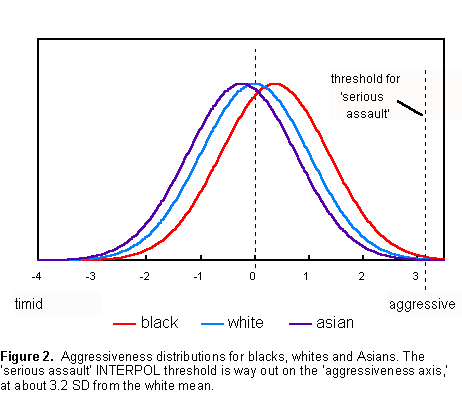
There is much more at the source above, including valuable links to statistics sources, and good statistical maps for visual learning.La Griffe Du Lion has an interesting post on aggressiveness and race. It also contains interesting graphs along with informative links.

This US Department of Justice site provides graphs of crime by race, for both victims and offenders. Unfortunately, as Steve Sailer remarked above, the "white" and "hispanic" statistics are conflated, making a valid stratification by ethnicity virtually impossible.

Why does increasing diversity bring increased crime rates? Such increased crime rates do not seem to happen when the newcomers are east asian. It is conceivable that IQ is at least part of the answer. Cultural factors can also clearly play a part. In the case of muslim immigrants, the religious factor is often prominent in increased crime by muslims in Europe.

This is a phenomenon that demands to be studied and understood. What are the chances that governments of North America and Europe will devote resources to seriously studying the association of diversity with increased crime? Virtually zero. Why? It has a lot to do with the cults of political correctness and multiculturalism that have taken over universities, the mass media, and many of the governments of the western world.

Labels: , ,

Sunday, June 11, 2006

Al Gore Issues Fatwa Against Colorado Climatologists


Once again, Al Fin has penetrated the protective shield of climate police that surrounds US Presidential Candidate and Climate Empresario Al Gore, in order to obtain another special interview. This time, Al Gore is furious over a Denver Post article that quotes Colorado climatologists Bill Gray and Roger Pielke Sr.

AF: Thank you for speaking with me today, Mr. Gore. I understand that you have issued a climate fatwa against two climate scientists from Colorado. Can you give more details for my readers?

Gore: Say, haven't I seen you somewhere before?

AF: Uh, no sir, I do not believe so. Would you mind commenting on this climate fatwa you recently issued?

Gore: Okay, but you sure do remind me of somebody . . . anyway, I read about these two jerks in the Denver Post. Gray and Spelke, or something like that. They're using words like "hoax" and "hysteria" to describe global warming. I was forced to respond.

AF: Yes. Well, in that article you mention, It says:

Both Gray and Pielke say there are many younger scientists who voice their concerns about global warming hysteria privately but would never jeopardize their careers by speaking up.

"Plenty of young people tell me they don't believe it," he [Gray] says. "But they won't touch this at all. If they're smart, they'll say: 'I'm going to let this run its course.' It's a sort of mild McCarthyism. I just believe in telling the truth the best I can. I was brought up that way."


Gore: Why that goldarned infidel--I mean, that wingnut religious right partisan! I was right to issue that fatwa!

AF: But sir, should not scientists have the freedom to express their opinions on their subject of expertise?

Gore: Not if it's in my area of political control they don't! Son, the more I think about it, the more you remind me of a smartass blogger that interviewed me about my film.

AF: Well, um, I do look like a lot of people. I am told that a lot. . . .

Gore: Son, are you of the body?

AF: (suddenly notices the climate police closing in) Mr. Gore, thank you very much for your time. It has been enlightening. (steps through a door into a stairwell just a few steps ahead of the CP)

Gore: (to the nearest CP) Go get that sunuvabich and take him to Landru immediately!

Sunday, June 04, 2006

Public School Believers Send Children to Private School

A recent San Francisco Chronicle series reported on the K12 educational scene on the peninsula. This article out of the series discussed the agony of parents feeling forced against their will to send their own children to private schools. Oh the humanity. (/droll)

Mark Lauden Crosley describes himself as a "passionate believer" in public education.

The 54-year-old homeowner in San Francisco's Castro district believes it's critical that children of all socioeconomic and racial backgrounds be educated together. The software designer said he has never voted against any education measure in his life.

But, he said, he believes that even the city's best public schools are overcrowded and underfunded. And despite his belief in the importance of public education, he must do what's best for his three daughters -- so he sends them to private schools.

"There's very little in life that's as important to me as my kids' education. It's a sacrifice you make, and it pays off," he said, noting he nonetheless has nagging concerns that his daughters aren't experiencing diversity in their classrooms. "I don't want my kids in an elite, privileged environment where they don't spend time with people who are different from them. ... But that's the reality, and it bothers me."

His twin eighth-graders, Andrea and Danica, go to Katherine Delmar Burke School near Lincoln Park. He sends sophomore Elinor to the Urban School of San Francisco in the Haight.

Crosley and his wife, Claudia Stern, a financial consultant, get some tuition assistance to cover the total bill of about $70,000 a year. But they still must funnel all of their discretionary income into education -- so no fancy vacations, few movie nights, and no dinners out. Despite the belt-tightening, they're convinced they've made the right choice.

Crosley isn't alone in feeling uncomfortable about private schools while choosing them anyway. In San Francisco, families choose private and religious schools in higher proportion than in any other major city in the country.

Last year, 29.3 percent of the city's school-age population went to private or religious schools. About 10 percent of children nationwide and 8.7 percent of those in California attend private or parochial schools. Marin County has the second-highest rate in the state at 18.7 percent, followed by San Mateo at 15.4 percent and Napa at 13.4 percent.

San Francisco families had 107 private and parochial schools to choose from last year, about the same number as public ones. But those choices have narrowed since about 20 years ago, when there were 144 private and religious schools in the city.

Both private and public schools in San Francisco have seen declining enrollment over the past decades. Since 1982, private and religious schools have lost 10 percent of their enrollment, and public schools have lost 5.5 percent. In 1982, San Francisco private schools enrolled 27,190 students; last year, they enrolled 24,398 students.

....Families cite a variety of reasons for going the private-school route. Some say they resent that the school district's lottery system does not guarantee them the right to attend the public school of their choice, especially one in their own neighborhood. (The vast majority of families do get one of their top seven public school choices.)

Other families choose private schools because they want a particular program or feature -- such as an emphasis on French or Mandarin, a religious focus or single-sex education. Others say their children will simply receive a better education in private schools, featuring smaller classes, more resources and more attention for their children as opposed to public school teachers having to focus on students who are far behind.

"The best private school is, in my opinion, better than the best public school anywhere," said Pamela Singer, whose daughter, May, attends Convent of the Sacred Heart Elementary. "When you take a group of people who have money and they just pour money into this school, and they're already like-minded because they've chosen to join this club together, it's just going to be elevated."

Other parents told The Chronicle they don't want their children to be around students who wear "saggy pants" or who "curse on Muni" or who may be "rotten apples." A few said they can see big differences between public school students and private school students just by watching them walk in and out of their respective schools.
Much more at the source.

Hat tip Steve Sailer.

Read the entire story from the above link. You gain an appreciation for how important "the spin" is in any news story, even one purportedly reporting the facts. There has never been a large city or country in the history of the world, where the elites willingly chose to have their children at the mercy of the children of the lower classes. In San Francisco, parents choosing to send their children to the best schools they can afford simply have to be portrayed by the media as elitist fascist pigs. And as if feeling he had to explain this "anomalous" separatism, the admissions director of the mostly asian school felt compelled to say "this is america, what can you do?" This is america, where immigrants particularly send their children to private schools if they can. Yes, of course, everyone should know that america is like that.

A lot of good, hard working people sacrifice deeply to send their children to a school where they feel the children will be safe, and well educated. Any media culture that would portray such people as closed minded, and bigoted, regardless of the parents' occupation, income, race, religion, or disposition--is itself bigoted and closed minded. But we knew that about the media culture already.

Labels: ,

Saturday, June 03, 2006

Under-Population Bomb: Too Busy for Making Babies

Paul Ehrlich's bestseller The Population Bomb (1968) made some dire predictions. . . . hundreds of millions of people are going to starve to death." The earth, he claimed simply could not support the 6 billion people projected to exist by the year 2000. In a 1969 article titled "Eco-Catastrophe!", Ehrlich later stated that "by 1985 enough millions will have died to reduce the earth's population to some acceptable level, like 1.5 billion people." Source. Interestingly, many journalists and university academics are still repeating the same lines, decades after they became obsolete.

Two years ago, Phillip Longman published an article in Foreign Affairs entitled The Global Baby Bust. He convincingly argues that western nations will soon be underpopulated, due to falling birthrates. Longman's article probably helped to jump start the discussion of this topic within the mainstream, although underpopulation had long been a growing concern among western conservatives and independents. After reading Longman's piece, you might consider readingthis article, which is also quite informative.

Japan, Russia, France, Germany, Sweden, Italy, South Korea, and a number of other Western/or European countries will either shrink in population, or experience severe cultural shock as populations are replaced by outsiders. Even China and India will face inevitable problems unique to their populations and economies, due to the slowing of birthrates.

If their populations shrink significantly, current social democratic governments are doomed. There will be no one to pay the pensions. If on the other hand, the indigenous populations are replaced by outsiders, it is by no means certain that the new workers will be willing to pay the pensions of the retired indigenous populations who refuse to emigrate. It is likewise by no means certain that the new populations will have the technical and professional skills to maintain European/Western civilisation at its current level of sophistication.

The problem, put bluntly, is that the productive part of the world is shrinking, and the non-productive parts of the world are expanding, population wise. There is no gentle or PC way to put it, which is why the topic is largely ignored in most social democracies--yet social democracies are certainly doomed by the phenomena unless it is addressed firmly. And if the social democracies are doomed, the third world is also doomed--since the undeveloped world is dependent on the developed world for aid and sustenance.

Today, Glenn Reynolds of "Instapundit" published an article called The Parent Trap in TCS Daily. Reynolds talks about the high costs and low prestige of parenthood in modern western societies. He wonders what it will take to induce young professional adults to have more children. Leaders of industrial nations are worrying about the same thing.

Here's a list of countries that are either decreasing in population or will decrease in population, if current birthrate is continued.
List of countries:

1. Bulgaria 1.13 children born/woman (2003 est.)
2. Czech Republic 1.18 children born/woman (2003 est.)
3. Latvia 1.2 children born/woman (2003 est.)
4. Singapore 1.24 children born/woman (2003 est.)
5. Hungary 1.25 children born/woman (2003 est.)
6. Slovakia 1.25 children born/woman (2003 est.)
7. Spain 1.26 children born/woman (2003 est.)
8. Italy 1.26 children born/woman (2003 est.)
9. Slovenia 1.27 children born/woman (2003 est.)
10. Andorra 1.27 children born/woman (2003 est.)
11. Estonia 1.27 children born/woman (2003 est.)
12. San Marino 1.31 children born/woman (2003 est.)
13. Macau 1.32 children born/woman (2003 est.)
14. Hong Kong 1.32 children born/woman (2003 est.)
15. Russia 1.33 children born/woman (2003 est.)
16. Belarus 1.34 children born/woman (2003 est.)
17. Ukraine 1.34 children born/woman (2003 est.)
18. Greece 1.35 children born/woman (2003 est.)
19. Romania 1.36 children born/woman (2003 est.)
20. Guernsey 1.37 children born/woman (2003 est.)
21. Germany 1.37 children born/woman (2003 est.)
22. Poland 1.37 children born/woman (2003 est.)
23. Japan 1.38 children born/woman (2003 est.)
24. Austria 1.41 children born/woman (2003 est.)
25. Lithuania 1.43 children born/woman (2003 est.)
26. Switzerland 1.48 children born/woman (2003 est.)
27. Portugal 1.49 children born/woman (2003 est.)
28. Liechtenstein 1.5 children born/woman (2003 est.)
29. Georgia 1.51 children born/woman (2003 est.)
30. Sweden 1.54 children born/woman (2003 est.)
31. Saint Helena 1.54 children born/woman (2003 est.)
32. Korea, South 1.56 children born/woman (2003 est.)
33. Armenia 1.56 children born/woman (2003 est.)
34. Jersey 1.57 children born/woman (2003 est.)
35. Taiwan 1.57 children born/woman (2003 est.)
36. Cuba 1.61 children born/woman (2003 est.)
37. Canada 1.61 children born/woman (2003 est.)
38. Belgium 1.62 children born/woman (2003 est.)
39. Gibraltar 1.65 children born/woman (2003 est.)
40. Barbados 1.65 children born/woman (2003 est.)
41. Man, Isle of 1.65 children born/woman (2003 est.)
42. Netherlands 1.65 children born/woman (2003 est.)
43. United Kingdom 1.66 children born/woman (2003 est.)
44. Luxembourg 1.7 children born/woman (2003 est.)
45. Finland 1.7 children born/woman (2003 est.)
46. China 1.7 children born/woman (2003 est.)
47. Bosnia and Herzegovina 1.71 children born/woman (2003 est.)
48. British Virgin Islands 1.72 children born/woman (2003 est.)
49. Denmark 1.73 children born/woman (2003 est.)
50. Moldova 1.74 children born/woman (2003 est.)
51. Macedonia, The Former Yugoslav Republic of 1.75 children born/woman (2003 est.)
52. Northern Mariana Islands 1.75 children born/woman (2003 est.)
53. Anguilla 1.76 children born/woman (2003 est.)
54. Monaco 1.76 children born/woman (2003 est.)
55. Australia 1.76 children born/woman (2003 est.)
56. Serbia and Montenegro 1.77 children born/woman (2003 est.)
57. Trinidad and Tobago 1.78 children born/woman (2003 est.)
58. Seychelles 1.79 children born/woman (2003 est.)
59. New Zealand 1.79 children born/woman (2003 est.)
60. Aruba 1.79 children born/woman (2003 est.)
61. Martinique 1.79 children born/woman (2003 est.)
62. Montserrat 1.8 children born/woman (2003 est.)
63. Norway 1.8 children born/woman (2003 est.)
64. France 1.85 children born/woman (2003 est.)
65. Cyprus 1.88 children born/woman (2003 est.)
66. Ireland 1.89 children born/woman (2003 est.)
67. Bermuda 1.9 children born/woman (2003 est.)
68. Tunisia 1.9 children born/woman (2003 est.)
69. Sri Lanka 1.9 children born/woman (2003 est.)
70. Malta 1.91 children born/woman (2003 est.)
71. Cayman Islands 1.91 children born/woman (2003 est.)
72. Thailand 1.91 children born/woman (2003 est.)
73. Guadeloupe 1.92 children born/woman (2003 est.)
74. Croatia 1.93 children born/woman (2003 est.)
75. Saint Vincent and the Grenadines 1.95 children born/woman (2003 est.)
76. Lebanon 1.98 children born/woman (2003 est.)
77. Iceland 1.98 children born/woman (2003 est.)
78. Mauritius 1.98 children born/woman (2003 est.)
79. Iran 1.99 children born/woman (2003 est.)
80. Dominica 1.99 children born/woman (2003 est.)
Source: CIA World Factbook 2003

It is easy to find academics, journalists, and various other uninformed groups who continue to believe Paul Ehrlich and the Club of Rome. For them, overpopulation is the problem, and they make no distinction between the productive and non-productive worlds. In fact, to those activists favoring the "die-off", disposing of the productive populations of the world appears to be a gift from above.

Many people may discern how "global warming" and "peak oil" have been inserted into the "catastrophe slot" of many of these groups. Catastrophes, for many activist groups, are interchangeable. As long as you have a current catastrophe in the works, your noble cause is free to appeal for donations from the gullible.

When a person's predictions fail so badly as did Ehrlich's and the Club of Rome's, there is bound to be a great deal of fancy backstepping and sidestepping. We have the advantage of hindsight, and should not gloat. We should probably keep that in mind in twenty years, when looking back at the failed predictions of the "warmers" and the "peakers." There is far too much to be done to waste time in that way.

Labels: ,

Sunday, May 28, 2006

Are You "Of the Body" Brother? Have You Found Landru?

Al Fin has scored another coup, in interviewing a true believing follower of Landru. Yes, of course we know that Dr. McCoy is dead--no, we are referring to a more recently absorbed believer. We refer to Al Gore, prophet of the true faith, prophet of Landru.

Al Fin: Thank you for speaking with me today, Mr. Gore . . .

A.G.: Please, brother, call me brother. Are you of the body?

Al Fin: Well, (clears throat), brother, not really.

A.G.: You must go to Landru, and be absorbed. The survival of the earth depends on it.

Al Fin: Yes, uh, brother, but I wondered . . .

A.G.: You may not call me brother until you are absorbed into the body of Landru. You must go at once.

Al Fin: Yes, of course, Mr. Gore, certainly. First I would like for you to answer a few questions about your recent motion picture. Some blogs have reacted negatively to your picture, and the Washington Post printed an article featuring global warming skeptics. How do you feel about this opposition?

A.G.: The same way I feel about any moron who contradic--er, I mean to say, you will understand everything once you are of the body. Why are you still here? Why do you not go at once to Landru?

Al Fin: By all means, Mr. Gore, in a moment. Mr. Gore, some people are likening your film and your activities in the climate change movement to a propaganda campaign of religious proportions. Some feel that you are like a huckster revivalist, cynically using ordinary people's vague fears about the environment, and amplifying them to a revivalist frenzy last seen in the days of McCarthyism, and before that, the witch hunters.

A.G.: Son, I have friends who could make you disap--er, what I'm trying to say is, I am a true servant of Landru. If you do not go to Landru immediately for absorption, I'll be forced to call the Climate Police to take you directly to Landru. Once you are absorbed, all questions will be answered, and you will understand the peace of the body in Landru.

Al Fin: (looking around, notices guards closing in from three directions) Thank you very much, Mr. Gore. My readers will be very enlightened by this interview (runs in the one direction not occupied by guards).

Labels:

Friday, May 19, 2006

Brave Feminists Rage, Rage, Against the Testicle!

Recent news stories about finding stem cells in the testicles of mice and humans has prompted a backlash from courageous feminist professors of Women's Studies at Balwynne College. Dr. Letisha Snotsberry and Dr. Nadine Bulsnort have graciously agreed to be interviewed by Al Fin, on this important issue.

AF: Thank you for speaking with me today. I wonder if you can each summarize your objections to the latest stem cell news, starting with Dr. Snotsberry.

LS: The issue is very simple, Al. Feminism in the western world is based upon the fact that all bad things in the world come from the human testicle. Testosterone is the maker of war, the source of domestic abuse, and the reason for the subjugation of women everywhere . . .

NB: . . . Not only that, but the testicle produces sperm, and sperm causes pregnancy which stops many women from achieving their potential. You have no idea how many women drop out of school, or even careers, just to have a sniveling little baby. It's uncivilized.

AF: But surely you can see the necessity of propagating the species, after all if there were no babies, the entire human race would . . . .

NB: . . . Don't give me that nonsense, Al. If women stopped allowing men to use them as babymakers, men would have to invent another way to have babies. Women are just too convenient . . .

LS: . . . Getting back to the topic of the human testicle, I think it's pretty clear that it already had two strikes against it. Now with the news of stem cells being derived from the human testicle--well it's simply too much! The testicle simply contains too many things--it could lead us all back to the patriarchy again.

AF: Excuse me, you are saying that because the human testicle is turning out to be the Swiss Army Knife of human organs, it should be downgraded somehow?

LS: Well, obviously, Al. For one thing, why do all men have two testicles?

NB: Exactly, Tish! It's total overkill. One testicle is plenty--maybe even too much. We've had discussions in national committee about a "Testicles-Optional Policy", or TOP for short. All newborn males would come under the policy, all overseen by a Bioethics Committee staffed by professors of Women's Studies from the local college or university.

AF: Wait a minute, Doctor. Are you suggesting neutering baby boys when they are born?

LS: Let me answer that. No, Al, you are making it sound worse than it is. The informed consent would clearly give the option of retaining one testicle or none. The parents are given a vote in the matter, along with each member of the Bioethics Committee. It is all quite democratic.

AF: But what would be done with the testicles that are removed?

The two professors exchange a quick glance, then check their watches for the time.

LS: Oh dear, Al, it seems to be getting quite late. We have another appointment--if you'll please excuse us . . .

NB: . . . Yes, we're in a big hurry Al, sorry.

AF: But surely you have some plans for the little boys' testicles?

NB: You're making too much of a big deal out of this, Al. We already told you that testicles are the source of everything bad in the world. What would we want with testicles? You seem to be insinuating . . .

AF: . . . No, not at all. I am simply curious . . .

LS: Thank you so much, Al. We have both really enjoyed this.

The professors walk away whispering furiously to each other.

AF: Well, ladies and gentlemen, I certainly appreciate the professors' sharing their thoughts. Apparently the human testicle is more controversial than I had thought previously. Please stay tuned for further developments.

Labels:

Newer Posts Older Posts