Brian Eno: First Light
Hat tip Cuanas.
Brian Eno is one of the grand old men of electronic music and soundracks. Relax and let him take you on a journey . . .
Labels: Online Music Videos
An assorted mix of posts, some original, some favourites previously published in other Al Fin blogs.
Labels: Online Music Videos
Last thing I remember, I was
Running for the door
I had to find the passage back
To the place I was before ....
Eagles: Hotel California
And the end of all our exploring will be to arrive where we started and know the place for the first time.
T. S. Eliot, Little Gidding
Labels: Online Music Videos, power of innocence
Labels: Beatles, Online Music Videos
Labels: Beatles, Online Music Videos, popular culture
Labels: Beatles, Online Music Videos, Orderly Brits
Labels: Islam
Labels: Idiocracy
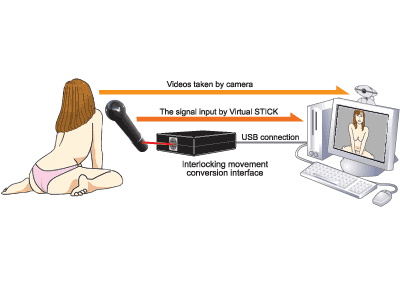
This really is a fascinating concept--using data-linked artificial sex organs, a man and a woman can pleasure each other over great distances. They can even record a "pleasure session" using the artificial sex organ interface and a data storage device, then transfer the "pleasure file" to their partner, who then replays the session using his or her own artificial sex organ as the interface.
Most of you already know that manure can produce methane via microbial digestion. In fact many dairy farmers are taking advantage of this process to create much of their own electricity with methane powered generators.
"Life Hacks" are simply personal shortcuts for getting the job done. Some may be elegant, others may be quick and dirty, but the end result is what is important.
| Hong Kong (PRC) | 107 | Russia | 96 | Fiji | 84 |
| South Korea | 106 | Slovakia | 96 | Iran | 84 |
| Japan | 105 | Uruguay | 96 | Marshall Islands | 84 |
| Taiwan (ROC) | 104 | Portugal | 95 | Puerto Rico (US) | 84 |
| Singapore | 103 | Slovenia | 95 | Egypt | 83 |
| Austria | 102 | Israel | 94 | India | 81 |
| Germany | 102 | Romania | 94 | Ecuador | 80 |
| Italy | 102 | Bulgaria | 93 | Guatemala | 79 |
| Netherlands | 102 | Ireland | 93 | Barbados | 78 |
| Sweden | 101 | Greece | 92 | Nepal | 78 |
| Switzerland | 101 | Malaysia | 92 | Qatar | 78 |
| Belgium | 100 | Thailand | 91 | Zambia | 77 |
| China (PRC) | 100 | Croatia | 90 | Congo-Brazzaville | 73 |
| New Zealand | 100 | Peru | 90 | Uganda | 73 |
| United Kingdom | 100 | Turkey | 90 | Jamaica | 72 |
| Hungary | 99 | Indonesia | 89 | Kenya | 72 |
| Poland | 99 | Suriname | 89 | South Africa | 72 |
| Australia | 98 | Colombia | 89 | Sudan | 72 |
| Denmark | 98 | Brazil | 87 | Tanzania | 72 |
| France | 98 | Iraq | 87 | Ghana | 71 |
| Norway | 98 | Mexico | 87 | Nigeria | 67 |
| United States | 98 | Samoa | 87 | Guinea | 66 |
| Canada | 97 | Tonga | 87 | Zimbabwe | 66 |
| Czech Republic | 97 | Lebanon | 86 | Congo-Kinshasa | 65 |
| Finland | 97 | Philippines | 86 | Sierra Leone | 64 |
| Spain | 97 | Cuba | 85 | Ethiopia | 63 |
| Argentina | 96 | Morocco | 85 | Equatorial Guinea | 59 |
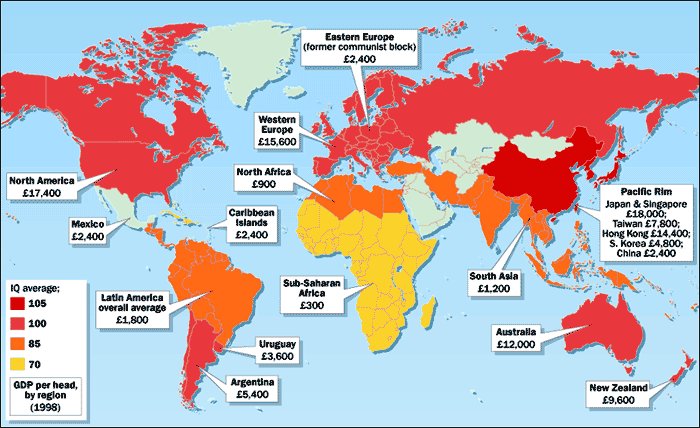
Here is another fine analysis of the concept of GDP vs. IQ--with the element of free market rules thrown in.Labels: demographics, IQ, Islam
| This is a great prank if your professor has a sense of humour. It's good for a belly laugh or two. No doubt this kind of prank is pulled at madrasas every day. | |
| Living la vida loca in the worker's paradise, courtesy of fearless leader. This sounds like Jimmy Carter's idea of the perfect world. No Billy Beer, though. | |
What is a Blog Carnival, you ask? A Blog Carnival is simply a blog posting that brings together in one place links to some of the best recent blog articles on a given topic.
The causes of Arab underdevelopment identified in the report are lack of freedom, marginal participation of women in public life and educational backwardness.Arab people enjoy least freedom compared to any other region in the world — less than even the countries bordering southern Sahara. Civil rights are mostly ignored though they are incorporated in constitutions and legislations in those countries. There are several impediments for the free functioning of the agencies that are supposed to ensure these rights. Arab women get the least opportunity to participate in the economic and political activities compared to any other place in the world. The level of education among Arab women is the lowest in the world. More than 50 percent of them are illiterate. One of the most alarming facts revealed by the report is the backwardness of Arabs in the field of science. The level of education in the region is falling while the per capita spending on scientific research and development is the lowest in the world. In 1996, it was 0.4 percent of the GNP which is one-third of what Cuba spent on scientific research. In 1994, Israel allocated 6.35 percent for the GNP for research programs while in Japan it was 6.9 percent. Naturally, the educational backwardness increases the rate of illiteracy among Arabs. More than 65 million people, which accounts for 43 percent of the Arab population, are illiterate.Source.Labels: arab dysfunction, demographics, Islam
Arabs are lagging in education, economy, democracy and freedom of expression, and computers. 2003—In Arab countries, with a combined population of 284 million, a “best seller” may have a print run of just 5,000 copies, due to censorship and other constraints on independent publishers. Translations of foreign works into Arabic lag far behind figures in the rest of the world: five times more books are translated yearly into Greek, a language spoken by just 11 million people, than into Arabic. Just 53 newspapers per 1,000 citizens are published daily in the region, compared to 285 papers per 1,000 people in the developed nations, and there are only 18 computers per 1,000 people in the Arab world, as compared to the global average of 78 per 1,000.
After dismal reports in 2002, 2003, and 2004, the UN HDR appears to have given up on the arab world. Who can blame them? Since World War II, the Arab world has lagged the rest of the planet in economic growth. For example, 300 million Arabs, and all that oil, generate less economic activity than Spain, and its population of 40 million. The main problem has been bad government. Too many dictators, and too much government restrictions on the economy. Too much corruption and waste. Even higher oil prices don't help, as it simply provides more money to be wasted on consumption, rather than business investment.
"Once people feel there are positive effects from the democratic process, they will want the same. Especially countries like Egypt who felt they were ahead of Iraq but are now lagging behind,” he said. Many arabs must be wondering if it takes an emasculating invasion from abroad and low level civil war to bring democracy to an arab country.Labels: arab dysfunction, Islam
Oscar Wilde said "there is no sin except stupidity." Voltaire said “The only way to comprehend what mathematicians mean by Infinity is to contemplate the extent of human stupidity." Einstein said, “The difference between genius and stupidity is that genius has its limits.” Source.Labels: IQ
The county government of St. Lucie County in Florida, has decided to build a US $425 million facility that will run on the energy produced on site, plus produce twice as much electricity as is consumed--and sell large quantities of steam and solids as lucrative byproducts. Where did this Florida county find such an energy gold mine? In its landfills.The $425 million facility expected to be built in St. Lucie County will use lightning-like plasma arcs to turn trash into gas and rock-like material. It will be the first such plant in the nation operating on such a massive scale and the largest in the world.Source.
Supporters say the process is cleaner than traditional trash incineration, though skeptics question whether the technology can meet the lofty expectations.
The 100,000-square-foot plant, slated to be operational in two years, is expected to vaporize 3,000 tons of garbage a day. County officials estimate their entire landfill - 4.3 million tons of trash collected since 1978 - will be gone in 18 years.
No byproduct will go unused, according to Geoplasma, the Atlanta-based company building and paying for the plant.
Synthetic, combustible gas produced in the process will be used to run turbines to create about 120 megawatts of electricity that will be sold back to the grid. The facility will operate on about a third of the power it generates, free from outside electricity.
About 80,000 pounds of steam per day will be sold to a neighboring Tropicana Products Inc. facility to power the juice plant's turbines.
Sludge from the county's wastewater treatment plant will be vaporized, and a material created from melted organic matter - up to 600 tons a day - will be hardened into slag, and sold for use in road and construction projects.
"This is sustainability in its truest and finest form," said Hilburn Hillestad, president of Geoplasma, a subsidiary of Jacoby Development Inc.

Once Iran gets the bomb, Turkey and Saudi Arabia are likely to develop their own nuclear weapons, for self-protection, and so as not to allow Iran to take de facto cultural-political control of the Muslim world. (I think you’ve got to at least add Egypt to this list.) With three, four, or more nuclear states in the Muslim Middle East, what becomes of deterrence?
A key to deterrence during the Cold War was our ability to know who had hit whom. With a small number of geographically separated nuclear states, and with the big opponents training satellites and specialized advance-guard radar emplacements on each other, it was relatively easy to know where a missile had come from. But what if a nuclear missile is launched at the United States from somewhere in a fully nuclearized Middle East, in the middle of a war in which, say, Saudi Arabia and Iran are already lobbing conventional missiles at one another? Would we know who had attacked us? Could we actually drop a retaliatory nuclear bomb on someone without being absolutely certain? And as Rosen asks, What if the nuclear blow was delivered against us by an airplane or a cruise missile? It might be almost impossible to trace the attack back to its source with certainty, especially in the midst of an ongoing conventional conflict.
We’re familiar with the horror scenario of a Muslim state passing a nuclear bomb to terrorists for use against an American city. But imagine the same scenario in a multi-polar Muslim nuclear world. With several Muslim countries in possession of the bomb, it would be extremely difficult to trace the state source of a nuclear terror strike. In fact, this very difficulty would encourage states (or ill-controlled elements within nuclear states — like Pakistan’s intelligence services or Iran’s Revolutionary Guards) to pass nukes to terrorists. The tougher it is to trace the source of a weapon, the easier it is to give the weapon away. In short, nuclear proliferation to multiple Muslim states greatly increases the chances of a nuclear terror strike.
In the 1950s and early 1960s, worrying about nuclear war was said to be quite common. Students were shown films in school of what to do in the case of a nuclear strike. Thinking and talking about installing a fallout shelter was not seen as extreme in certain locations of North America. Then came detente, and fears of nuclear war subsided significantly. After detente, only extreme survivalists were still talking seriously about fallout and survival shelters.Labels: apocalypse, Islam, shelter
Too often, climate modeling approximates the scientific accuracy of a voodoo priestess throwing "dem bones." When mathematical models are based upon poor proxy data, and sloppy, incomplete models, the famous rule of "GIGO" takes center stage.The more exhaust we spew, the more temperatures will go up. But when you get into the details, as Chylek is quick to tell you, you find that climate science is not a monolith:More at source.
Could changes in the sun be responsible for some of the warming?
While scientists obsess over greenhouse gases, are they missing other things that could be having equally large effects on the climate?
Are the thermometer records that show warming as good as scientists think they are?
Contrary to the common perception of textbooks filled with fixedknowledge, real science is a tangled process fraught with uncertainties, and such debates are common in any field.
“Science,” said Texas A&M climate scientist Andrew Dessler, “is this turbulent interface between what we know and what we don’t know.”
But if all science is turbulent, then climate science, because of its political dimensions, is all the more so.
Chylek placed that turbulence center stage last week, inviting more than a hundred scientists from around the world to Santa Fe for the 2nd International Conference on Global Warming, to discuss what scientists know and don’t know about our changing climate.
.... The range of views held by working climate scientists does not show up in the political version of the debate, according to Roger Pielke Jr., a University of Colorado political scientist who studies the politics of climate science.
The science becomes caricatured, according to Pielke, dichotomized into “skeptics versus alarmists … even though it does not do justice
to the complexities of the science debate.”
....Pielke Sr. thinks greenhouse gases are not the whole story. Massive human land-use changes? wholesale shifts from forest to agriculture, for example? are also important but are being given short shrift because of the emphasis on greenhouse gases.
Pielke Sr. also thinks global temperature data, the backbone of global warming claims, are fraught with uncertainties. And he is skeptical of the computer climate simulations used to forecast future climate change.
All of those legitimate scientific questions are lost in the simplified black-and-white version of climate science that shows up in
public discourse, Pielke Sr. believes.

The root of the problem is "social justice" education. It starts in teacher preparation programs, where rigorous training in math, science and literacy takes a backseat to theories about victimization and inequality. Teachers-to-be are told that conventional instruction is an outgrowth of capitalist oppression; "true" education helps students see the unfairness all around them and challenge society to change.Source.
But it doesn't stop there. Far too many New York City public schools - including some of the new small schools created by Chancellor Joel Klein and funded with money from the Bill and Melinda Gates Foundation - distort education by imbuing social justice into everything they do.
There's a propensity among educators to reinvent education every decade or so. I'm not sure why except each decade a new generation of educators are in the position to make changes and feel compelled to do so. There has also been a movement away from what previously worked - in terms of providing a student with the basic tools needed to be literate as well as assimilate into our civic culture - and more toward exactly what Stern notes. I don't know a thing about these three schools except what Stern writes, but in each, I don't see much of a focus on education, or at least not what I consider education. It's almost like the cart is before the horse. What good is an understanding of activism and "social justice" if you can't read the poster announcing the next peace rally?Source.
Again this seems a logical outgrowth of the multiculturalism movement who's basic premise is the need for "social justice". But probably a larger and more important need than hearing one side of the social justice story is that of getting a good basic education. The school day is a finite amount of hours. The more "social justice" finds its way into the curriculum, the less time there is for math, science, reading, literature, writing and other core subjects necessary to enable someone to maneuver successfully in this society.
Labels: academic lobotomy, competence, education, psychological neoteny

Labels: academic lobotomy, competence, education, psychological neoteny

Labels: academic lobotomy, education
Higher education in North America is badly in need of an overhaul. The modern world is crying for solutions from our brightest minds, yet universities are spending more time indoctrinating students in political correctness and politically biased anti-western multiculturalism, than in teaching students to learn, solve problems, and face the world as it is.In this memorandum, our focus is placed on the undergraduate education required to produce knowledge and direct it toward continuous innovation. We call for an entirely new undergraduate education mission –one that requires a different vocabulary and mindset compared to the now globally-distributed education missions for agricultural, industrial, and information-based societies. We believe that reforming undergraduate education to lead the competition in knowledge production and innovation is accomplishable; that it is appropriate, harmonizes with workforce needs, and better prepares students for post-graduate work.Much more in the original memo.
....Knowledge production results from the conversion of information to actionable form. Routine knowledge production at the undergraduate level would constitute a major paradigm change for tertiary education and would constitute the backbone of a world-leading Leapfrog University.
We contend that creative knowledge production by youth is essential for societies planning to compete and collaborate successfully in the global economy. Knowledge production results from the transformation of information into formats suitable for actionable decision making. We believe that undergraduates who learn to participate in knowledge production can help catalyze a shift from curriculum consumption and mass education to knowledge production, meaningful personalized education, and innovation.
Below, we define six types of creative knowledge production which we assert are critical to successful participation in the work and civic forces of the 21st Century. The six types of knowledge production, driven by constructivist theory and supported by continuously available advanced technology, are:
* Mode 1: rigorously developed scientific and scholarly knowledge;
* Mode 2: rigorous, collaboratively developed knowledge that is intended for highly practical applications;
* Mode 3: subjectively developed knowledge intended for personal applications;
* Mode 4: experientially developed knowledge that defines the capabilities and limitations of human contexts, including cultures;
* Mode 5: machine developed knowledge beginning to emerge from expert systems and very early artificial intelligence;
* Mode 6: integrative and chaordic knowledge that fosters the most effective uses of knowledge Modes 1-5.
While only the first two of the six modes of knowledge production are routinely employed in undergraduate education, the full range of modes offers students many opportunities to demonstrate the goodness of fit between their studies, their lives, and the demands of everyday life in an innovative global economy where knowledge production is increasingly socially distributed.
In order to avoid the perpetual game of “catching-up,” we offer nine quite different archetypal undergraduate development futures. These types permit institutions to strategically place themselves within or beyond the confines of historical practice.
All nine of these archetypes may choose to employ the six modes of knowledge production and utilization in different, market-centered ways. Every such choice can readily manifest the characteristics of Leapfrog University by helping to create variety, new strategic alternatives, and new innovation potentials.
1. Genius-Centered Future (Individuality Product). Focus on uniqueness development creates graduates capable of functioning as articulate, proactive individualists, in other words as human intellectual leaders.
2. Think Tank Future (Knowledge Worker Product). Students invent most of their own education experiences, evolving graduates capable of joining the workforce as full-fledged knowledge workers bent on innovation.
3. Development Teams Future (Collaborator Product). An business opportunity focus creates graduates who have worked in teams to produce patented or copyright materials, have started companies or non-profits, and have joined or created professional societies appropriate for their interests.
4. Student Services-Based Future (Student Culture Product). Students are matured within a culture nurtured by redefined and upgraded student services. Graduates leave college able to work well with as creative assistants in similar programs.
5. Global/International Learning Future (Globalized Individuality Product). This holistic approach creates students who can work within existing and emerging global cultures. The students utilize language translation devices and in-country experiences within local/global systems development models.
6. Old Economy Personnel Development Future (Student Employee Product). A talent/interest development approach permits business and industry the opportunity to locate potential star employees earlier in life. Chosen students are financially supported throughout college while acting as apprentices.
7. Home College Future (Family Culture Product). The domestic venue permits wide age-range access to services, including co-generated curriculum choices, domestic experiential learning options, campus- and age-independent services, and assistance from learning consultants.
8. Experiential Innovation Future (Context Worker Development Product). Students are selected for their capacity to integrate knowledge products. Their education is experiential in advanced design and innovation contexts. They may be paid to engage in tertiary education, and/or they are charged nothing on their loans while in school (e.g., Tony Blair’s recent student loan plan).
9. Chaordic Systems Future (Chaordic Systems Design and Management Product). Students are selected for their capacity to work in the phase-shifting contexts of uncertainty, unpredictability, and limitless diversity. They are provided the latest in simulation software, including advanced games, to hone their skills at coping with chaordia. Students are helped to develop the skills to work primarily in virtual space and time through simulations, games, and prototypes.
We believe that the above-mentioned nine scenarios allow for innovation based on the continuous rejuvenation of knowledge resources based on attention to the creative, inventive, and innovative individual. Even the several more traditional approaches require applications of innovative social capital to help them survive and evolve. We contend that, in particular, the production of Mode 3 knowledge offers stakeholders very appealing returns on investment in tertiary education, since most innovation begins in the mind of the creative individual. We also heavily favor Mode 4 knowledge production, or the creation of appropriate contexts or cultures to help students competitively leverage their futures.
Required: A New Emphasis on Undergraduates as Creatives
The Leapfrog University will invariably need to rethink its approach to undergraduate education to develop and cultivate the creative potential of its students. To this end, University leaders need to address several questions:
* How can the University vastly expand its impact on undergraduates and vice-versa?
* How do undergraduates routinely produce tacit and explicit knowledge, and then employ it innovatively?
* Can the University move to create expectations of innovative leadership among its undergraduate students?
* How can this daily expression of personal capital growth become part of expected services delivered by the University?
* How can the University expand both personal capital and social capital, in part by making the substance of each more individualized and purposively developmental?
* Can the University of Minnesota shift from industrial/information-age models of human capital preparation to knowledge/innovation models?
* Can the University seriously focus on recognizing and developing the uniqueness and variety of undergraduates through technology-supported, individualized learning services?
* Can the University focus more on student innovations as opposed to context-free testing and rigidly constrained paper topics?
* Can the University become more experiential and experimental as it moves toward knowledge based, innovation-supportive learning services?
* Can the University support development of the innovative individual through lifelong subscription services?
* Can the University provide new subscription networking for its alumni, productively linking them to one another and to undergraduate students?
....
Labels: academic lobotomy, education

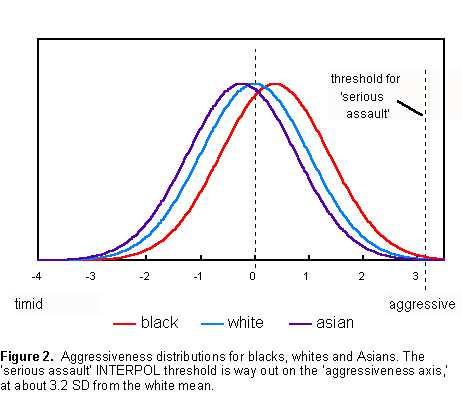
La Griffe Du Lion has an interesting post on aggressiveness and race. It also contains interesting graphs along with informative links.Labels: crime, IQ, multiculturalism