Thursday, August 16, 2012

Low Cost Online Accredited Degrees Coming Soon

The high cost of college education is hobbling the economic present and future of millions of young people in the US. With over $1 trillion in student loan debt, American youth are forced to postpone marriage, family, home ownership, and many other important aspects of life in the US. Meanwhile, university officials continue to grow an expensive administrative and staff bloat throughout the US university system.

The Saylor Foundation -- in collaboration with Excelsior College and Straighter Line, is developing a way to bypass this corrupt and destructive system, while acquiring the important and varied career-advancing knowledge that youth and adults need.

Excelsior is a private, nonprofit college that offers relatively inexpensive, online degree programs. The regionally-accredited college is also one of the first to have competency-based programs, where students can take Excelsior-developed examinations in a fairly broad range of subjects – earning credits without having to take classes. The exams are worth three to six credits, and typically cost $95.

The college discovered Saylor when it was tracking down open-education material online to suggest for students to use as study guides for exams. John Ebersole, Excelsior’s president, said faculty members at the college were impressed with Saylor’s courses.

“We found ourselves at Saylor’s door,” Ebersole said, adding that the foundation “doesn’t get the cachet, but they have the quality.”

Price Wars?

StraighterLine has a similar partnership in place with Saylor, and, as of this week, with Excelsior. As a result, the group has created what is perhaps the lowest-cost set of credit-bearing courses on the Internet.

Like Excelsior, StraighterLine offers inexpensive courses online. Students pay $99 per month to enroll, shelling out $39 per course. The material is self-paced, and students can take final exams whenever they’re ready. Tutors are available to help them along the way.

...The new credit pathway between the three institutions is obviously a tad complex, and not as simple as just enrolling in an online college. But the price might be attractive to savvy adult students – already the typical Excelsior and StraighterLine student. And Saylor hopes to be an option for students, including those in developing countries, who lack affordable or quality education options.

“Online courses should be really inexpensive,” says Burck Smith, StraighterLine’s CEO. “There’s no overhead. There is no reason for costs to be what they are.”

...The foundation is the brainchild of Michael J. Saylor, an Internet entrepreneur who has had several brushes with techie fame. The founder of MicroStrategy, a Beltway-based business intelligence software company, Saylor once lost $6 billion in personal wealth amid a U.S. Securities and Exchange Commission inquiry. At the time, he promised to donate $100 million to create a free online university.

That idea grew into the Saylor Foundation, which has a long-term goal of putting a lot of quality academic content on the web – as much as possible, really.

This fall will be Saylor’s launch, for all practical purposes. Although the foundation has gotten some notice among higher-education reformers, the fleshed-out majors make the concept tangible. _Highered
Saylor thinks that education should be free. And that is the direction that online educational technology is taking us.

This is good news for newer generations of learners, and very bad news for the corrupt system of indoctrination that calls itself "US higher education."

Labels:

Friday, August 03, 2012

4 in 1 Survival Tool

Multi-use tools allow for the saving of space and weight, when you are packing everything in yourself. And if you like to keep a small survival kit in your car at all times, high quality multi-use tools can remain unobtrusively out of the way, while providing excellent service.
The device is a wood saw with a 15-inch (38.1-cm) steel blade. Zippo says that it makes easy work of sticks and logs up to four inches (10.1 cm) thick. It's positioned at campers that need to cut up firewood, and the saw's handle has a little secret that will help: it's a sheath for a hatchet underneath. Take off the sheath to reveal the five-inch (12.7-cm) blade; store the saw blade in the hatchet handle, and sawing lends way to chopping and splitting.

...On the flip side of the hatchet blade is a mallet designed to hammer tent stakes into the ground. When it comes time to pack up and pull the stakes out, a stake puller on the end of the hatchet handle provides some assistance. The puller is a closed loop, so it appears that it will only work with stakes that have some type of a grab point – Zippo shows it pictured pulling out a hooked plastic stake.

The 4-in-1 Woodsman will hit the market in time for the northern spring of 2013. It will retail for US$79.95. Replacement saw blades will run $12.95. _Gizmag
I can think of a few other handy tools to include in the medley, but Zippo's Woodsman appears to be one convenient compromise out of the many possible multi-tools for such use.

Labels:

Saturday, July 21, 2012

Adventures in Unconventional Propeller Flight

The Austrian D-Dalus design is meant to be the "hummingbird" of this class of unconventional rotor designs. Think of how maneuverable a hummingbird can fly, while still achieving a very high top speed.

The D-Dalus has the potential to be the "special ops" platform of choice for rapid insertions, extractions, and quick stealthy near ground-level attacks.
A flying machine with no airfoil, rotor or jet propulsion can travel where most cannot: in very tight spaces and through terrible weather.

ROTOR ASSEMBLIES

The craft’s four rotors spin at 2,200 rpm, and six blades attached to carbon-fiber disks create directional thrust. The blades act as mini airfoils, their angle of attack constantly shifting in relation to rotation. For vertical lift, a blade’s leading edge rises away from the center of the disk at the top of its rotation and toward the center of the disk at the bottom [pictured], creating a pressure differential.

FRICTIONLESS BEARINGS

Existing bearings were unable to withstand 1,000 Gs of force between the carbon-fiber disks and their blades and still deliver some degree of maneuverability. Engineers at IAT21 developed their own bearings, shaped like metal barrels, that hold up to the force better than spheres (think: arches) but can still roll enough for the blades to move. _Popsci


The Fanwing, seen below, is more of a slow semi-hovering craft, meant to linger overhead for extended periods of observational time. Fanwing is more of a recon aircraft.

Fanwing Simulation


The cycloidal drive propeller below was taken from an earlier marine drive -- used for tugboats and other highly maneuverable water craft.

When applied to a flying craft, the cycloidal drive has the potential to function as either a helicopter replacement, or as a drive for a larger airship or "blimp."


Cycloidal Drive Simulation


The Voith Schneider propeller (VSP), also known as a cycloidal drive (CD) is a specialized marine propulsion system (MPS). It is highly maneuverable, being able to change the direction of its thrust almost instantaneously. It is widely used on tugs and ferries.

From a circular plate, rotating around a vertical axis, a circular array of vertical blades (in the shape of hydrofoils) protrude out of the bottom of the ship. Each blade can rotate itself around a vertical axis. The internal gear changes the angle of attack of the blades in sync with the rotation of the plate, so that each blade can provide thrust in any direction, very similar to the collective and cyclic of helicopter flight controls. _ngcraft

Labels:

Wednesday, July 11, 2012

From Hypersonics to Space Planes: A New Era

The US Defense Department's DARPA is resuming efforts to develop a hypersonic "X-plane (HX). DARPA's plans are ambitious, and will require very rapid innovation and development in order to meet its schedule -- achieving a rocket launched hypersonic craft by the year 2016.
The hypersonic X-plane (HX) will launch using a disposable rocket stack, unlike previous models which have used space launch rockets, then begin its hypersonic glide. The plan is for the "highly manoeuvrable" vehicle to be recoverable, meaning it will either return to Earth with the help of a parachute, or possibly land on a runway.

Darpa is reigniting the hypersonic flight research with the intention of launching future missions ranging from "space access to survivable, time-critical transport [troop deployment] to conventional prompt global strike." _Wired

Development of the Skylon spaceplane has passed a critical milestone following tests on the key component for its Sabre engine.

The engine, being developed by Reaction Engines Ltd, looks set to revolutionise not only space travel but also air transport around the world.

It promises to allow a new generation of aircraft to fly from one side of the Earth to the other, e.g. the UK to Australia, in just four hours instead of the 22 or so needed nowadays.

But it will also provide sufficient boost to send the Skylon spaceplane into orbit where it could deliver satellites or link up with the International Space Station.

What makes Sabre different from other aircraft engines is a revolutionary ability to switch from an air-breathing mode to that of a rocket engine.

This hybrid function will allow it to power aircraft at up to five times the speed of sound within the atmosphere or directly into Earth orbit at 25 times the speed of sound. _Wired
Hybrid engines of this type may provide a crucial weight savings in the early stages of the development of workable hypersonic craft. Engineers need to be cautious in avoiding excessive complexity in this new type of engine. KISS (Keep it simple, stupid!) is the key, as far as it is possible.
The type of craft pictured above has been discussed by Brian Wang in multiple articles. It is powered in multiple ways: by chemical rocket, air-breathing propulsion, by MHD, and by dense plasma focus fusion -- all of which should combine to allow it to travel at very high velocities. It will require significant development of several components, including the focus fusion module, before it becomes practical.

The Stratolaunch air launch system pictured above allows for a very versatile approach to orbital insertions. The huge carrier craft serves as the "first stage" of the launch system, carrying the launch craft to altitude and providing a wider range of opportunistic launch attitudes than is conveniently possible for fixed launch sites.

Ideally, all components of the system would be reusable, to save on costs. There are several tradeoffs to be made in terms of launch platforms, launch attitudes, propulsion strategies: pure vs. hybrid vs multiple etc., numbers of propulsion stages, orbital vs sub-orbital flight, method of terrestrial return, and so on.

Hypersonic flight inside the Earth's atmosphere is very punishing, physically. Better types of outer covering materials are needed to provide greater durability for multiple flights. Alternatively, inexpensive spray-on outer skins may be applied prior to each flight, which will naturally ablate in the course of the flight.

An earlier Al Fin article on this topic

Labels:

Sunday, July 01, 2012

Using Nuclear "Waste" to Provide Thousands of Years of Electrical Power and Industrial Process Heat

This article was previously published on the Al Fin Energy blog

Scientists at Argonne National Labs are developing ways of utilising 95% of the energy in Uranium fuel rods -- rather than the mere 4% or so currently being extracted. They are developing new techniques of chemical separation of waste from fuel, and more efficient ways of burning the recycled fuel after being separated from the waste.
When used fuel comes out of a light-water reactor, it’s in a hard ceramic form, and almost all of it is still just uranium – about 95 percent, along with one percent other long-lived radioactive elements, called actinides. Both of these can be recycled as fuel. The remaining four percent are fission products, which are truly unusable.

Pyroprocessing begins by chopping the ceramic fuel into little pieces and converting it into metal. Then it’s submerged in a vat of molten salts, and an electric current separates out uranium and other reusable elements, which can be shaped back into fuel rods.

The truly useless fission products stay behind to be removed from the electrorefiner and cast into stable glass discs. These leftovers do have to be put into permanent storage, but they revert back to the radioactivity of naturally occurring uranium in a few hundred years – far less than the thousands of years that untreated used fuel needs to be stored. _PO

One of the reasons why so little uranium is used is that almost every commercial reactor today is a type called a light-water reactor, or LWR. While LWRs are good at many things, they aren’t designed to wring every last watt of energy out of fuel. But LWRs aren’t the only type of reactor. Another class, called fast reactors, boasts the ability to “recycle” used fuel to get much more energy out of it. The main difference between the types of reactors is what cools the core. LWRs use ordinary water. Fast reactors use a different coolant, such as sodium or lead. This coolant doesn’t slow the neutrons as much, and consequently, the reactor can fission a host of different isotopes. This means that fast reactors can get electricity out of many kinds of fuel, including all of that leftover used fuel from LWRs. (LWRs can burn recycled fuel too, with some modification, but they aren’t as good at it.) _PO


More on pyroprocessing used nuclear fuel (PDF)

Extracting 30 times more energy from the same amount of nuclear fuel will help to make the same amount of fuel go much further. While we are being more efficient at using the nuclear fuel (and nuclear wastes) that we already have, we can learn many more ways to generate energy from mass.

The limits are in our heads.

Labels:

Tuesday, June 26, 2012

Human Body Re-Designed to Survive on 1 Oz H2O Daily

How could you re-design your body so that instead of requiring over 2 litres per day of water, you suddenly need only about 30 ml?

Such a radical reduction in daily water requirements suddenly opens up large areas of the planet for human habitation.

In addition, reducing human water requirements makes it easier for humans to live in outer space habitats and long-distance spaceships, and in undersea habitats.

Video via Takram (h/t Popsci)

The video describes the Shenu Hydrolemic System, which works to limit water losses through perspiration, urination, and feces through multiple body implants and prostheses.
We were given a vision of cathartic future. A world in which humanity experiences a cataclysmic sequence of events that will bring us to the brink of annihilation. Afflicted by manmade causes, the rising sea level, radioactive emissions and release of hazardous materials into the environment, art and culture cease to exist. This provides an opportunity, not lament, to re-evaluate what constitutes art, design, culture and the quality of life itself when all prejudices and preconceptions vanish.

With this premise, takram was tasked to design a water bottle.After a period of thorough research and analysis, takram reached an uncanny solution. Our conclusion was that it would make more sense, in fact, to regulate how much water the human body can retain and recycle in this dire environment. This revelation resulted in the Hydrolemic system, a set of artificial organs. _Takram

Watch the short video, and follow the link above for more information.

The human body is in for some radical re-design, as humans attempt to expand their activities into more and more extreme environments. From the polar regions to the deep seas, to high altitude atmospheric regions, to the many environments available off-planet -- humans are looking to extend their reach and expand their practical vision.

We were not evolved for most of those environments, however. We can compensate for some of these evolutionary deficiencies by creating artificial environments around us. Submarines allow us to live and work at depth undersea. Spaceships can protect us from vacuum and temperature extremes in space, with partial protection from radiation hazard. Pressurised capsules could allow us to live at high altitudes either on mountaintops or in large high altitude lighter than air habitats.

But we are the naked ape, and we would rather be able to face these exotic environments with a minimum of artifact between us and the environment -- if we could do so safely.

That is why reducing the daily water requirement is just the beginning for the grand project of re-designing humans for the challenges ahead of us.

Much more on this topic in future postings.

Labels: ,

Tuesday, June 19, 2012

A Safer Escape to the Deep Ocean?


Vertical Ship Designed to Withstand Even Largest Sea Waves


The vertical ship "Sea Orbiter" is supposedly designed as a research vessel to study ocean currents and climate effects.

But we all understand that unmanned submerged and floating platforms can do just as well to gather whatever research data is necessary. Clearly the Sea Orbiter is meant as a deep ocean escape platform -- but what is it escaping?

Zombies, of course. While zombies can survive almost indefinitely underwater without needing to breathe, they do have trouble with flotation in deep water. They can walk along the seabed, but cannot easily swim along the surface. Once your ship or seastead achieves ocean depths of over 100 metres, you are relatively safe from zombies.

The Sea Orbiter was designed to be self-sufficient in terms of energy production, and could house a number of families, as designed. By scaling up the size of the vertical ship, and altering a few features, it could be turned into a self-sufficient vertical floating city for tens of thousands of people.


A vertical ship that is highly mobile, wave resistant, and stable with 2/3 of its length submerged, offers a new paradigm for naval design of self-sufficient floating arcologies meant to stay afloat for long periods of time.

Any added anti-zombie protective measures should add only minimally to the total costs.

Labels: ,

Friday, June 15, 2012

Silent Zombie Kill Seaplane: Fly Nano Stealth Electric


This nifty one-person seaplane has made its first test flight with a battery powered electric motor. It is so quiet that you can dive-bomb a zombie nest in broad daylight, and they'll never hear you coming. Base price is $34,000.

Wing guns and bomb mounts are extra.

Fly Nano News Blog_via_Gizmag

Flynano main website


The electric version has a relatively short range, so be sure not to let your batteries run down in the middle of a zombie attack.

Labels: ,

Monday, June 11, 2012

Behind the Scenes in the Green Eco-Fascist Doomer Cult

This article was previously published on Al Fin Energy and the Al Fin blogs

Green doomer eco-fascist cultists all follow similar guidelines: Slash the human population of the planet, although they themselves are unwilling to go first.. Blame free markets and western civilisation for most of the world's problems. Eschew all viable forms of large-scale energy in favour of those which are exorbitantly expensive and innately unreliable. Hate advanced technology, and want to push the world toward primitive lifestyles and global poverty. They are essentially anti-individual and pro-collective.

Members of any doomer cult will recognise the litany, whether from the climate change catastrophe cult, the peak oil doomer cult, the overpopulation doom cult, the global pollution doom cult, the biodiversity doom cult, etc.

Here is more from one of the horses' mouths:

This is Finnish writer Pentti Linkola — a man who demands that the human population reduce its size to around 500 million and abandon modern technology and the pursuit of economic growth — in his own words.

He likens Earth today to an overflowing lifeboat:

What to do, when a ship carrying a hundred passengers suddenly capsizes and there is only one lifeboat? When the lifeboat is full, those who hate life will try to load it with more people and sink the lot. Those who love and respect life will take the ship’s axe and sever the extra hands that cling to the sides.

He sees America as the root of the problem:

The United States symbolises the worst ideologies in the world: growth and freedom.

He unapologetically advocates bloodthirsty dictatorship:

Any dictatorship would be better than modern democracy. There cannot be so incompetent a dictator that he would show more stupidity than a majority of the people. The best dictatorship would be one where lots of heads would roll and where government would prevent any economical growth .

We will have to learn from the history of revolutionary movements — the national socialists, the Finnish Stalinists, from the many stages of the Russian revolution, from the methods of the Red Brigades — and forget our narcissistic selves.

A fundamental, devastating error is to set up a political system based on desire. Society and life have been organized on the basis of what an individual wants, not on what is good for him or her.

As is often the way with extremist central planners Linkola believes he knows what is best for each and every individual, as well as society as a whole:

Just as only one out of 100,000 has the talent to be an engineer or an acrobat, only a few are those truly capable of managing the matters of a nation or mankind as a whole. In this time and this part of the World we are headlessly hanging on democracy and the parliamentary system, even though these are the most mindless and desperate experiments of mankind. In democratic coutries the destruction of nature and sum of ecological disasters has accumulated most. Our only hope lies in strong central government and uncompromising control of the individual citizen.

_azizonomics.com

H/T Zerohedge

This fellow is not actually so extreme, for a green. He may be a bit more honest and open about his convictions than most, but that is changing. Even the WWF -- which has written many of the supporting "studies" for the IPCC climate change reports -- has come out in support of policies which would ultimately result in a large scale human dieoff.

Is this also the face of the peak oil doomer cult? Certainly you find a lot of peak oil cult wankers fixated on doom porn, compulsively getting their doom fix whenever possible. It would be easy to assume that they actually want to see suburbia burning, that they would like to see the end of civilisation as we know it.

Not that most of the incompetent athols would survive very long after such an event. More: Europe as the canary in the coal mine

Early dissent among former believers in the CAGW orthodoxy and carbon hysteria warming cult

Labels:

Wednesday, June 06, 2012

City In the Sky vs. Floating Islands and Cities

The images of the City In the Sky come courtesy of Inhabitat. The idea is to elevate parks, gardens, and perhaps residences high above street level noise, pollution, and crime.

Towers are expensive to build, and once built they cannot be easily moved.


Contrast the sky city with a floating city, which is close to the water, and which can be moved if necessary.

Images of floating islands and cities courtesy of Gizmag:

Dutch Docklands Maldives


Floating islands could be located anywhere from the tropics to the polar regions -- as long as the possibility of encountering ice is accounted for. One could even put a floating island on an alpine lake, as a vacation home away from home.
Always be aware that zombies can travel through the water, and cannot be drowned. If you are looking for shelter from zombies, the tower approach may well be superior to the floating island.

Labels: ,

Wednesday, May 30, 2012

Pathways to Female Sexual Pleasure

Previously published on Al Fin, You Sexy Thing! blog


Different women may travel somewhat different paths to achieving their ultimate sexual pleasure. The path begins with basic health and self esteem, and will be more ore less accessible depending upon the state of receptivity. That will vary by time of the month, basic physical comfort and satiety levels, a sense of physical safety, and more. Receptivity is influenced by degree of physical and emotional attraction, by chemical intoxicants, or by other influences on the brain -- particularly the pre-frontal lobes (judgment and decision-making) and the pleasure centres of the brain.

But once a couple proceeds past the preliminaries, and are committed to the act, a knowledge of the basic anatomy of erogenous areas can prove immensely facilitating.

There are a number of erogenous areas which elevate the levels of female sexual excitement when properly stimulated at the right time. Kissing the lips and fondling the breasts stimulates two very powerful erogenous areas, and helps to direct blood flow to the pelvic erogenous areas, pictured below.

The clitoris is the best known female pelvic erotic trigger, and the easiest to find right away. The "U-spot" around the urethral opening is much less well known, but in certain women it can open the gate to orgasms not accessible otherwise. The same is true for the "G-spot," located along the mid-anterior wall of the vagina, at about the level of the bladder sphincter. The "A-spot" is further back on the anterior vagina, toward the cervix. The cervix itself -- and attached structures -- can also be considered an erogenous area for many women. Stimulation of both the A-spot and the cervix requires deeper penetration as opposed to stimulation of the more superficial erogenous centres.

The trick to being a great lover of women, is understanding each phase of female sexual attraction and arousal, and stimulating the appropriate erogenous zones of the woman's mind and body for the particular stage of seduction. The approach to pleasing a woman will necessarily be different for each woman. If you have found this not to be the case, than it is likely that you are being deceived by both the women involved and by your own narcissistic nature.

Once you reach the stage of genital contact and penetration, it is important to visualise what is taking place on the inside, in places where the sun and other sources of illumination are unlikely to shine.

By studying the anatomy of intercourse, as well as the anatomy of the female erogenous areas, one should be capable of modifying one's approach in response to how the woman is responding to the situation as a whole.

A woman may achieve intense orgasm by using a vibrator or other sexual utensil. But a vibrator does not satisfy the multiple levels of sexual needs and desires which a woman is likely to have. Of course, neither do most men. But that is a situation which we hope to remedy, at least for the most insightful readers of the Al Fin blogs.

;-)

More reading:

Clitoris, G spot, U spot, A spot . . .

Female erogenous zones in general

Does the female G spot exist for every woman?

The female is a subtle and highly variable animal. Make broad and blanket assumptions at your own peril.

Labels:

Saturday, May 19, 2012

General Fusion Gets New Funding to Pursue Unconventional Fusion Power Approach


For all its promise, the quest for net gain fusion has been a time consuming and costly endeavor. The ITER reactor is projected to take 10 years and 13 billion euros to construct. That doesn’t count the 25 years and counting since the project began and the millions poured in by contributors so far. Even when built, ITER’s super conducting magnets and other components would require 50 MW worth of input power to start and maintain the reaction. Similarly, costs for Laurence Livermore’s National Ignition Facility are estimated at upwards of $850 million and its reactor requires 500 trillion watts of laser light to kick-start fusion reactions.

Where General Fusion’s magnetized target method stands apart is in its relatively low-tech, low-cost mechanical means of compressing the plasma. “As an energy storage medium, compressed gas is orders of magnitude less expensive than capacitors,” Delage explains, “but it’s hard to release this energy quickly.”

...“Our sphere is in fact full of holes, like a Wiffle ball,” he explains. “Each hole is plugged with an ‘anvil’ and compressed gas is used to accelerate a 100 kg ‘hammer’ piston. This acceleration takes about 80 milliseconds. When the hammer piston impacts on the anvil piston, it moves a small amount and transfers the energy into the liquid metal in about 80 microseconds. That’s a timescale shorter than the lifetime of the magnetized target and an increase in power of 1000 times.” _Canadian Manufacturing _via_NBF

General Fusion has secured a new round of funding (PDF) and is prepared to take their unconventional approach to fusion as far as they can take it. No one needs to tell the General Fusion team or their investors that they are pursuing a long shot.

But then, the same applies to all the other small-scale fusion startups, who are trying to do an end-run around the huge multi-billion dollar approaches taken by ITER and Lawrence Livermore, etc.

The General Fusion website contains much more information about the science, technology, and the people behind this dark horse candidate to develop commercial fusion power.

Brian Wang provides a library of NextBigFuture articles devoted to the General Fusion effort

Labels: ,

Thursday, May 17, 2012

What is True? The Dynamic 3D Jigsaws of Reality

The following article by Peter Ellerton is re-published from The Conversation

The truth, the whole truth and … wait, how many truths are there?

7qc34r6r-1336628304
You want the truth? You can’t handle the … wait: it’s actually quite simple.

Calling something a “scientific truth” is a double-edged sword. On the one hand it carries a kind of epistemic (how we know) credibility, a quality assurance that a truth has been arrived at in an understandable and verifiable way.

On the other, it seems to suggest science provides one of many possible categories of truth, all of which must be equal or, at least, non-comparable. Simply put, if there’s a “scientific truth” there must be other truths out there. Right?

Let me answer this by reference to the fingernail-on-the-chalkboard phrase I’ve heard a little too often:

“But whose truth?”

If somebody uses this phrase in the context of scientific knowledge, it shows me they’ve conflated several incompatible uses of “truth” with little understanding of any of them.

As is almost always the case, clarity must come before anything else. So here is the way I see truth, shot from the hip.

Venture Vancouver

While philosophers talk about the coherence or correspondence theories of truth, the rest of us have to deal with another, more immediate, division: subjective, deductive (logical) and inductive (in this case, scientific) truth.

This has to do with how we use the word and is a very practical consideration. Just about every problem a scientist or science communicator comes across in the public understanding of “truth” is a function of mixing up these three things.

Subjective truth

Subjective truth is what is true about your experience of the world. How you feel when you see the colour red, what ice-cream tastes like to you, what it’s like being with your family, all these are your experiences and yours alone.

In 1974 the philosopher Thomas Nagel published a now-famous paper about what it might be like to be a bat. He points out that even the best chiropterologist in the world, knowledgeable about the mating, eating, breeding, feeding and physiology of bats, has no more idea of what it is like to be a bat than you or me.

-Bi-

Similarly, I have no idea what a banana tastes like to you, because I am not you and cannot ever be in your head to feel what you feel (there are arguments regarding common physiology and hence psychology that could suggest similarities in subjective experiences, but these are presently beyond verification).

What’s more, if you tell me your favourite colour is orange, there are absolutely no grounds on which I can argue against this – even if I felt inclined. Why would I want to argue, and what would I hope to gain? What you experience is true for you, end of story.

Deductive truth

Deductive truth, on the other hand, is that contained within and defined by deductive logic. Here’s an example:

Premise 1: All Gronks are green.
Premise 2: Fred is a Gronk.
Conclusion: Fred is green.

Even if we have no idea what a Gronk is, the conclusion of this argument is true if the premises are true. If you think this isn’t the case, you’re wrong. It’s not a matter of opinion or personal taste.

PistoCasero

If you want to argue the case, you have to step out of the logical framework in which deductive logic operates, and this invalidates rational discussion. We might be better placed using the language of deduction and just call it “valid”, but “true” will do for now.

In my classes on deductive logic we talk about truth tables, truth trees, and use “true” and “false” in every second sentence and no one bats (cough) an eyelid, because we know what we mean when we use the word.

Using “true” in science, however, is problematic for much the same reason that using “prove” is problematic (and I have written about that on The Conversation before). This is a function of the nature of inductive reasoning.

Inductive truth

Induction works mostly through analogy and generalisation. Unlike deduction, it allows us to draw justified conclusions that go beyond the information contained in the premise. It is induction’s reliance on empirical observation that separates science from mathematics.

In observing one phenomenon occurring in conjunction with another – an electric current and an induced magnetic field, for instance – I generalise that this will always be so. I might even create a model, an analogy of the workings of the real world, to explain it – in this case that of particles and fields.

This then allows me to predict what future events might occur or to draw implications and create technologies, such as developing an electric motor.

And so I inductively scaffold my knowledge, using information I rely upon as a resource for further enquiry. At no stage do I arrive at deductive certainty, but I do enjoy greater degrees of confidence.

I might even speak about things being “true”, but, apart from simple observational statements about the world, I use the term as a manner of speech only to indicate my high level of confidence.

Now, there are some philosophical hairs to split here, but my point is not to define exactly what truth is, but rather to say there are differences in how the word can be used, and that ignoring or conflating these uses leads to a misunderstanding of what science is and how it works.

For instance, the lady that said to me it was true for her that ghosts exist was conflating a subjective truth with a truth about the external world.

I asked her if what she really meant was “it is true that I believe ghosts exist”. At first she was resistant, but when I asked her if it could be true for her that gravity is repulsive, she was obliging enough to accept my suggestion.

AMERICANVIRUS

Such is the nature of many “it’s true for me” statements, in which the epistemic validity of a subjective experience is misleadingly extended to facts about the world.

Put simply, it smears the meaning of truth so much that the distinctions I have outlined above disappear, as if “truth” only means one thing.

This is generally done with the intent of presenting the unassailable validity of said subject experiences as a shield for dubious claims about the external world – claiming that homeopathy works “for me”, for instance. Attacking the truth claim is then, if you accept this deceit, equivalent to questioning the genuine subject experience.

Checkmate … unless you see how the rules have been changed.

It has been a long and painful struggle for science to rise from this cognitive quagmire, separating out subjective experience from inductive methodology. Any attempt to reunite them in the public understanding of science needs immediate attention.

Operating as it should, science doesn’t spend its time just making truth claims about the world, nor does it question the validity of subject experience – it simply says it’s not enough to make object claims that anyone else should believe.

Subjective truths and scientific truths are different creatures, and while they sometimes play nicely together, their offspring are not always fertile.

So next time you are talking about truth in a deductive or scientifically inductive way and someone says “but whose truths”, tell them a hard one: it’s not all about them.

This article was originally published at The Conversation. Read the original article.


The above article provides a nice introduction to the idea of truth discovery. In the real world, of course, there are many more types of truth which are utilised by a wide range of occupations, industries, avocations, and institutions.

One important type of truth in the real world, is "legal truth." The standards of truth in legal proceedings are likely to involve the hybrid combination of subjective judgments, inductive determinations, and deductive logic. If you add "probabilistic truth" to the mix, you provide at least a patina of objectivity to the judicial process.

What is "probabilistic truth?" It is the attempt to utilise the tools of modern probability theory in order to achieve something that is most likely to be true. Such tools have been customised to serve a wide range of industries and institutions from political campaigns to marketing to engineering design to social engineering.

There is also something called "literary or artistic truth." It is a deeper type of subjective truth that can be elicited when verbal and logical judgment is suspended as far as possible, and the core consciousness is allowed to react to art, literature, or music while in a relatively undefended state. Such subjective truths are likely to be ineffable, falling outside of language or conventional logic.

The author of the re-published piece above is a student of philosophy, and still finding his voice and style. By helping to tease out the tangles of conventional ideas about truth, he is making a good and useful start.

Labels:

Monday, May 14, 2012

Fighting Zombies with Automated Ghosts

Researchers have chosen a site near Hobbs, New Mexico, to build an automated ghost town, empty of human inhabitants. The town will function as if it were a real human town, but it will be controlled by advanced automation and communications networks. In case of a zombie apocalypse, it is hoped that zombies will be attracted to the carefully simulated town, where they can be trapped, destroyed, and properly disposed of according to government regulations.
Associated Press
A scientific ghost town in the heart of southeastern New Mexico oil and gas country will hum with the latest next-generation technology - but no people.

A $1 billion city without residents will be developed in Lea County near Hobbs, officials said Tuesday, to help researchers test everything from intelligent traffic systems and next-generation wireless networks to automated washing machines and self-flushing toilets -- in an attempt to create a zombie trap, in case of a zombie apocalypse.

Hobbs Mayor Sam Cobb said the unique ... empty city will be a key for protecting the nearby human community from zombies, by acting as a type of bait and trap. _AP
The plan is to conduct a controlled release of groups of 50 to 100 zombies at random locations midway between Hobbs and the automated ghost town. The zombies will be fitted with tracking devices and their locations will be monitored closely throughout each experiment. Zombies which stray too closely to the human settlement of Hobbs will be either trapped and relocated, or will be destroyed in place, depending upon the assessed threat by officials on the scene.

As groups of zombies shuffle into the automated ghost town, proximity detectors will be triggered, and reactive systems will automatically activate. The zombies will be unwittingly herded into a specially designed "zombie kill zone" area in the middle of the ghost town, where they will be reduced to atomic particles for later conversion into fuels, high value chemicals, and fertilizers. In this way it is hoped that the zombie apocalypse can be turned to the benefit of the human survivors.

The New Mexico town is considered a prototype automated zombie trap ghost community, which will facilitate advance preparation work to minimize the impact of the full scale zombie apocalypse, when it eventually occurs. We can only hope that there will be time to apply the lessons learned.

Labels: ,

Saturday, May 12, 2012

Ultimate Zombie Escape Vehicle?

When the zombie apocalypse hits, you may not have much warning to get out of town. Freeways and surface roads will be jammed to a standstill, and walking out of the city with zombies on the loose could be extremely dangerous. In such an event, you will want a method of urban exfiltration. Helicopters are generally considered the best method of fast evacuation, but a flying car or flying motorcycle ranks high on the list. The Pal-V personal flying road vehicle is an auto-gyro and a three-wheel motorcycle all in one. Here's more:
On the ground this slim, aerodynamic, 3-wheeled vehicle has the comfort of a car with the agility of a motorcycle thanks to its patented, cutting-edge, ‘tilting’ system. It can be driven to the nearest airfield and take off just like any other airplane. The single rotor and propeller are unfolded to make the PAL-V ONE ready to fly. When airborne, the PAL-V usually flies below 4,000 feet (1,200 m), the airspace available for uncontrolled Visual Flight Rules (VFR) traffic; so there will be no interference from commercial air traffic. Furthermore, the PAL-V is powered by a very robust, flight certified aircraft engine. It runs on gasoline. It can reach speeds of up to 180 km/h (112 mph) both on land and in the air. The PAL-V ONE has a very short take off and landing capability, making it possible to land practically anywhere. When not using controlled airspace, you can take off without filing a flight plan. Flying a PAL-V is like a standard gyrocopter. It is quieter than helicopters due to the slower rotation of the main rotor. It takes off and lands with low speed, cannot stall, and is very easy to control. The gyroplane technology means that it can be steered and landed safely even if the engine fails, because the rotor keeps auto rotating. _PAL-V
Escaping a Zombie-Infested San Francisco
The PAL-V One can reach speeds up to 112 mph. On the road, the PAL-V One has a range of 750 miles from its gasoline engine and in the air it has a range of up to 315 miles. It runs on gasoline like a conventional car, but there will also be versions that use biodiesel or bio-ethanol. _Inhabitat
In a world of zombies, there are very few second chances. Best to plan ahead.

Labels: ,

Monday, May 07, 2012

Did Gigantic Phartosaurs Devastate the Mesozoic Climate?

UK climate scientologists scientists have discovered that huge dinosaurs -- nicknamed "phartosaurs" -- may have produced enough methane by flatulence to tip the balance of the mesozoic climate into catastrophe.
Baby Phartosaurs in Various Stages of Hatching
Like huge cows, the mighty sauropods would have generated enormous quantities of methane. Sauropods, recognisable by their long necks and tails, were widespread around 150 million years ago.

They included some of the largest animals to walk the Earth, such as Diplodocus, which measured 150 feet and weighed up to 45 tonnes.

Scientists believe that, just as in cows, methane-producing bacteria aided the digestion of sauropods by fermenting their plant food.

''A simple mathematical model suggests that the microbes living in sauropod dinosaurs may have produced enough methane to have an important effect on the Mesozoic climate,'' said study leader Dr Dave Wilkinson, from Liverpool John Moores University.

''Indeed, our calculations suggest that these dinosaurs could have produced more methane than all modern sources - both natural and man-made - put together.''

The research is published today in the journal Current Biology. _Telegraph_via_WUWT

This "phartosaur hypothesis" is still in its preliminary stages, although it is as well supported as any other catastrophic theories or models of climate put forward by IPCC climate scientologists scientists up until now.

One must admire the brilliance of the keen minds capable of dreaming up modeling such clever hypotheses.

By the way, how long is it going to take Steven Spielberg to grow some of those giant phartosaurs, as food livestock? Imagine how many hungry people could be fed around the world from just a small herd of domesticated phartosaurs! Hurry up, Steven. There are hungry people out there!

Labels:

Saturday, May 05, 2012

Sizing the Power Supply for Your Doomsday Bunker


After the Apocalypse

After the doomsday bell tolls, you will want to have a safe hideaway, packed with your favourite foods, beverages, people, and prescription drugs. But no matter how safely your bunker is designed, you cannot survive long without a source of heating and electrical power.

Issues of energy density dictate the need for a nuclear power and heat source -- either fission or fusion. The choice seems to come down to either a small modular nuclear fission reactor -- such as the NuScale or Wilcox and Babcock models, vs one of the new scalable fusion reactor models. The Lawrenceville Plasma Physics focus fusion device pictured below, appears to be the leader of the pack in terms of timeline for proof of concept, prototype, commercial demo, and mass production.
All images below taken from Lawrenceville Plasma Physics Inc (PDF) (via) NBF

Five megawatts baseload power should be enough to supply the power and heat needs of most medium-sized doomsday communities. When living in an underground environment, it is easy to underestimate needs for space lighting and grow-lighting, as well as power for supplying pumps, compressors, blowers, fans, filtration devices, and various electronic devices.

The diagram above attempts to illustrate energy flows and losses in the focus fusion system. Operation of the reactor will be highly automated, but a certain amount of oversight will be necessary, to assure smooth function and to limit any need for routine maintenance shutdown.

Baseload power generation means that the reactor produces 5 MW at all times. Any heat and power produced above the needs of the doomsday community will converted as needed, and routed to storage or to a sink. Since the reactor utilises hydrogen and boron as fuel, a significant amount of excess power will be used to maintain hydrogen stores. The hydrogen can be used as fuel in either the focus fusion reactor, or in backup fuel cell CHP generators.

The timeline for production of the LPP focus fusion reactors is particularly optimistic, with estimates for mass production as early as 2016.

Keep in mind that US federal and state regulators are unlikely to approve these devices for sale in the US anytime within the next decade. This means that any US citizen wishing to use these reactors as backup power supplies for their home, seastead, polar outpost, or doomsday bunker, will either need to locate outside the US, or will need to find extra-legal ways of installing their nuclear fusion (or SMR fission) reactors within the borders of the US.

In the event of doomsday, it is expected that nuclear enforcement by US federal or state officials will be suspended for a number of years. In such a case, issues of survival are likely to be paramount, over issues of bureaucratic red tape.

Labels: ,

Friday, April 27, 2012

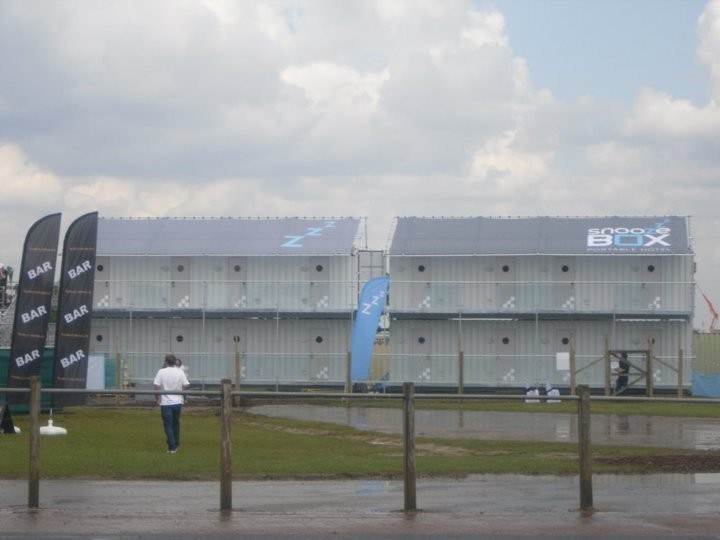
Instant Zombie-Proof Dormitory, Hotel, Village

All images via Gizmag

The steel shipping container is a strong and versatile architectural starting point. Using the ubiquitous steel structures, one can build a house, a workshop, an artist's studio, an underground survival bunker, or an entire dormitory, hotel, or village.

The structures can be stacked, cantilevered, buried, bermed, or perched on a pedestal.
... British company Snoozebox has come up with yet another clever use for [shipping containers] – a modular, scalable portable hotel system made up of multiple tiered containers, that can be set up anywhere within 48 hours.

Each climate-controlled Snoozebox room features a double bed, wet room, flat screen TV, free Wi-Fi, two power outlets, a safe, and key card entry. Maid service and a continental breakfast are also provided. Currently, there are four rooms in each container, although a couple of other options should be available soon – the company plans on offering larger Luxury rooms that each occupy half a container, along with cheaper five-per-container Budget rooms. The containers themselves are standard ISO (International Organization for Standardization) size, meaning that they can be stacked and shipped anywhere by road, rail, air or water. The system includes its own infrastructure, so no electricity, water or sewage access is necessary. It can also be leveled by its installation crew, so absolutely flat terrain isn’t a requirement. _Gizmag

Such self-contained dorm/hotel/village systems could be set up anywhere in the wilderness, desert, or polar areas where power and sanitation could be provided. Above, you can see the interior layout of individual container units for the "Snoozebox" system.

Shipping containers are built of strong steel structural material, easily capable of holding off an extended and determined zombie attack, as long as sufficient food, water, sanitation, temperature control, and clean air are available.

A multi-unit installation would be suitable for remote drilling or mining crews, remote education or training centers, or for large scale refugee camps when flight from zombie-infested cities is necessary.

Labels: ,

Sunday, April 08, 2012

Russian President Putin Presses for Psychotronic Zombie Gun

Mind-bending ‘psychotronic’ guns that can effectively turn people into zombies have been given the go-ahead by Russian president Vladimir Putin.

The futuristic weapons – which will attack the central nervous system of their victims – are being developed by the country’s scientists.

They could be used against Russia’s enemies and, perhaps, its own dissidents by the end of the decade. _DailyMail
Daily Mail

While there may be a need to develop weapons that will reliably kill zombies once and for all, there appears to be little need for weapons which will create zombies, as Mr. Putin apparently intends. This appears to be a case begging for the involvement of UN weapons inspectors, who have never failed an assignment yet. ;-)
Plans to introduce the super- weapons were announced quietly last week by Russian defence minister Anatoly Serdyukov, fulfilling a little-noticed election campaign pledge by president-elect Putin.

Mr Serdyukov said: ‘The development of weaponry based on new physics principles – direct-energy weapons, geophysical weapons, wave-energy weapons, genetic weapons, psychotronic weapons, and so on – is part of the state arms procurement programme for 2011-2020.’ _DailyMail
Russia is suffering an ongoing demographic collapse of its core population. Its military is rusting away, in desperate need of more and better recruits, and crying out for policy reform and infrastructure upgrade.

This latest ploy by Putin appears to be a desperation move in hopes of discovering some type of compensatory weapons system which will negate the technological lead enjoyed not only by western militaries, but increasingly by Chinese armed forces -- a much closer and more realistic threat to Russia.

Labels: ,

Tuesday, March 20, 2012

GTL (Gas to Liquids) and CTL (Coal to Liquids) + HT GCR (High Temperature Gas Cooled Reactors) = Cheap Hydrocarbons w/ Excellent EROEI

Unconventional liquid fuels are slated to provide ever growing proportions of future demand for transportation fuels. The burgeoning success of plants such as Shell's Pearl GTL plant in Qatar herald a new era of liquid fuels production.
In terms of what GTL is, it is the process of chemically turning natural gas into cleaner-burning liquid products, including fuel, base oil for lubricants and feedstock for chemicals. To produce, the process firstly involves methane and oxygen which are converted into a mixture of hydrogen and carbon monoxide known as synthesis gas or syngas. This is then fed to a reactor with a proprietary Shell catalyst that accelerates the conversion of the mixture to long-chained waxy hydrocarbons and water.

From the GTL reactor, the long-chained hydrocarbons are then reacted with hydrogen and ‘cracked,’ into a range of smaller molecules of various sizes using another proprietary Shell catalyst. This process is referred to as ‘hydrocracking.’ The final step is distillation. Various boiling points are reached to separate out the products, which can be in the form of GTL naphtha, GTL kerosene, GTL normal paraffins, GTL gas oil, or GTL base oils. These are then eventually fed to their own storage tanks ready for use.

...One of the products, GTL gasoil (diesel-type fuel), can contribute significantly to the diversification of the diesel fuel supply. This product can reduce local emissions of nitrogen and sulfur oxides and particulate matter. Because it contains virtually no sulfur or aromatic compounds and has a high cetane number – a measure of combustion quality – GTL gasoil burns more efficiently than conventional oil-based diesel and thus produces fewer local emissions and less black smoke than conventional diesel. The high cetane of GTL gasoil can lead to noise reductions in certain engines under certain driving conditions and improve cold start performance. GTL gasoil can also be blended with conventional diesel and/or biodiesel and used in the same vehicles and infrastructure, thus offering a low investment cost compared with other alternatives.

GTL Kerosene is an alternative to conventional oil-based kerosene. Its primary use is expected for aviation. GTL kerosene can be used as a blend with traditional jet fuel without any modifications to existing aircraft and engines. Given that the aviation sector will rely on liquid hydrocarbons for decades, this fuel can help support the future energy needs of the industry, and offer customers fuel diversification. GTL kerosene has higher energy density than conventional oil-based kerosene and this reduces the required fuel payload, thus aircraft may be required to carry less fuel weight to cover the same distance. _QatarShell
When even pro-nuclear activists such as Rod Adams are speaking out in favour of a coal - nuclear partnership to produce liquid transportation fuels, you should understand that people are finally beginning to look at the possibilities.
Coal is a valuable resource that can be safely mined for centuries by well-trained and compensated miners. Instead of eliminating the use of coal, I would prefer to help coal miners and coal mine owners to recognize that they could make more money and sell a cleaner product if they upgraded their fuel at the mine rather than shipping a dirt-filled, unrefined product that sells for a huge discount in the energy market.

...My pitch to the coal industry would be to use cheap, clean nuclear heat to convert H2O and their carbon rich fuel into a refined hydrocarbon that could compete with petroleum products.

...Shipping oil instead of coal from our domestic mines would also be very beneficial to the US national security and to the prosperity of the world. Just think about the positive impact that substantially lower US demand would have on the price of diesel fuel delivered to a developing country. _RodAdams
Until more people are able to think of energy in multi-disciplinary, multi-industrial terms, societies will be forced to pay higher prices for fuels and energy than is necessary. By including cheap and unlimited nuclear reactor process heat into the fuel production mix, we can immediately bring CTL, GTL, bitumens to liquids, kerogens to liquids, and even biomass to liquids (BTL) into the feasible and profitable arena.
Fortunately, more nuclear advocates are beginning to understand the importance of cleanly integrating coal and gas into the overall energy and fuels mix. But we need more bright chemical engineers like Robert Rapier, and physicists like Tom Murphy, to crunch the numbers once again -- this time including the powerful impact of high temperature process heat from modular and mini-modular HT gas-cooled nuclear reactors.
By utilising scalable, factory produced reactors which can be sited at the point of production of gas, coal, bitumens, kerogens, methane hydrates -- and even biomass in some situations of intensive cultivation -- it should be clear to any objective observer that a new era of hydrocarbon production is quite feasible.

Government action could certainly prevent this development. The great carbon hysteria delusion -- if firmly enacted into law in the developed world -- would not only kill unconventional fuels, it would kill the economic viability of the underlying societies themselves. That is what several governments, from the UK to Obama's US to Australia to the EU are attempting to do in various ways.

A far less likely -- but still potentially effective -- way to stop the revolution in unconventional fuels, is for the national oil companies of OPEC and other oil dictatorships to route needed funds into oil field production, exploration, discovery, and development. It would be easy for existing oil fields and fields under development to ramp up production to overwhelm even the current inflated levels of global demand -- if the equipment, manpower, and funding were allotted for the purpose. But this will not be done, because governments from Russia to Venezuela to Saudi Arabia etc need oil prices to remain artificially high so that they can use oil profits to pacify unstable populations and pay off highly placed insiders.

Previously published on Al Fin Energy

Extra bonus just for loyal Al Fin readers: China apparently has vast shale gas reserves. China is vigorously pursuing the development of these gas reserves.

In the early phases this will help the North American engineers and drilling companies who assist in China's learning curve for shale gas production. It will also help China negotiate more favourable gas prices with Russia's Gazprom.

In the long run, these huge natural gas reserves will help reduce China's oversize demand for imported crude oil. This down-shifting of global oil demand will occur due to China's increasing use of an up and coming coal -- natural gas hybrid liquefaction process. This process of synthetic fuels production should become particularly economical when using cheap nuclear process heat as the primary heat source.

Russia itself will be forced to adopt GTL technologies as it finds some of its best customers turning to their own shale gas reserves, and turning away from Gazprom.

Labels:

Saturday, March 17, 2012

Space Planes and Supersonic Biplanes

DVice features two stories here and here, dealing with the next generation of space planes and supersonic atmospheric craft. First, 5 spaceplanes you may want to keep an eye on:


1. Virgin Galactic


The heavy hitter in commercial suborbital flight right now is definitely Virgin Galactic. Its White Knight Two carrier aircraft and Space Ship Two passenger spacecraft are currently undergoing flight testing. WK2 has undergone 78 flight tests, and SS2 has done 16 glide tests. The rocket engine is being test-fired on the ground (with the most recent firing lasting the full duration that SS2 would need to make it to orbit), and Virgin plans for a fully integrated flight of SS2 later this year, which should reach 110km at Mach 3.5.


Looking farther ahead, Virgin Galactic's Vice President of Special Projects William Pomerantz said that it's "actively exploring" both point to point suborbital transportation (sweet!) and flights to low Earth orbit. As far as we know, this makes Virgin the first company to talk about point to point flights: you shouldn't go expecting a suborbital commuter flight yet, but it's exciting to think about taking a rocket plane into space to travel across the world.


2. XCOR Aerospace


XCOR's Lynx rocketplane is undergoing hardware integration, which means that they're sticking a bunch of operational bits together to make the final spacecraft. XCOR COO Andrew Nelson promised that a prototype would be "off the ground toward the end of this year," and since Lynx is self-powered, that suggests a flight with the engines lit up and everything (although probably not to space).


XCOR also announced their first passengers and payload: researchers from SWRI (sponsors of the NSRC conference) along with some science experiments including a bio-harness for astronauts, something about asteroid regolith, and a small telescope. This highlights one of the other major markets for suborbital spaceflight besides tourism: it's possible to get some series science done in a few minutes of high-quality microgravity, and since it's not something we can replicate on Earth, suborbital flights are the going to be the cheapest way to make it happen.


3. Blue Origin


Bretton Alexander, the director of business development and strategy over at Blue Origin, made it clear that the recent loss of its test vehicle was unfortunate, but that it "always expected to lose it during flight testing." The rest of the panel very deliberately backed Alexander up on this, saying that they all expected to lose test vehicles at one point or another and that it was just part of the process. Still, potential space tourists should certainly be aware of the risks: getting into space does generally involve sitting on top of a barely controlled explosion, and while it's probably one of those things that'll end up being safer than driving a car, we imagine that strapping yourself into a rocket is probably one of the most nerve-wracking things that a human can do.


Blue Origin is currently building its next vehicle, which will have a capsule on top that separates from the propulsion module in flight. The module will come to a powered landing, while the capsule coasts up to space (spending 3-5 minutes in microgravity) before using parachutes to land. Long term, this will be an orbital (not just suborbital) launch system, but nobody is talking about selling tickets for an orbit or two quite yet.


4. Masten Space Science Systems


Masten is focusing primarily (let's just go ahead and say exclusively, at least for now) on cargo flights as opposed to passengers. Just over a week ago, their Xaero rocket (which is functionally complete) made a short-hop test flight, and CEO Joel Scotkin says that Masten is ready to start FAA testing, gradually increasing fuel tank size and target altitude, with flights to five or six kilometers happening in the "very near future.


To hit 20 kilometers, they'll need a bigger rocket, and parts are currently on order for what will be called "Xaero20." 100km+ suborbital flights should happen within a few quarters, and Masten has been secretly working on a suborbital lunar lander demonstration vehicle called Xeus, which you can see in the picture above. Xeus won't be going to the Moon, but it will be proving a testbed for the technologies that will one day take private industry to the lunar surface, asteroids, and beyond.


5. Armadillo Aerospace


Armadillo has been working on a rocket called Stig B (after The Stig from Top Gear), which should be complete in under 70 days. Stig B is tall and skinny, and a "six pack" of them will likely be used to launch payloads (including people). Neil Milburn, a VP at Armadillo, said that they hope to make a first flight in May of this year, but that they're still working on a few different options for re-entry, including a supersonically-deployed balloon to slow down followed by steerable parachutes to make a landing somewhere near the launchpad.


Long term, Armadillo will be partnering with Space Adventures to develop a crewed vehicle codenamed "Hyperion." It may look something like the concept in the picture above, and it'll make vertical takeoffs and landings, taking two passengers into space. Hyperion will only seat two people, meaning that no pilots will be on board: it'll be under autonomous control the whole time, making for a "personal and intimate" experience. Yeah, use your imagination on that one.


Via NSRC


___Source

When an airplane is in flight, it's continuously pushing a series waves of air out of the way in front of it, the same way that a boat moving through water is pushing out a bow wave. These waves of air travel at the speed of sound, and as long as the airplane is going slower than that, the waves can get out of the way of each other and people on the ground will just hear a regular airplane noise when the plane passes overhead.


Sonic booms happen when an aircraft starts going fast enough that the waves of air (pressure, really) that it's producing can't outrun the aircraft anymore, and they all stack up on each other, forming a single shockwave of sound at the front of the plane which can be decidedly unpleasant for anyone on the ground who gets smacked with it. And then they get smacked again by another, trailing shockwave, formed by the negative pressure at the rear of the aircraft. This is where that distinctive "double boom" comes from.


misora2.jpg


Misora (the honorific name for "sky" in Japanese) is a conceptual design for an entirely new sort of supersonic aircraft, from the Institute of Fluid Science at Tohoku University. As you can see, it's a biplane, a type of aircraft that went out of style back in the 1930s since two wings create tons of drag, generally making high speeds difficult. If you're clever, though, you can arrange those two wings to reflect shock waves back at each other, taking the positive pressure shockwave and the negative pressure shockwave and zeroing them both out. Without shockwaves, you get supersonic airspeeds with no booms at all.


misora3.jpg


As far as getting to supersonic speeds with two wings, a group from MIT and Stanford has come up with a design that uses smooth inner-wing surfaces combined with bumpy wing edges to reduce drag so much that it should be possible to develop a supersonic biplane that can travel at Mach 5 while simultaneously using half as much fuel as a conventional supersonic aircraft. Mach 5, for the record, is nearly 4,000 mph, which is fast enough to make the hop from LA to New York, or New York to London, in under an hour.


IFS Biplane (PDF), via LiveScience and Gizmodo

__Source

Labels:

Newer Posts Older Posts